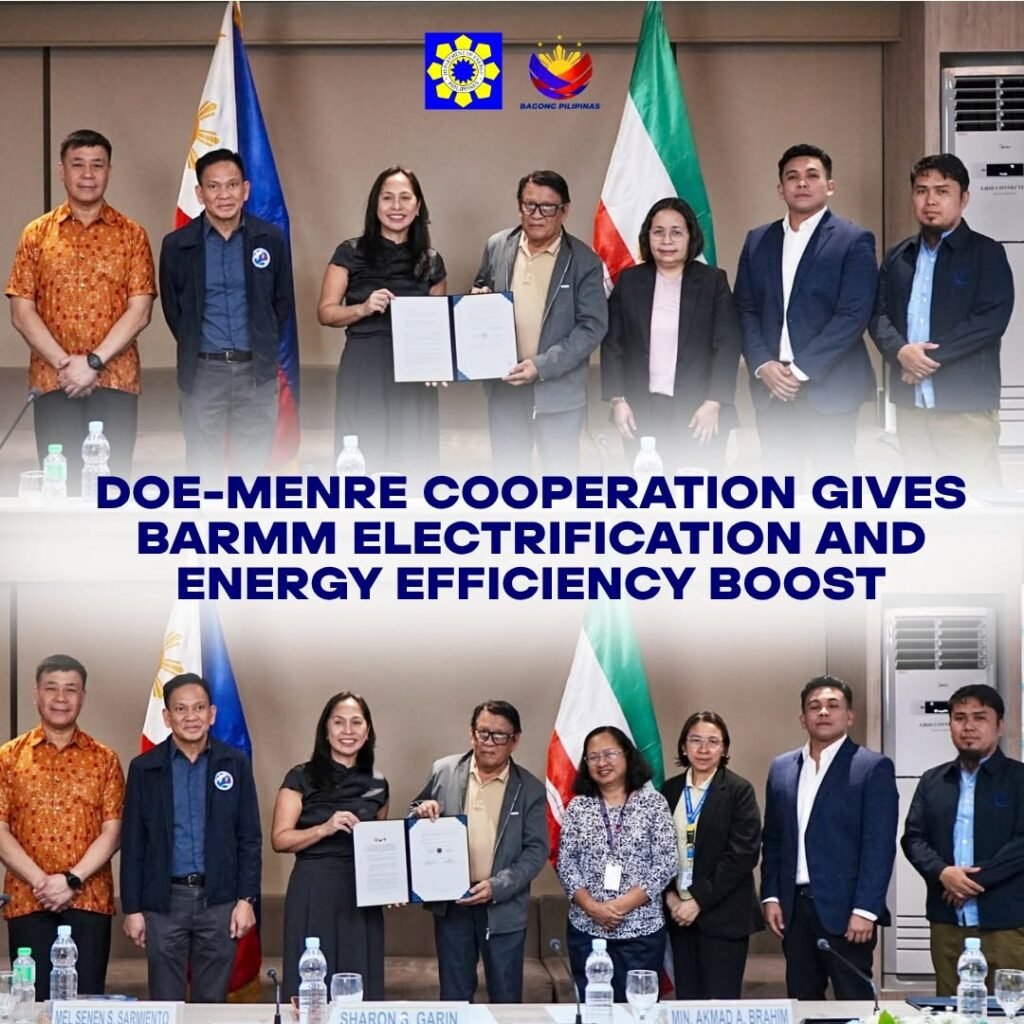
CAGAYAN DE ORO CITY (August 14) — For families living on remote Bangsamoro islands and communities beyond the reach of the power grid, energy security is not about grand investment plans.
It is about having electricity at home.
It is about children being able to study at night, health facilities keeping vaccines and medicines cold, fishermen preserving their catch, and small businesses staying open after sunset.
The Department of Energy (DOE) and the Bangsamoro government are now pushing a broader energy program aimed at bringing electricity to these underserved communities while developing the region’s own petroleum, renewable energy and hydrogen resources.
DOE Undersecretary Giovanni Carlo J. Bacordo said the government is working with the Ministry of Environment, Natural Resources and Energy (MENRE) through the Intergovernmental Energy Board to build the policies and institutions needed to expand energy access.
“Our direction is clear: BARMM must not be left behind in the country’s energy development,” Bacordo said.
The hardest communities to reach
The challenge is geography.
Some Bangsamoro communities are scattered across islands and isolated areas where extending conventional power lines can be technically difficult and costly.
The DOE is developing a consolidated total electrification roadmap to identify these remaining gaps, including communities such as the Turtle Islands.
The goal is not simply to improve electrification statistics, Bacordo said, but to ensure that geography does not determine whether a family gets electricity.
“Total electrification must mean reaching communities where providing electricity is most difficult,” he said.
For residents in off-grid areas, that could mean the difference between relying on expensive fuel-powered generators and having more dependable electricity for everyday life.
BARMM’s energy resources
While expanding access, the government is also looking at what lies beneath and around the region.
The DOE and MENRE are expediting a joint circular on the co-management of Petroleum Service Contracts 80 and 81 in the Sulu Sea. The arrangement is expected to give BARMM a bigger role in developing petroleum resources within its jurisdiction.
The government is also developing rules for the exploration and development of native hydrogen, potentially adding another indigenous energy source to the region’s portfolio.
Renewable energy is another major part of the plan.
Hydropower, wind and biomass projects are being supported through data sharing, technical assistance and joint guidelines for projects involving areas under both national and BARMM jurisdictions.
These efforts are consistent with the national target of raising renewable energy’s share of the country’s power generation mix to 50 percent by 2040.
From Manila-led to Bangsamoro-led
The energy program also signals a gradual transfer of responsibility.
The DOE is pursuing the phased devolution of energy and electrification functions to MENRE while helping develop the proposed BARMM Energy Code.
The code is expected to provide the region with its own long-term policy and regulatory framework for energy development.
The DOE and MENRE are also expected to work with the BARMM Parliament on a proposed Universal BARMM Electrification Act that would provide a stronger legal basis for expanding electricity access.
For Bangsamoro communities, however, the real measure of these reforms will be felt on the ground.
Will electricity reach the last island?
Will a rural health facility have reliable power?
Will a child in an off-grid village finally be able to study under a light without depending on a generator?
Will small businesses be able to operate beyond daylight hours?
Those are the questions that will determine whether the region’s energy push becomes more than another set of policies and investment plans.
For BARMM, energy security ultimately means making sure that development does not stop where the power grid ends.