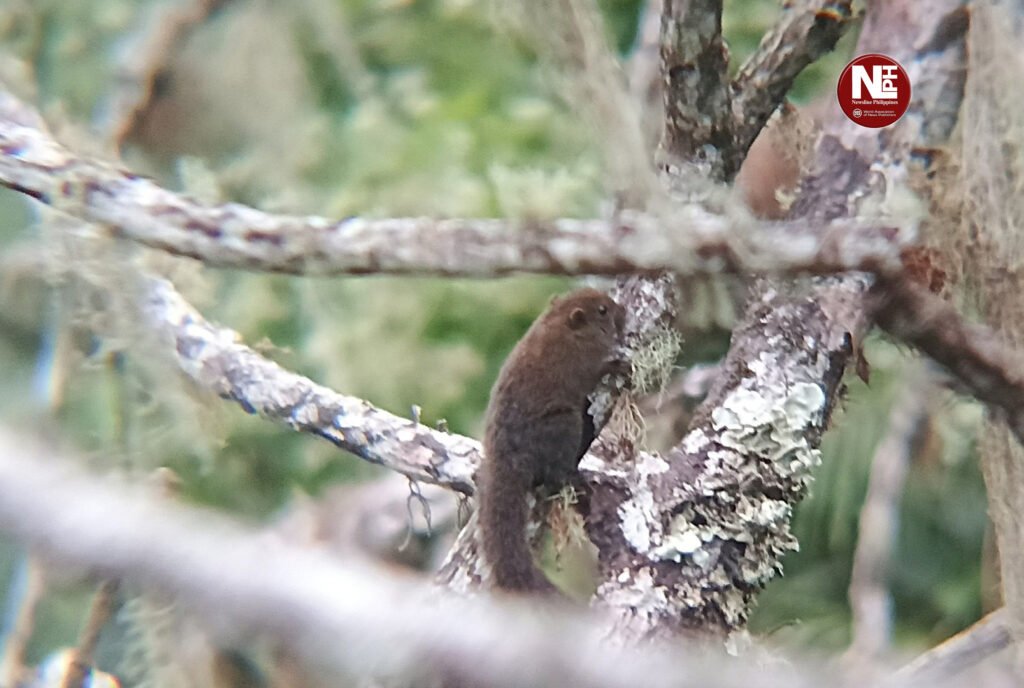
MAGPET, COTABATO (October 24) — In the quiet highlands of Barangay Sallab, a pair of quick, russet-colored squirrels leapt between branches of an ancient Ulayan tree — a small but powerful sign that Mindanao’s forests are still very much alive.
The rare sighting of two Mindanao squirrels (Sundasciurus mindanensis), documented from October 15 to 17, 2025, thrilled conservation teams from the Community Environment and Natural Resources Office (CENRO)–Matalam. The observation was part of a biodiversity survey assessing the health of Magpet’s upland forests, which form part of the Mt. Apo Natural Park buffer zone.
A rare glimpse of resilience
The squirrels were found nesting in Ulayan trees, native Philippine oaks whose acorns serve as a vital food source for forest animals. To environmentalists, their presence is a hopeful indicator that the area’s ecosystem remains stable and capable of supporting native wildlife.
“These squirrels remind us that Mindanao’s forests are still alive — still capable of supporting diverse species,” CENRO said in a statement. “They give us reason to protect what remains.”
Why the Mindanao squirrel matters
Endemic to the Philippines and currently listed as Least Concern by the International Union for Conservation of Nature (IUCN), the Mindanao squirrel depends on old-growth and secondary forests for food, nesting, and shelter.
Yet, habitat loss due to deforestation continues to threaten their population across the island.
The species plays a quiet but crucial ecological role: by feeding on fruits, nuts, and seeds, the squirrels help disperse plant life throughout the forest — aiding natural regeneration and maintaining biodiversity.
Nature’s quiet engineers
Wildlife biologists say the squirrels’ reliance on native trees such as the Ulayan reveals the deep interconnection between Mindanao’s flora and fauna. The Ulayan’s acorns are energy-rich and sustain not only squirrels but also birds and small mammals, forming a food web that keeps the forest alive.
“Every time these squirrels scatter acorns or seeds, they help plant tomorrow’s forest,” one CENRO field biologist explained. “They’re tiny, but their impact is huge.”
Protecting the forests that protect us
CENRO–Matalam is urging local communities to intensify reforestation, wildlife monitoring, and responsible forest use to sustain Magpet’s natural habitats. Even small actions — such as planting native trees or reporting wildlife sightings — can strengthen ongoing conservation efforts.
For Cotabato residents and forest stewards, the recent discovery is both a celebration and a call to action.
“Every squirrel, every bird, every tree tells a story of survival,” said a CENRO officer. “If we protect them, we protect ourselves.”
As Mindanao’s upland forests continue to be explored and studied, each rediscovery — no matter how small — reaffirms a vital truth: the island’s wild heart still beats, and it deserves every chance to keep thriving.