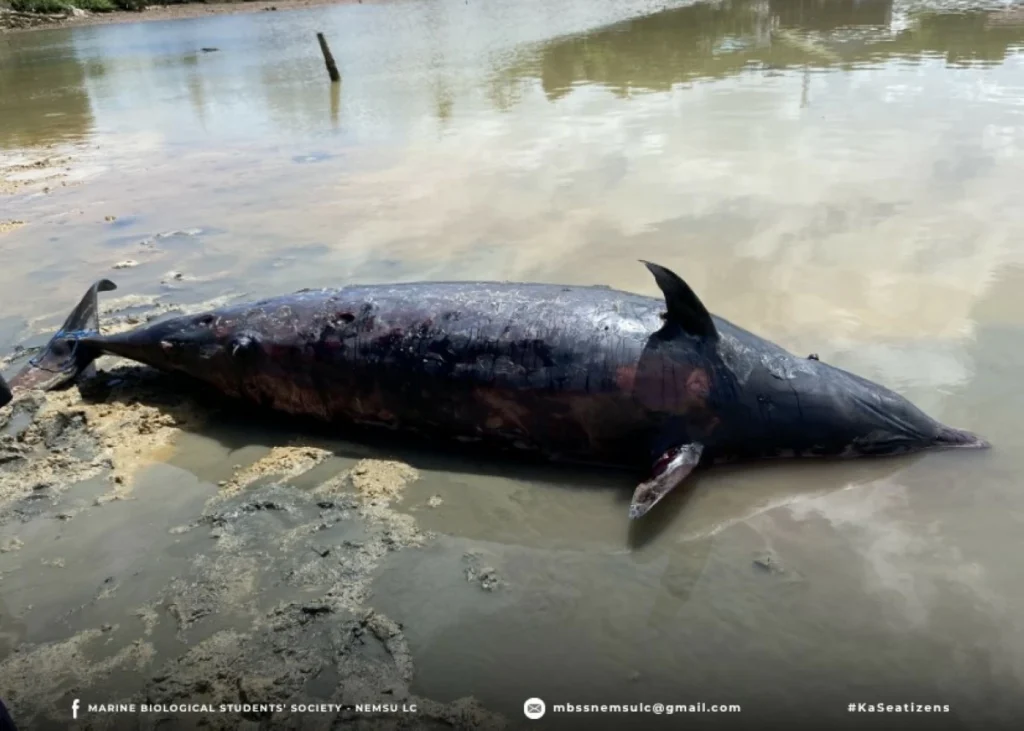
BUTUAN CITY (May 7) — The second recorded death of a beaked whale in just over a year along the coast of Lianga is raising deeper concerns—not only about what is happening along the shoreline, but about the largely unseen pressures building in the waters far offshore.
The 3.86-meter male whale, recovered Monday and examined by experts from North Eastern Mindanao State University–Lianga Campus, had shrimp remains and a fish hook in its gut—evidence pointing to human-linked hazards even for species that typically inhabit deep, remote ocean zones.
For the Bureau of Fisheries and Aquatic Resources (BFAR-13), the incident adds to a troubling pattern. This is the second beaked whale stranding in the area since April 2025, alongside a separate dugong case—suggesting that these events may not be isolated.
Deep-sea species, surface risks
Beaked whales are among the ocean’s most elusive mammals, spending most of their lives in deep waters and diving to extreme depths in search of squid and fish. Their rare appearances near coastlines often signal distress.
Marine scientists note that when such species strand repeatedly in the same area, it can indicate disruptions in their deep-sea habitat—whether from changing ocean conditions, underwater noise, or food scarcity.
The presence of a fish hook in this whale’s stomach underscores a growing overlap between human activity and deep-sea ecosystems, as fishing pressures extend farther offshore and deeper into previously less-disturbed waters.
Climate signals beneath the surface
Warming ocean temperatures linked to Climate Change are increasingly altering marine food chains. For deep-diving species like beaked whales, even subtle shifts in water temperature can affect the distribution of prey, potentially forcing them into unfamiliar or riskier areas.
Changes in ocean currents and productivity may also be pushing marine animals closer to coastal zones, where they are more vulnerable to entanglement, ingestion of fishing gear, or disorientation.
While a single stranding cannot be directly attributed to climate change, the recurrence of such incidents strengthens concerns about cumulative environmental stress.
The sonar factor
Another factor under scrutiny globally is underwater noise—particularly military sonar and seismic surveys used in offshore exploration.
Scientific studies have linked certain mass strandings of beaked whales to exposure to high-intensity sonar, which can disrupt their navigation and cause rapid surfacing, leading to internal injuries similar to decompression sickness.
While no direct link has been established in the Lianga cases, experts say the sensitivity of beaked whales to sound makes them important indicators of acoustic disturbances in the marine environment.
Gaps in monitoring and response
Local authorities have acted quickly in documenting the stranding, with marine biology students set to preserve the skeleton for research. But the incident highlights a broader challenge: the lack of sustained, real-time monitoring of marine ecosystems in many coastal areas.
Without baseline data on whale populations, migration routes, and ocean conditions, it remains difficult to determine whether such strandings are increasing—or simply underreported.
From response to prevention
For coastal communities like Lianga, the question is shifting from how to respond to strandings to how to prevent them.
That includes stricter regulation of fishing practices, better management of marine debris, and stronger coordination between local governments, scientists, and national agencies. It also means expanding awareness that even remote, deep-sea species are not insulated from human impact.
Each stranding, scientists say, is both a loss and a warning.
As the waters off Mindanao continue to change—quietly but rapidly—the fate of species like beaked whales may offer one of the clearest signals yet that the pressures on marine ecosystems are no longer confined to the surface, but are unfolding in the depths where few are watching.