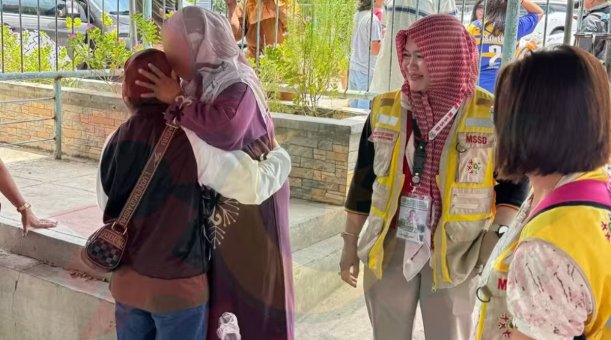
COTABATO CITY(March 18) — The rescue of two minor girls from an attempted illegal recruitment scheme in Maguindanao del Sur is being hailed as a success by authorities in the Bangsamoro Autonomous Region in Muslim Mindanao (BARMM). But the case also exposes a deeper, more troubling reality: exploitation networks continue to find easy targets among the region’s most vulnerable youth.
Lured by promises of overseas work as household service workers, the girls—both underage—were already preparing to leave the country when authorities intervened. Their rescue, carried out through coordinated efforts by the Bangsamoro government’s Ministry of Social Services and Development and national agencies, prevented what could have escalated into a case of trafficking and long-term abuse.
Yet for every intercepted case, advocates warn, many others go undetected.
Poverty, Not Ignorance, Drives Risk
Officials often frame illegal recruitment as a problem of awareness. But on the ground, the drivers are more structural: poverty, lack of access to education, and limited employment opportunities.
In conflict-affected and economically marginalized areas of BARMM, migration—legal or otherwise—remains one of the few perceived pathways out of hardship. Recruiters exploit this desperation, offering what appear to be legitimate opportunities abroad.
The case underscores how minors, particularly girls, are pushed into high-risk decisions not simply by deception, but by necessity.
Laws Exist, Enforcement Struggles
Under Republic Act No. 11862, recruitment of minors for overseas domestic work is explicitly prohibited. The law sets the minimum age for such employment at 24, a safeguard designed to prevent exploitation in one of the most vulnerable labor sectors.
“The recruitment of minors is a clear violation of the law,” said Jan Michella Agata, focal person for the Reintegration Program for Trafficked Persons (RRPTP).
But the persistence of such cases points to gaps not in legislation, but in enforcement and early detection. Recruiters continue to operate through informal networks—often within communities—making them difficult to track and prosecute.
Rescue Is Only the First Step
Following their interception, the girls were temporarily housed at the Tahanan ng Inyong Pag-Asa Center and later reunited with their families.
Authorities coordinated through the Department of Social Welfare and Development and the Inter-Agency Council Against Trafficking to ensure protection services, including psychosocial support and reintegration assistance.
But reintegration itself is fraught with challenges.
Without sustained economic support, families may remain vulnerable to repeat exploitation. In many cases, survivors return to the same conditions that made them targets in the first place—raising the risk of re-trafficking.
A Cycle Difficult to Break
Programs like RRPTP offer livelihood aid, educational support, and legal assistance. However, these interventions often operate on limited resources and must compete with broader systemic issues such as unemployment and underdevelopment.
The Bangsamoro government has pledged to pursue charges against those responsible, but successful prosecution remains rare nationwide, where trafficking cases are notoriously difficult to build and sustain in court.
Beyond Rescue Operations
The swift action of authorities in this case demonstrates that coordination can work. But it also highlights a reactive system—one that intervenes at the point of departure rather than addressing vulnerabilities at the community level.
Experts argue that prevention must go beyond checkpoints and rescue missions. It requires sustained investment in education, local employment, and community-based monitoring—especially in high-risk areas.
A Persistent Threat
Human trafficking in BARMM is not an isolated issue but part of a broader national and regional pattern, where economic precarity intersects with weak enforcement and transnational labor demand.
The rescue of two minors is, undeniably, a success. But it is also a warning: that as long as structural vulnerabilities remain unaddressed, illegal recruitment will continue to adapt—and find new victims.
For authorities, the challenge is no longer just to intercept—but to prevent