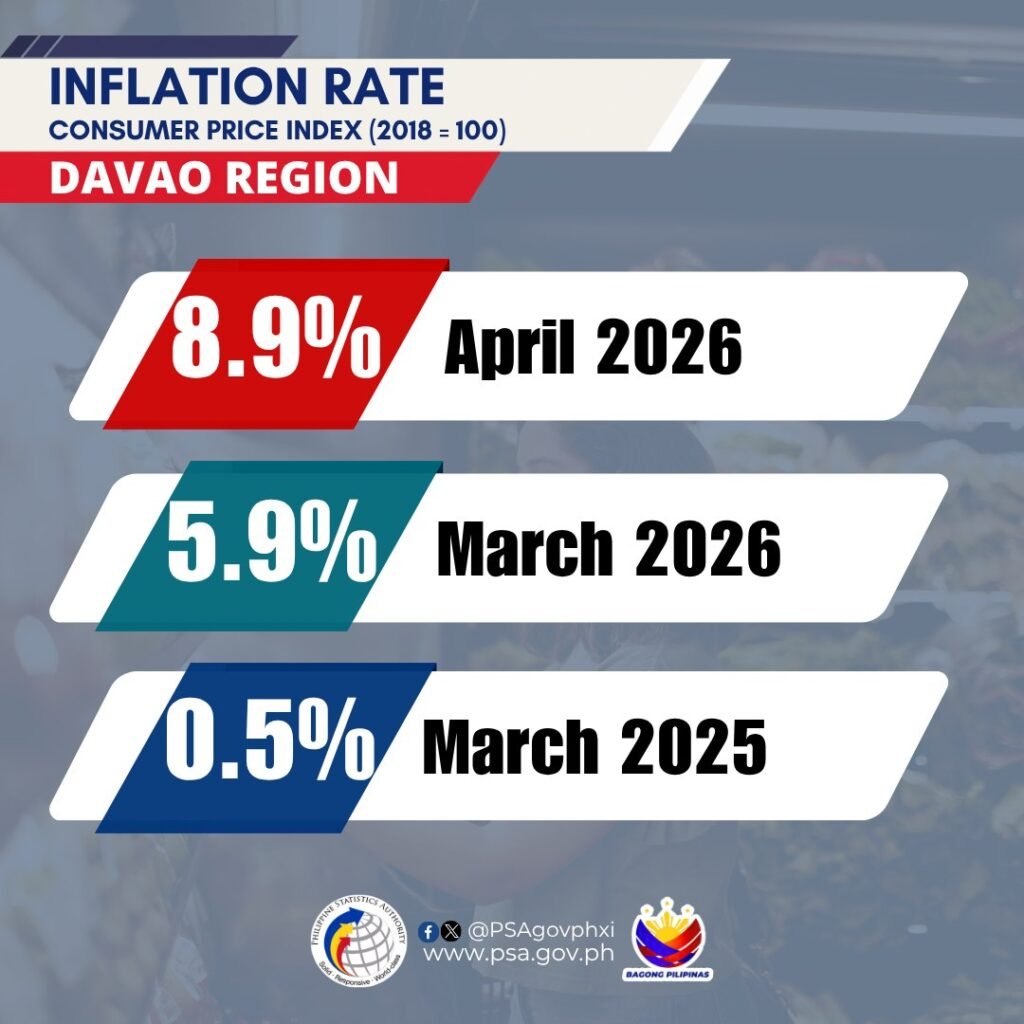
DAVAO CITY (May 15) — Families across Davao Region felt a sharper squeeze on household budgets in April as inflation surged to 8.9 percent, driven largely by rising rice prices, higher transport fares, and increasing utility costs.
Data released Thursday by the Philippine Statistics Authority in Davao Region (PSA-11) showed inflation jumped three percentage points from March’s 5.9 percent rate — a dramatic increase compared to the 0.5 percent inflation recorded in April last year.
The steep rise means basic goods and services are becoming significantly more expensive for ordinary consumers, especially low-income households already struggling with daily expenses.
PSA-11 said the biggest pressure came from food and non-alcoholic beverages, which posted a faster annual increase of 5.7 percent from 3.3 percent in March.
Transport costs also surged sharply to 20.7 percent from 11.9 percent, reflecting the growing burden of fuel and commuting expenses on workers, students, and small businesses.
Restaurants and accommodation services likewise recorded faster increases, adding to the overall rise in consumer prices.
But the strongest alarm came from food inflation, which climbed to 11.3 percent in April from 5.9 percent in March.
Rice prices emerged as the biggest driver of the spike.
According to PSA-11, the rice index soared to 28 percent from 11.2 percent the previous month, highlighting how staple food costs continue to strain household budgets across the region.
For many families in Davao Region, rice alone already consumes a large portion of daily income, making sudden price increases especially painful for minimum wage earners and informal workers.
The PSA-11 said food and non-alcoholic beverages accounted for more than half of April’s inflation rate, contributing 4.6 percentage points or 51.9 percent of the total inflation figure.
Transport followed with a 21.6 percent share, while housing, water, electricity, gas, and other fuels contributed 15 percent.
Some sectors showed slower price increases, including household maintenance and communication services, while inflation rates for clothing, utilities, education, and financial services largely remained unchanged.
Still, the overall trend signals growing cost-of-living pressure in the region, especially as food and fuel prices continue to rise.
For many residents, the inflation spike translates directly into harder choices at home — from cutting back on groceries and transportation to delaying other daily needs just to make ends meet.