
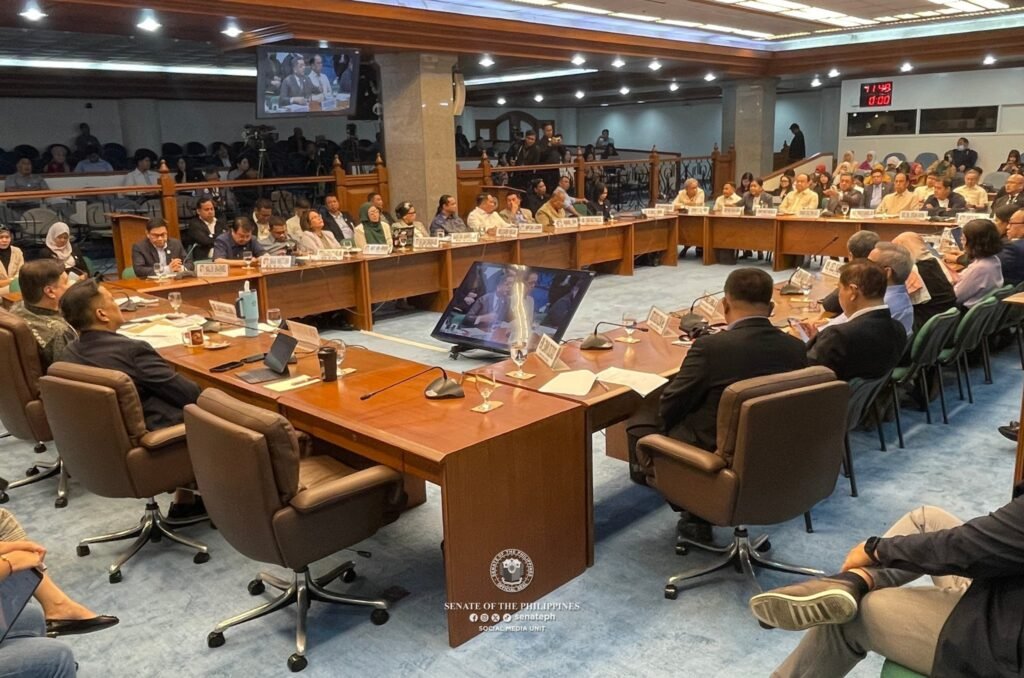
MANILA (February 6) — The Senate on Thursday launched urgent deliberations on a measure to reset the first regular parliamentary elections in the Bangsamoro Autonomous Region in Muslim Mindanao (BARMM), amid growing concern that repeated postponements have locked the region into a cycle of political limbo, voter disenfranchisement, and rising insecurity.
Sponsoring Senate Bill No. 1587, Senate Majority Leader Juan Miguel Zubiri warned that after three postponements, the continued absence of elected leaders threatens to hollow out the democratic foundations envisioned under the Bangsamoro Organic Law (BOL)—more than seven years after its passage.
“It is starting to feel like we have trapped ourselves in a loop,” Zubiri said, describing a pattern where transitional governance has become the norm rather than the exception.
BARMM Still Waiting for Its First Vote
For communities across Maguindanao del Norte and del Sur, Lanao del Sur, Basilan, Tawi-Tawi, and parts of Cotabato, the delay means another extension of rule by appointed officials under the Bangsamoro Transition Authority (BTA)—with no direct mandate from voters.
Local civil society groups have warned that prolonged transition governance weakens public accountability, blurs political legitimacy, and fuels frustration among young voters who have never experienced a BARMM parliamentary election.
Zubiri acknowledged that earlier postponements were unavoidable—first due to the COVID-19 pandemic, then because of legal and redistricting issues following Supreme Court rulings, including the exclusion of Sulu from BARMM. But he stressed that further delays are no longer defensible.
“This cycle of disenfranchisement is not where we want to be,” he said.
Peace Process at Risk
During the hearing, Sen. Joseph Victor Ejercito underscored that democratic participation is central to lasting peace in the Bangsamoro.
“Genuine peace comes from a genuine voice,” Ejercito said, warning that peace agreements lose credibility when people are repeatedly denied the right to elect their leaders.
Analysts note that in conflict-sensitive provinces such as Maguindanao and Lanao del Sur, prolonged political uncertainty risks reopening fault lines—particularly amid reports of recent security incidents and election-related violence.
Zubiri echoed these concerns, suggesting that escalating violence may be linked to the absence of a clear electoral roadmap.
“If this is truly the reason, then we must not delay the election any longer. We must not delay peace,” he said.
Legal Fixes, Practical Limits
The Supreme Court’s nullification of the Bangsamoro Parliamentary Redistricting Act forced Congress to postpone the October 2025 elections. Although the Bangsamoro Transition Authority enacted a revised redistricting law in January, Zubiri said its late passage has again cast doubt on the feasibility of holding elections by March 2026, citing logistical and operational constraints faced by the Commission on Elections (Comelec).
The Senate subcommittee is now examining whether the new redistricting law fully addresses the constitutional defects flagged by the high court, while also assessing:
- the earliest viable election date
- alignment of BARMM polls with the national electoral calendar
- safeguards to ensure this reset becomes the final postponement