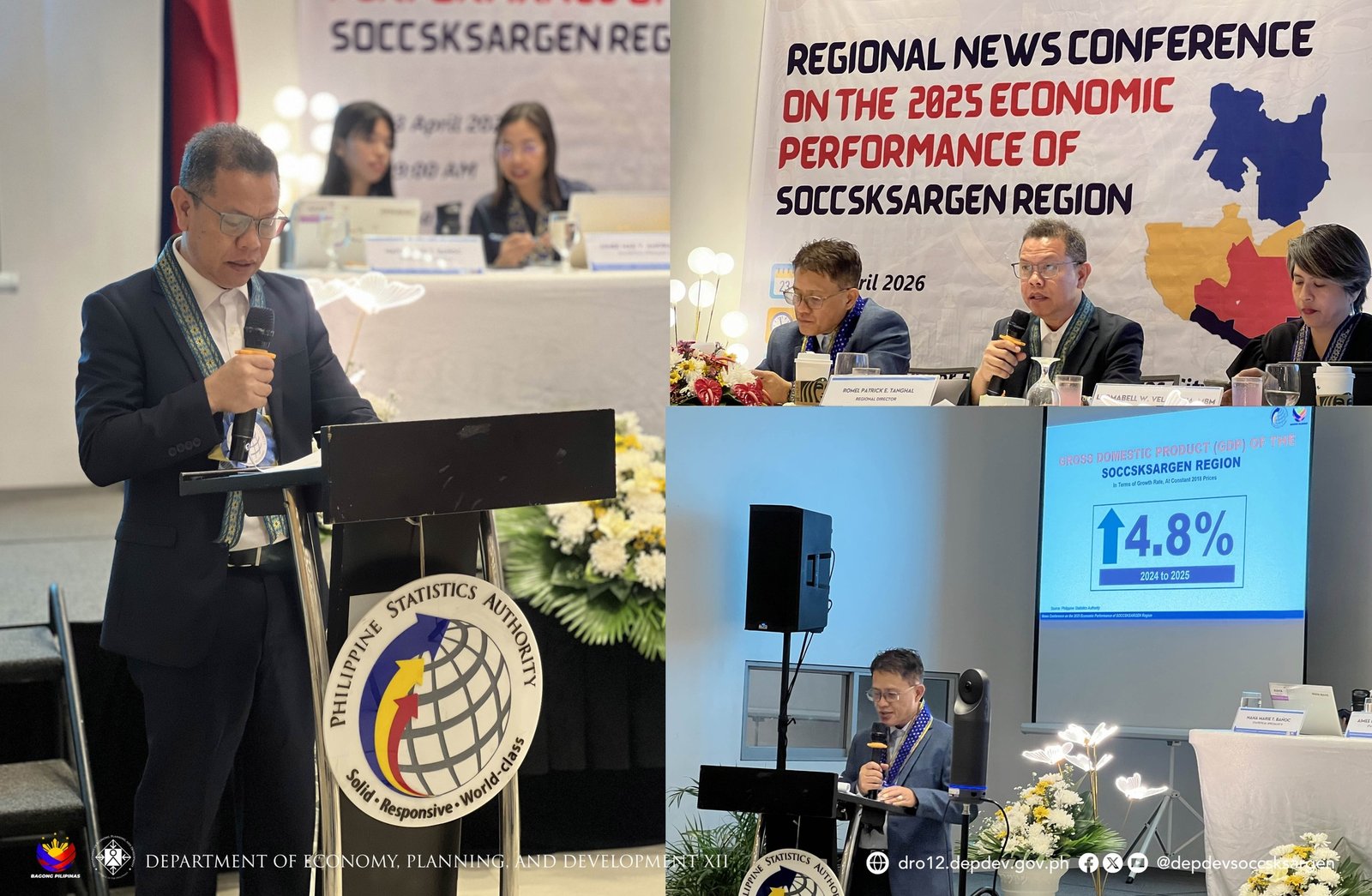
GENERAL SANTOS CITY(April 27) — The SOCCSKSARGEN economy grew by 4.8 percent in 2025, outpacing the national average of 4.4 percent, but the gains are not being felt evenly across communities—especially in farming towns where climate shocks and weak farm output continue to weigh down incomes.
Data from the Philippine Statistics Authority (PSA) showed the region still expanded despite a slowdown from 5.6 percent in 2024, placing SOCCSKSARGEN eighth among 18 regions.
PSA Regional Director Maqtahar Manulon said the services sector carried most of the growth, expanding by 7.0 percent, followed by industry at 4.0 percent, while agriculture lagged at just 1.2 percent.
Farmers: growth on paper, struggle on the ground
In agricultural towns like Alabel in Sarangani and parts of North Cotabato, farmers say the numbers do not reflect their daily reality.
“Maganda sana ang report, pero sa bukid, mahina ang ani,” said “Ruel,” a rice farmer from Alabel. “Nagmahal ang inputs, pero hindi sabay ang presyo ng palay.”
Erratic weather patterns and rising fertilizer costs continue to squeeze farm incomes, even as the region posts overall growth.
Strong consumption, weak investments
Household spending rose by 5.3 percent, helping support local businesses in urban centers like General Santos City. But investments dropped sharply by 19.1 percent, raising concerns about long-term job creation.
A store owner in Koronadal City said consumer activity remains steady, but big-ticket business expansion has slowed.
“May benta pa rin, pero yung malalaking orders at expansion plans, medyo nagdadalawang-isip ang iba,” she said.
Infrastructure seen as lifeline
Officials pointed to ongoing infrastructure projects as key stabilizers, including the Central Mindanao Airport project and the General Santos Fish Port Complex expansion, both expected to improve trade, logistics, and regional connectivity.
These projects also generate temporary jobs for construction workers and subcontractors across SOCCSKSARGEN.
A construction foreman in Polomolok, South Cotabato said government projects remain a critical source of work.
“Kung walang infra projects, maraming walang kita sa amin,” he said. “Kaya malaking tulong talaga kapag tuloy-tuloy.”
Balancing growth and risks
Romel Patrick Tanghal of the Department of Economy, Planning, and Development said reforms may have slowed short-term activity but are intended to strengthen long-term resilience.
Regional planners say the next challenge is closing the gap between strong service-led growth and vulnerable agricultural communities.
Focus areas include farm modernization, irrigation support, and digital tools for small producers—efforts aimed at making growth more inclusive beyond city centers.
For many in rural SOCCSKSARGEN, however, the question remains whether the region’s economic gains will eventually reach the fields where most livelihoods still depend on harvests.