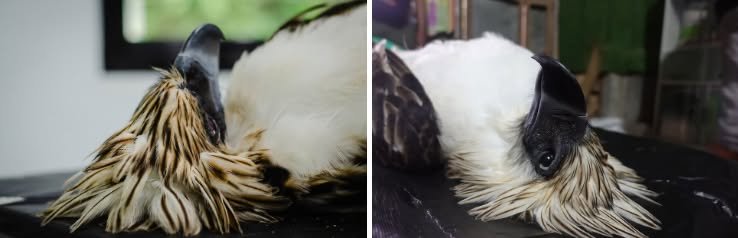
COTABATO (October 12) — Two young Philippine Eagles died in separate electrocution incidents in Mindanao within three days, while another was found with air-gun pellets lodged in its body, prompting North Cotabato authorities to strengthen enforcement of wildlife protection laws.
Cotabato Gov. Emmylou “Lala” Taliño-Mendoza has ordered the creation of an inter-agency task force following the death of Libertad, a young female Philippine Eagle found dead in Barangay Libertad, Arakan, on October 4.
A necropsy by the Philippine Eagle Foundation (PEF) confirmed that Libertad died from electrocution. Two air-gun pellets were also recovered from her body, one associated with a recent wound on her left wing.
The shooting injury was considered a significant finding but was not identified as the primary cause of death, the foundation said in an October 8 report.
Libertad’s death highlights two threats facing the country’s critically endangered national bird: unsafe electrical infrastructure near wildlife habitats and direct violence against the birds.
Deaths expose threats in eagle habitats
Libertad was the second young female Philippine Eagle reported dead from suspected electrocution in Mindanao within three days.
On October 1, another young eagle, named Salay, was found dead near an electric post in Barangay Guinalaban, Salay, Misamis Oriental. Post-mortem findings were consistent with suspected electrocution.
The PEF said juvenile eagles may be particularly vulnerable as they leave their parents’ territories and navigate forest edges, farms and communities where power lines and other infrastructure intersect with their natural habitats.
Libertad was found near a known Philippine Eagle nesting site on Mt. Mahuson in Arakan. The foundation first documented the site in 1995 and has since validated at least six nesting attempts that produced young eagles.
“Power infrastructure makes an attractive perch for birds because it’s an elevated site. It gives them a good view of their surroundings,” said Dr. Andrew Dixon, director of science and conservation at the Mohammed bin Zayed Raptor Conservation Fund.
The deaths raise questions about how quickly power-distribution hazards near known eagle territories can be identified and corrected.
Task force targets wildlife violations
On October 7, Taliño-Mendoza convened a coordination meeting with representatives from the Cotabato Police Provincial Office, Department of Environment and Natural Resources (DENR), Office of the Governor, Sangguniang Panlalawigan and Office of the Provincial Veterinarian.
The Office of the Provincial Agriculturist also participated, with its head serving as interim provincial environment and natural resources officer.
The meeting focused on strengthening coordination among government offices and law enforcement agencies in implementing Republic Act 9147, or the Wildlife Resources Conservation and Protection Act of 2001.
The proposed task force is expected to improve enforcement and ensure compliance with wildlife protection laws throughout the province.
Taliño-Mendoza also stressed the need to inform residents that acts that injure or kill protected wildlife carry penalties under existing laws.
The initiative comes as the province faces another reported shooting incident involving a Philippine Eagle.
On September 27, a young eagle later named Magpet was rescued in Barangay Manobo, Magpet, with three air-gun pellets lodged in its body. The PEF reported the incident on October 1.
Veterinarians removed two pellets, while the third was left in place because extraction could pose additional risks. Magpet remains under veterinary monitoring and rehabilitation.
Enforcement must reach power lines
Under Sections 27 and 28 of RA 9147, prohibited acts involving wildlife can carry imprisonment and fines, with penalties depending on the offense and the species’ classification.
For killing or destroying a species classified as critical, the law prescribes imprisonment of six years and one day to 12 years and a fine of P100,000 to P1 million.
The Philippine Eagle’s critically endangered status underscores the importance of investigating suspected wildlife violations and enforcing the law against those responsible.
But prosecution alone cannot prevent deaths caused by electrical infrastructure.
The PEF has urged government agencies, electric cooperatives, local governments and conservation groups to identify hazardous power lines near eagle habitats, insulate exposed electrical components and retrofit dangerous poles.
Work to retrofit power lines around Mt. Sinaka in North Cotabato began after an earlier electrocution incident. The foundation reported that three kilometers of a planned 4.5-kilometer project had been completed in 2023 and 2025.
For Cotabato’s proposed task force, the challenge is to turn coordination into measurable protection: investigate wildlife injuries, pursue violations, identify dangerous power infrastructure and ensure that preventive measures reach areas where eagles nest and forage.
With Libertad dead, Salay also lost, and Magpet still under veterinary care, the response will be measured not only by the creation of another government body but by whether fewer eagles die from preventable human-caused threats.