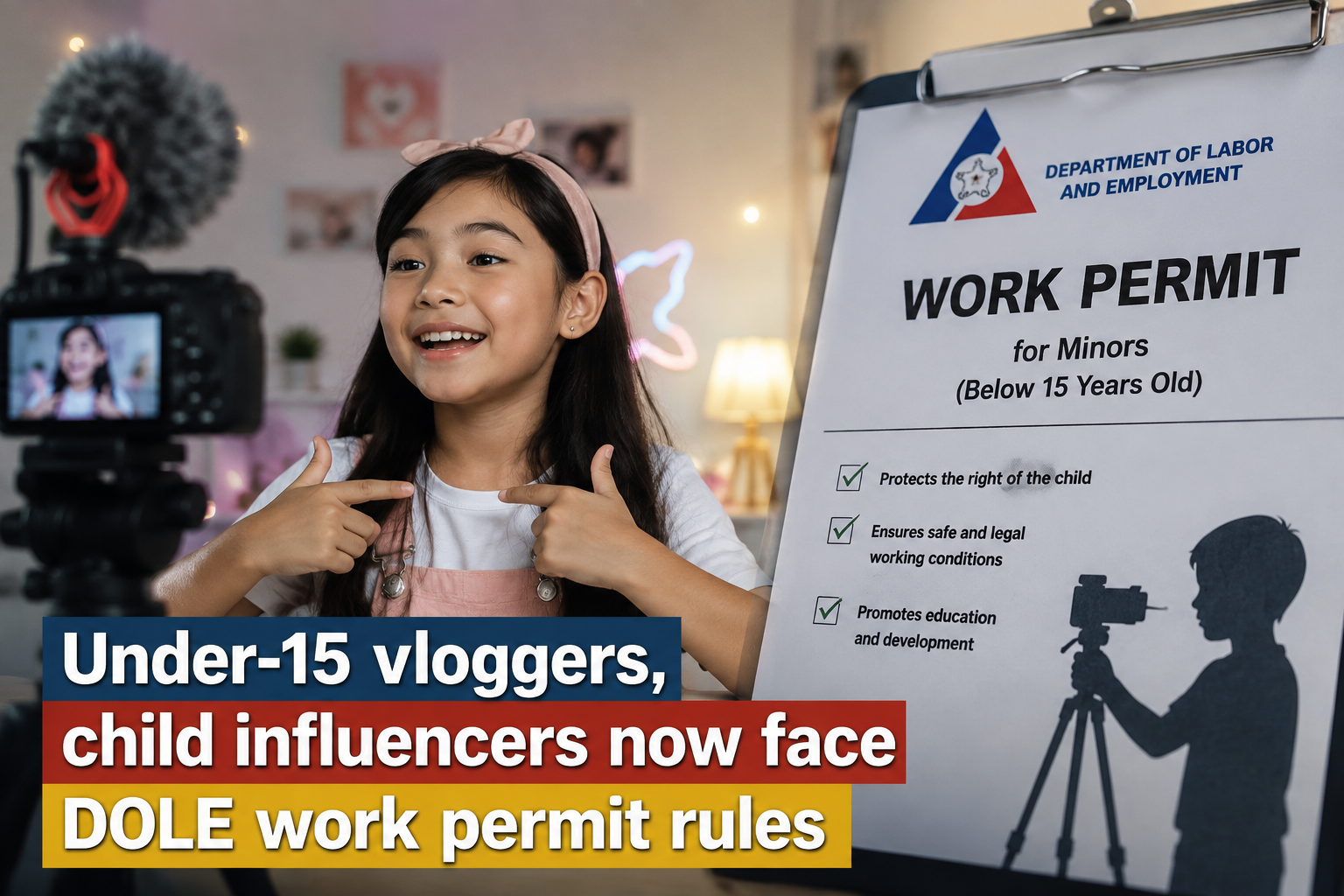
DAVAO CITY (August 3) — Children below 15 who appear in vlogs, livestreams, digital advertisements and other online content may not simply be treated as “kids having fun” when their participation becomes work.
The Department of Labor and Employment (DOLE) has reminded parents, guardians and employers that child labor safeguards extend to the rapidly growing digital content industry, including social media and monetized online platforms.
Labor Secretary Francis Tolentino issued Labor Advisory No. 12, Series of 2026, on July 21, clarifying that children involved in public entertainment or information activities may require a working child permit before they can legally participate.
The advisory applies not only to television, radio, film, theater and print but also to streaming platforms, social media, vlogs, web series, podcasts, digital advertisements and other content distributed online.
The issue is increasingly relevant as children become part of family vlogs, brand promotions and livestreams that can generate advertising revenue, sponsorships and other commercial returns.
When does a child’s appearance become work?
Under Republic Act 9231, or the Special Protection of Children Against Abuse, Exploitation and Discrimination Act, children below 15 are generally prohibited from employment.
There are limited exceptions, including work performed under the sole responsibility of a parent or legal guardian in an undertaking involving only family members, and participation in public entertainment or information when such participation is essential.
But an online platform does not automatically put an activity outside those protections.
DOLE said the determining factor is the nature of the child’s activity and how the content is distributed, rather than whether it appears on television or on a social media feed.
When the child’s participation falls under the rules governing public entertainment or information, a working child permit must be secured from DOLE.
The requirement applies to covered digital content just as it does to traditional media.
Parents are not exempt
The advisory also puts responsibility on parents and guardians who involve children in digital content.
When a child works under a parent or legal guardian’s responsibility, the parent or guardian remains accountable for complying with RA 9231 and its implementing rules.
That matters in an online economy where the line between a family activity and commercial work can quickly blur.
A child appearing in a casual family video is different from a child repeatedly producing sponsored posts, promotional videos or livestreams that generate income. But where participation becomes work, the protections under child labor law cannot be set aside simply because the workplace is a smartphone, bedroom or home studio.
DOLE said the advisory is intended to protect the welfare, safety and rights of children engaged in entertainment and information activities.
For parents and content creators, the message is straightforward: the absence of a physical workplace does not mean the absence of labor protections.
As children’s digital exposure grows, the bigger challenge may be ensuring that online popularity and family income do not come at the expense of a child’s right to protection, education, rest and childhood.