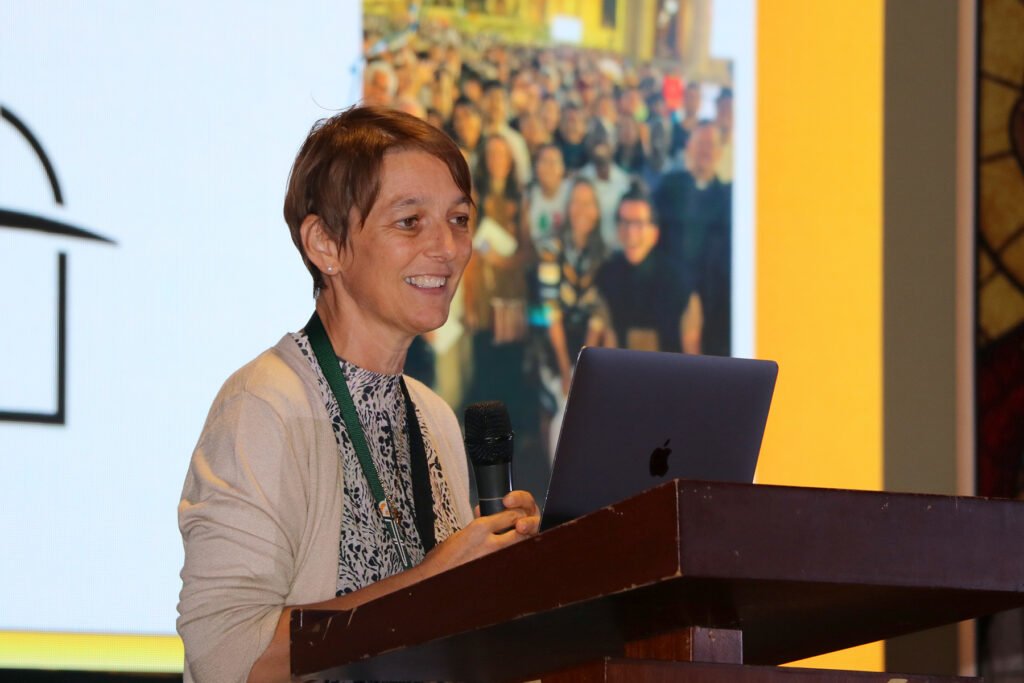
Photo: Natasa Govekar, director of the theological-pastoral department of the Dicastery for Communication, addresses the participants of the first Asian Catholic Digital Missionary Assembly at the Radio Veritas Asia headquarters in Fairview, Quezon City on Sept. 11, 2026. PHOTO FROM RVA
MANILA (September 13) — In a digital world where influence is often measured in followers, views and likes, Catholic missionaries should resist becoming online influencers and instead use their platforms to build relationships, communities and faith, a Vatican communications official said.
Natasa Govekar, director of the theological-pastoral department of the Dicastery for Communication, issued the challenge Sept. 11 during the first Asian Catholic Digital Missionary Assembly at the Radio Veritas Asia headquarters in Fairview, Quezon City.
Her message cuts against a social-media culture that often equates reach with influence.
Catholic digital missionaries, she said, should become “leaders of communion”—people who connect and collaborate with others rather than individuals competing for attention online.
“We should take our influence seriously,” Govekar said. But that influence, she stressed, must be learned and exercised “together, as a community and not as individuals.”
The issue is not simply how many people a Catholic communicator can reach, but what happens after the message reaches them.
Beyond the numbers
Govekar grounded her argument in Communio et Progressio, the Church’s social communication document that presents Christ as the “Perfect Communicator” and describes communication as an act of giving oneself in love.
That principle raises a difficult question for Catholic communicators working in an attention economy: Is communication successful because it attracts an audience—or because it changes relationships?
For Govekar, the answer lies in the latter.
Catholic digital communication should help people encounter and live the Gospel rather than merely generate attention or grow an online following.
“Fruitfulness comes from daring to share the vision and hope,” she said.
The challenge is particularly significant as Catholic institutions and missionaries increasingly rely on digital platforms to reach young people, spread Church teaching and engage public conversations.
The platforms reward speed, visibility and engagement. Christian communication, Govekar argued, must not lose sight of the human person behind the screen.
AI cannot replace conscience
That concern becomes more urgent with the rapid spread of artificial intelligence.
Govekar warned that even increasingly sophisticated technology cannot reproduce the distinctly human dimensions of Christian communication.
“No computational system, however sophisticated, can create a heart that gives itself, or a conscience that discerns good from evil,” she said.
The warning places a limit on the Church’s embrace of AI: technology can assist communication, but it cannot become a substitute for human encounter, moral discernment or relationships.
For digital missionaries, the challenge is therefore not simply learning to use new tools.
It is deciding what those tools are ultimately for.
Collaboration over competition
Govekar pointed to the Vatican’s Faith Communication in the Digital World program as one model of a different approach.
The 11-month program brings together 16 young Catholic communications professionals each year for online formation, workshops, projects and residential training in Rome.
Participants work across cultures, time zones and professional backgrounds. Govekar acknowledged that such collaboration can be difficult—but said those difficulties are part of the formation itself.
“The most important outcome of this project is not the final product,” she said. “But the process, relationships.”
The program now includes continuing accompaniment, with tutors supporting participants even after formal training ends.
“This is why I call it discipleship,” Govekar said.
Her message to Asian digital missionaries was not to reproduce a Vatican model wholesale but to build forms of collaboration rooted in their own communities.
“What we try to do internationally can be replicated, but not in the same way,” she said.
The challenge, ultimately, is larger than social media strategy.
In a culture increasingly shaped by algorithms, Catholic digital missionaries are being asked to make a choice: chase influence—or use influence to build communion.