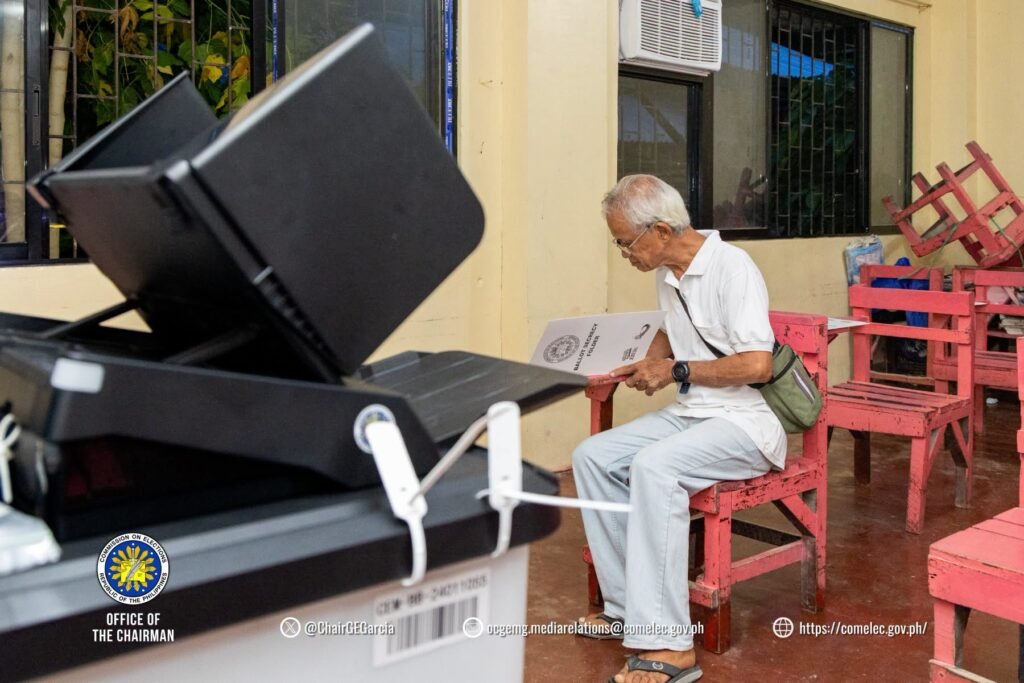
COTABATO CITY (September 15) — The first parliamentary elections in the Bangsamoro Autonomous Region in Muslim Mindanao (BARMM) ended Monday with voting proceeding across most of the region, but violence, ballot problems and reported voting irregularities exposed vulnerabilities that could test public confidence in the new parliamentary system.
The Sept. 14 polls were the first regular elections for the Bangsamoro Parliament, marking the region’s transition from an interim government to an elected regional government. Nearly 2.4 million voters were registered to choose representatives to the 80-seat Parliament.
The Commission on Elections described the overall conduct as generally peaceful, despite isolated but serious incidents. The Philippine National Police reported seven suspected election-related incidents—three shootings, three alleged explosions and one recovered improvised explosive device—while Comelec later reported four people killed and 18 injured in two separate shootings in Cotabato City. The city was placed under Comelec control.
The election also faced a ballot controversy in Basilan, where pre-shaded ballots were discovered in 36 of 68 precincts in Maluso. Replacement ballots were ordered, leaving some polling centers waiting for new ballots during the voting period.
Ballot secrecy, voter choice questioned
The more fundamental concerns came from election monitoring reports.
The Legal Network for Truthful Elections (LENTE) said its monitors documented practices that could compromise voters’ ability to cast their ballots freely and privately.
Of 492 monitoring reports on the voting process, 137 indicated that voters did not personally feed their ballots into automated counting machines. In 119 of those reports, LENTE identified Electoral Board members as the persons who fed the ballots into the machines.
LENTE also recorded assisted voting in 187 of 501 monitoring reports.
“A major issue to emerge from the Barmm elections thus far is the vulnerability of voters’ ability to freely choose their own representatives, with the sanctity of the ballot repeatedly violated and the assisted voting process abused across several areas,” the watchdog said.
It warned that improper assistance could compromise ballot secrecy and, in extreme cases, allow an assistor to substitute their own choice for that of the voter.
LENTE also recorded vote-buying or vote-selling in 19 monitoring reports and partisan political activity involving Electoral Board or Sectoral Electoral Board members in 27 reports, mostly in Marawi City, Lanao del Sur.
These remain monitoring reports, not final findings of election violations, and must still be validated by election authorities.
Violence remains a major concern
The Asian Network for Free Elections (ANFREL) and the National Democratic Institute (NDI) also raised concerns over violence surrounding the elections.
The observers reported shooting, explosive and intimidation incidents in Cotabato City and parts of Basilan and Maguindanao del Sur from the eve of the polls through election day.
They called for restraint and urged authorities to prevent further violence from undermining the gains of the Bangsamoro peace process.
“The immediate priority must be to prevent further loss of life and ensure that violence does not undermine the hard-won gains of the Bangsamoro peace process,” ANFREL-NDI said.
Despite the incidents, voting continued, and observers noted the determination of Bangsamoro voters to participate in the historic election.
What comes next
The immediate task for Comelec and law-enforcement authorities is to validate the reported irregularities, determine whether election laws or procedures were violated, and establish whether any incidents affected the integrity of the vote.
That accountability will matter beyond the outcome of individual races.
The first parliamentary election was designed to give the Bangsamoro government its first direct electoral mandate under the region’s autonomous political system. Its credibility will therefore depend not only on who wins, but on whether voters and communities believe the process was safe, free, secret and fair.
For the Bangsamoro’s first parliamentary election, a credible vote is not just about who wins—it is about whether voters can trust how the winners got there.