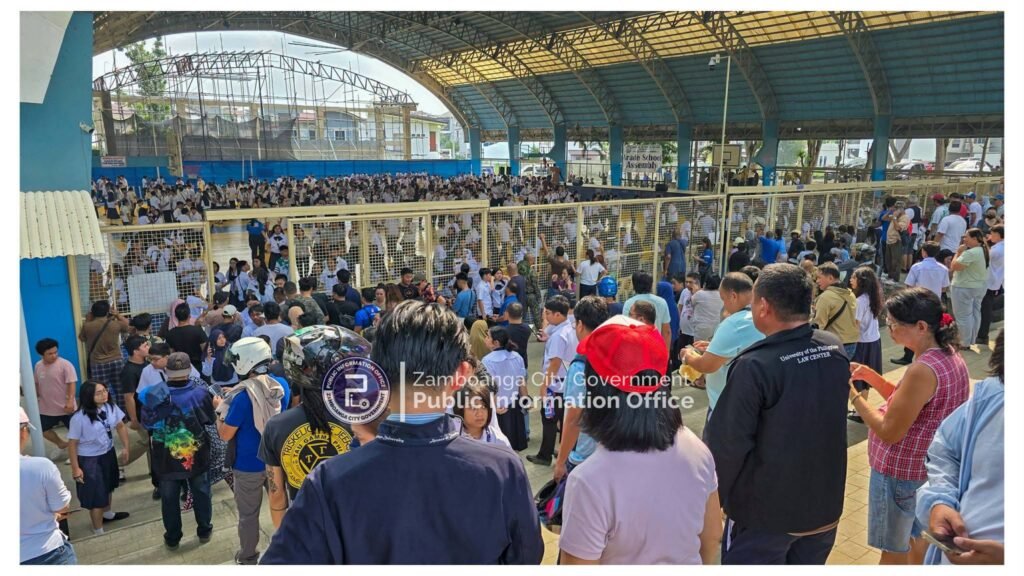
MANILA(August 19) — The fatal shooting at Ateneo de Zamboanga University-Junior High School has renewed alarm over the safety of Philippine schools, raising difficult questions about how firearms reach campuses, how vulnerable young people are exposed to violent influences, and whether schools have enough capacity to detect and prevent threats before they turn deadly.
The Aug. 18 shooting at the university’s junior high school campus in Barangay Tumaga, Zamboanga City, left two people dead, including a student and the alleged shooter.
The incident came less than two months after a June 22 school shooting at San Jose National High School in Tacloban City that killed three students, prompting renewed calls for stronger school security, mental health support, firearm controls and safeguards against harmful online content.
For the Department of Social Welfare and Development (DSWD), the immediate priority is helping students and other members of the school community cope with the trauma.
DSWD prepares psychosocial response
DSWD Secretary Rex Gatchalian said the agency is ready to intervene and provide assistance to those affected.
“The DSWD is sad that this [shooting incident] happened. We extend our sympathies to those affected, including those [recorded] casualties,” Gatchalian said in a media interview.
He said DSWD social workers and counselors are prepared to provide psychosocial interventions and mental wellness assistance to students affected by the shooting.
“We are ready to intervene in whatever way we can to help the victims,” he said.
The agency said its response to school shooting incidents begins with psychosocial intervention and an assessment of the circumstances surrounding victims and their families.
Gatchalian said DSWD examines four broad areas: the individual, the family, the school or community environment, and external factors, including possible exposure to nihilistic violent extremism.
“Those are the four aspects that we look at—the individual and the family, school setting or the community, as well as external factors,” he said.
The assessment, he added, is intended to determine the appropriate intervention.
The agency said it remains ready to assist students and the school community whenever the school requests support.
A second school shooting raises a bigger question
The proximity of the Zamboanga and Tacloban incidents has intensified concern over whether school shootings are isolated tragedies or symptoms of broader vulnerabilities that authorities have yet to adequately address.
The June shooting in Tacloban killed three students. The Zamboanga incident now adds another school community to the growing list of young people exposed to extreme violence in what should be among the safest spaces for children.
The incidents have also brought renewed attention to the possible role of online communities and violent content.
Senator Risa Hontiveros cautioned against prematurely assigning a motive to the Zamboanga shooting while authorities continue their investigation. She said it was too early to determine whether the incident was connected to nihilistic violent extremism or online communities that lawmakers began examining after the Tacloban shooting.
But she warned that the problem becomes more serious when violence is not only committed but also displayed, imitated or livestreamed.
As chairperson of the Senate Committee on Women, Children, Family Relations and Gender Equality, Hontiveros said her panel would continue examining nihilistic violent extremism, online grooming for serious violent activity and other threats to children’s safety.
“Hindi dapat matutong mabuhay sa ganitong takot ang ating mga pamilya,” she said, stressing that families should not have to learn to live with such fear.
How did firearms enter a school?
The immediate investigation is also expected to focus on a basic but critical question: how firearms entered the school premises.
Senate President Win Gatchalian called for a thorough investigation, particularly into how the shooter allegedly obtained two firearms and how the weapons were brought into the campus.
The question goes beyond the circumstances of one shooting.
If firearms can be brought into schools, authorities must examine whether existing security protocols, access controls, threat reporting systems and firearm regulations are adequate to prevent unauthorized weapons from reaching students.
Senator Joel Villanueva called for stronger firearm controls covering ownership, safe storage and access prevention to ensure weapons do not reach unauthorized individuals or minors.
He also pointed to proposed legislation aimed at protecting children from harmful online content and practices.
Villanueva said the proposed SMART Kids Act seeks stronger safeguards for children in digital spaces, while legislation restricting children’s access to social media is among the priorities identified by the Legislative-Executive Development Advisory Council.
Lawmakers push school safety and mental health measures
Senator Mark Villar renewed support for Senate Bill No. 2321, or the LIGTAS Act, which seeks to establish a national basic education safety framework covering emergency drills, threat reporting, coordination with law enforcement and parent notification.
He also advocated Senate Bill No. 2133, or the Students’ Guidance Counseling Act, which seeks to increase the availability of qualified mental health personnel in schools.
“We need to identify threats early, strengthen security in our schools, and make sure that students have access to the guidance and support they need,” Villar said, emphasizing prevention and early intervention.
The proposals point to a growing recognition that school safety cannot depend solely on guards, gates and emergency drills.
Mental health services, threat assessment, counseling and systems that allow students and teachers to report warning signs may be equally important in identifying risks before violence occurs.
Social media, violent content also face scrutiny
House Senior Deputy Minority Leader Leila de Lima questioned how a firearm could again be brought into a school less than two months after the Tacloban shooting.
She also raised concerns over the possible influence of social media and video games on young people, calling for urgent safeguards against harmful influences.
The concern reflects a difficult policy question: how to protect children from online content that may encourage or normalize violence without compromising legitimate access to information, communication and technology.
For lawmakers, the answer may require stronger digital safeguards, closer monitoring of online threats and better digital literacy among children, parents and educators.
Akbayan party-list Rep. Chel Diokno, meanwhile, called for Congress and the administration to advance the proposed Child Safety Against Gun Violence Act, or House Bill No. 10058, which seeks stronger protections for children against gun-related violence.
From reaction to prevention
The statements from government agencies and lawmakers converge on several fronts: immediate psychosocial support, tighter firearm controls, stronger school security, better mental health services and closer attention to online threats.
But the repeated emergence of these measures after tragedies raises another question: How much more violence must occur before prevention becomes systematic rather than reactive?
For students returning to classrooms after a shooting, counseling can help address trauma. For families, investigations may provide answers. For lawmakers, new legislation may strengthen safeguards.
But none of these measures can undo the damage once a firearm enters a school and violence begins.
The more difficult task is identifying the warning signs, closing gaps in firearm access, strengthening school reporting and response systems, and ensuring that vulnerable children have adults and professionals who can intervene before a crisis escalates.
The Zamboanga shooting has once again exposed the fragility of the assumption that schools are inherently safe spaces.
The challenge now is to ensure that the response does not end with condolences and investigations.
For children, safety must begin before the next gun enters a school gate.