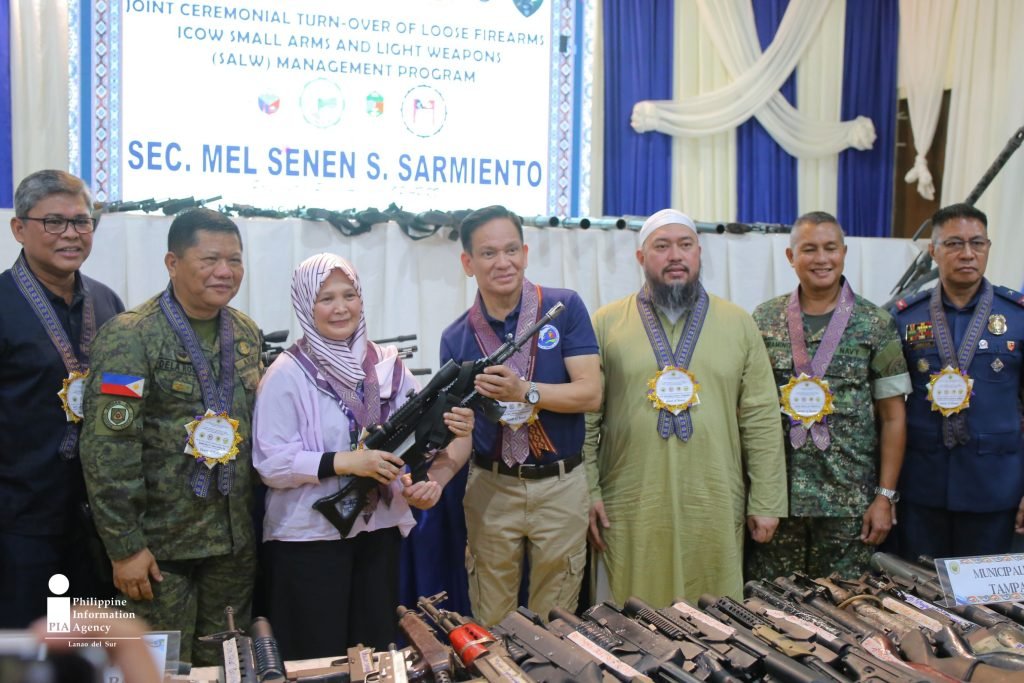
Taraka mayor Nashiba Gandamra-Sumagayan turns over 38 loose firearms to OPAPRU and the Philippine Army during a ceremony held at the Taraka Municipal Gym on May 19, 2026. The activity, under the Small Arms and Light Weapons Management Program, aims to support peace and security efforts in the province through the voluntary surrender of firearms. (Photo: ZRD/PIA-10)
MARAWI CITY (May 21) — In a province long scarred by armed conflict and clan violence, local officials in Lanao del Sur turned over 108 loose firearms this week in a fresh push to strengthen peace and prevent communities from slipping back into instability.
The firearms surrender ceremony, held in Taraka on May 19, brought together mayors, security officials, and peace advocates backing the government’s Small Arms and Light Weapons Management Program under the normalization track of the Comprehensive Agreement on the Bangsamoro.
Witnessing the turnover was Mel Senen Sarmiento, secretary of the Office of the Presidential Adviser on Peace, Reconciliation and Unity.
Officials said the firearms came from four municipalities — 39 from Tamparan, 38 from Taraka, 16 from Lumba Bayabao, and 15 from Mulondo.
But local leaders stressed the initiative was about more than collecting weapons.
For communities that endured decades of insurgency, rido, and political violence, the surrender symbolized an attempt to replace fear with trust and restore confidence in civilian governance.
Nashiba Gandamra-Sumagayan described the turnover as a direct investment in safer communities and public accountability.
“Every firearm surrendered represents a step away from fear and toward safer communities,” she said, praising residents who voluntarily turned over weapons.
The Bangsamoro peace process has reduced large-scale conflict in recent years, but illegal firearms remain deeply embedded in many communities across Mindanao, often fueling election violence, family feuds, and organized armed groups.
That reality has made weapons control one of the most difficult — and politically sensitive — parts of the post-conflict transition.
Mohammad Juhar Disomimba said peace cannot be sustained through police operations alone, emphasizing the need for cooperation between communities, local governments, and security forces.
Meanwhile, Mahar Dagalangit said genuine development remains impossible without peace and stability, especially in rural towns still recovering from years of insecurity.
Representing Mulondo Mayor Abdulhakim Panandigang, municipal administrator Alyasah Mala said the surrender drive reflected a growing desire among residents to build safer futures for younger generations.
He said peace efforts succeed only when national agencies, the Bangsamoro Autonomous Region in Muslim Mindanao government, local leaders, and ordinary citizens work together.
Ali Sumandar, head of the League of Municipalities of the Philippines-Lanao del Sur chapter, said the SALW program provides local governments with a coordinated strategy to curb armed violence and tighten accountability over firearms.
He added that reducing loose weapons could help lower violent incidents, improve investor confidence, and create safer conditions for families and businesses.
Even as the Bangsamoro transition government pushes peacebuilding programs, security concerns remain a persistent challenge in parts of Lanao del Sur and neighboring provinces, where loose firearms continue to circulate despite years of normalization efforts.
For local officials, the latest surrender ceremony was both symbolic and urgent — a reminder that lasting peace in the Bangsamoro will depend not only on signed agreements, but on whether communities can finally break their dependence on guns.