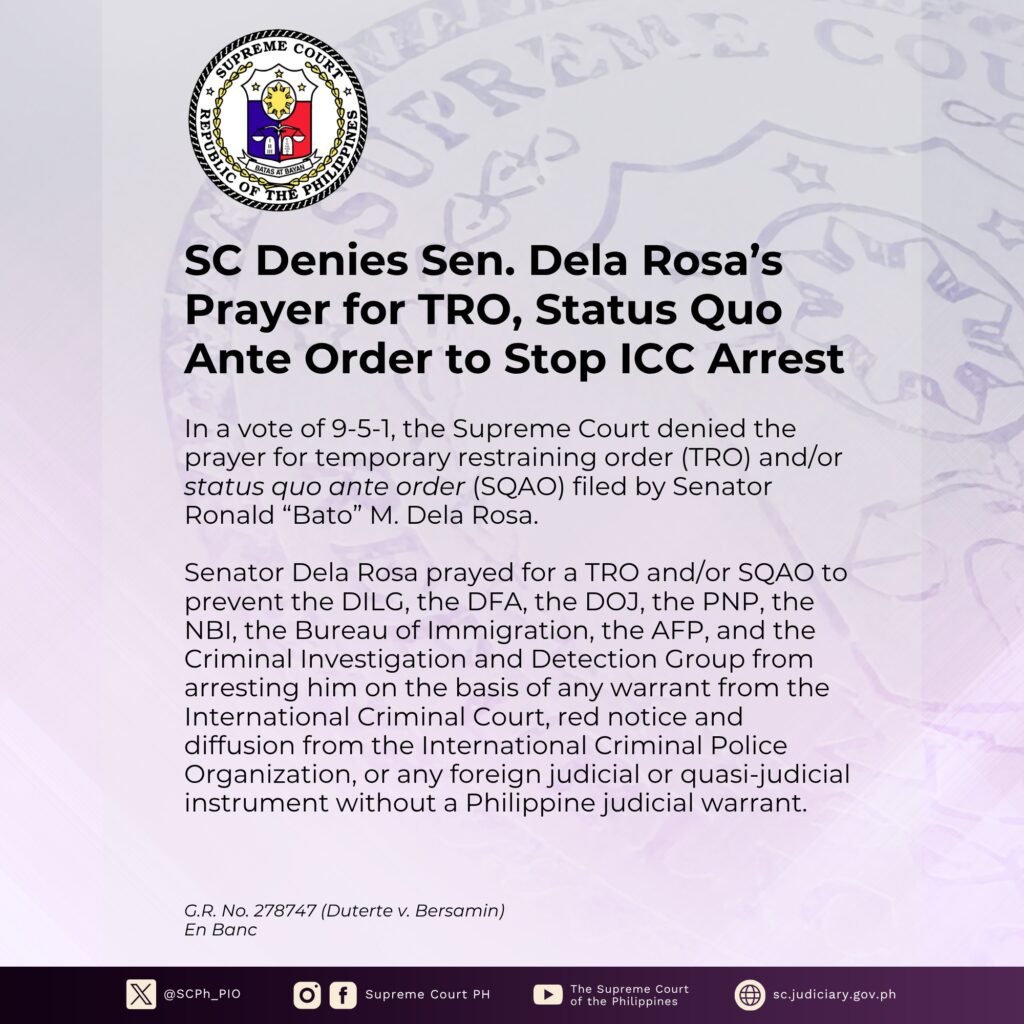
MANILA (May 21) — The Supreme Court of the Philippines has refused to shield Sen. Ronald dela Rosa from possible arrest actions tied to the International Criminal Court, marking a major legal setback for one of the key architects of the Duterte administration’s bloody anti-drug campaign.
In a divided 9-5-1 vote during a special session Tuesday, the High Court denied Dela Rosa’s plea for a temporary restraining order and status quo ante order that would have barred Philippine authorities from cooperating with ICC warrants, Interpol notices, or similar foreign-issued arrest requests without a local court warrant.
The ruling does not yet settle the larger constitutional dispute surrounding the ICC’s reach in the Philippines. But it sends a clear message: the Court is not prepared, at least for now, to stop government agencies from acting on international legal processes while the main case remains unresolved.
For accountability advocates, the decision weakens a major legal shield that Dela Rosa sought as scrutiny over the drug war continues to intensify.
The petition had targeted multiple state agencies, including the Department of Justice, Philippine National Police, National Bureau of Investigation, Bureau of Immigration, and the Department of the Interior and Local Government, seeking to prevent them from assisting in any ICC-related arrest effort.
Malacañang quickly seized on the ruling.
Presidential Communications Office Undersecretary Claire Castro said the Supreme Court resolution reinforced the legal standing of ICC-related actions and echoed the position of the Office of the Solicitor General that Dela Rosa is now considered a fugitive.
The Palace also said the ruling would be referred to Justice Secretary Frederick Nacino for evaluation.
The accountability pressure on Dela Rosa has steadily escalated in recent months.
The former police chief resurfaced publicly only last week after months out of sight, appearing at the Senate to support the leadership takeover that installed Alan Peter Cayetano as Senate president.
Hours later, he quietly exited the Senate complex with assistance from Robin Padilla after a shooting incident inside the Senate grounds triggered investigations by authorities.
Once the public face of former president Rodrigo Duterte’s anti-drug campaign, Dela Rosa has long defended police operations that human rights groups say left thousands dead, many in disputed encounters and vigilante-style killings.
Rights advocates argue the Supreme Court ruling now places greater emphasis on whether state institutions are willing to uphold legal accountability for officials linked to the controversial campaign, despite years of political resistance to the ICC.
The Court stressed that its ruling covered only Dela Rosa’s request for immediate protection and that the broader constitutional questions remain pending.
But politically and symbolically, the denial carries weight.
For critics of the drug war, it signals that legal institutions may no longer be willing to automatically insulate powerful officials from international scrutiny.
For Dela Rosa, it narrows the space between political rhetoric and possible legal reckoning.