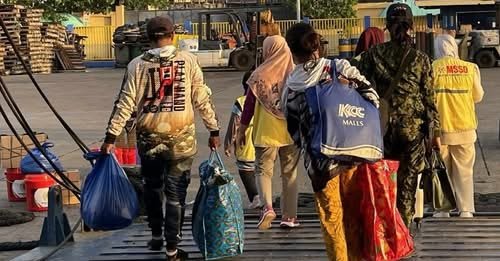
DAVAO CITY (June 30) — Twenty-five alleged victims of human trafficking were rescued last week in separate operations in Tawi-Tawi and have been safely repatriated to their hometowns in Bohol, authorities confirmed on Saturday.
Personnel from the Ministry of Social Services and Development of the Bangsamoro Autonomous Region in Muslim Mindanao (MSSD-BARMM) intercepted the individuals—mostly residents of Talibon, Bohol—in a coastal municipality near Bongao, Tawi-Tawi, close to the maritime border with Malaysia.
According to Atty. Raissa Jajurie, the victims were immediately provided with food, clothing, and psychosocial support. The Department of Social Welfare and Development in Region VII collaborated closely with BARMM officials to ensure the safe return of the victims to Bohol.
The rescue operations were carried out with the support of the Police Regional Office–Bangsamoro Autonomous Region (PRO-BAR) and the Philippine Marines, under the coordination of Lt. Gen. Antonio Nafarrete, chief of the Western Mindanao Command. Security forces were strategically deployed to ensure the mission’s success.
Police Brig. Gen. Jaysen Carpio De Guzman, regional director of PRO-BAR, said that local law enforcement helped identify the trafficking syndicate that had lured the victims with promises of jobs in Malaysia in exchange for fees.
Earlier this week, authorities also rescued seven other human trafficking victims in Sulu who were similarly bound for Malaysia. These operations form part of an intensified crackdown on illegal recruiters operating along southern maritime routes.
The Philippines remains a source and, to a lesser extent, a destination and transit country for human trafficking. According to the 2024 Trafficking in Persons Report by the U.S. State Department, the Philippines remains on the Tier 1 list but continues to face serious challenges, particularly in Mindanao’s coastal provinces.
Thousands of Filipinos are trafficked each year, most often for forced labor and sexual exploitation. Remote border provinces such as Tawi-Tawi are frequently used as gateways by trafficking syndicates targeting vulnerable populations from Visayas and Mindanao.
BARMM officials emphasized that human trafficking remains a growing threat in the region, exacerbated by poverty, misinformation, and limited local employment opportunities.