DAVAO CITY (April 6) — The Environmental Management Bureau Davao Region insists that the upcoming public scoping for Davao City’s proposed waste-to-energy (WTE) project is merely procedural — but critics say what happens at this “preliminary” stage could ultimately define the project’s fate.
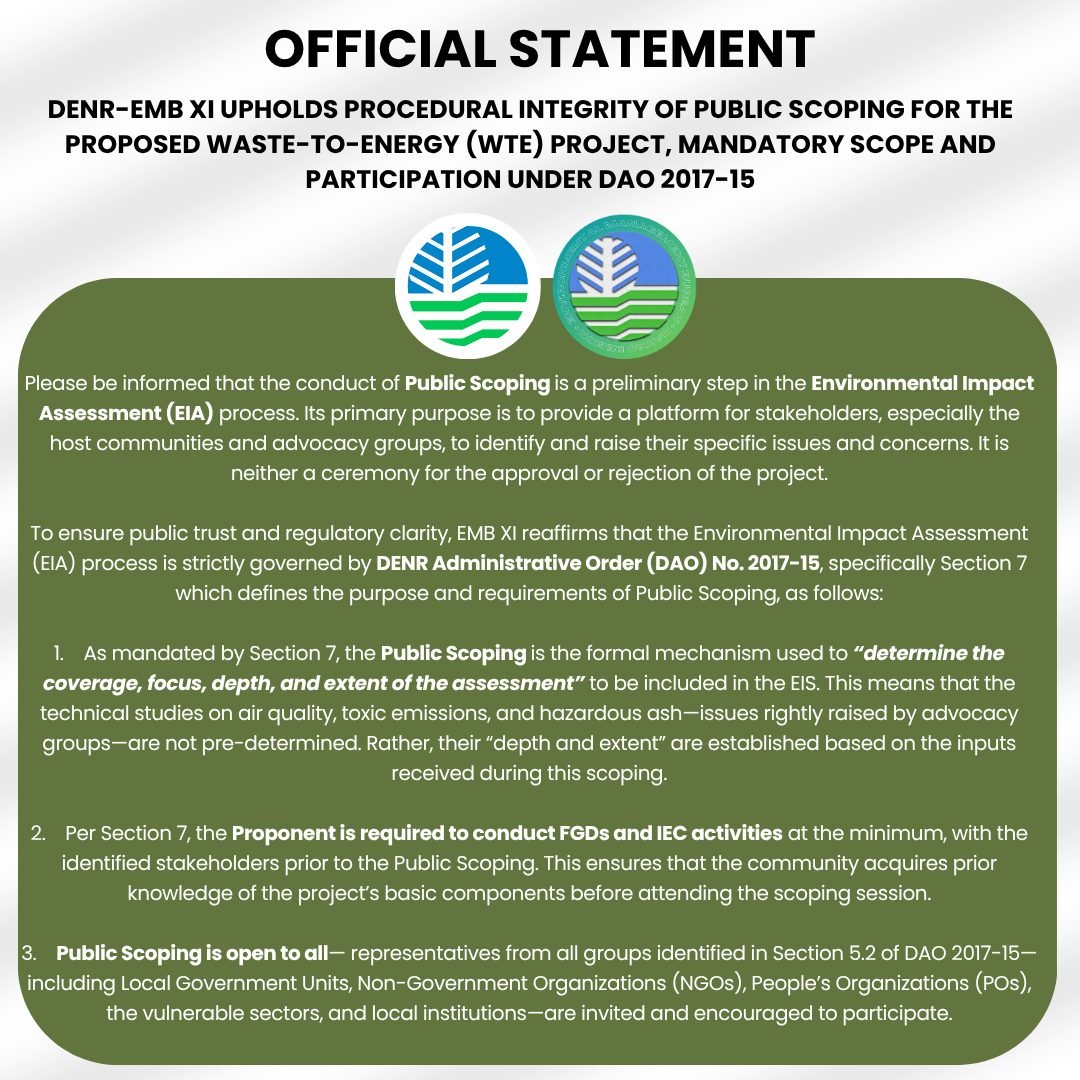
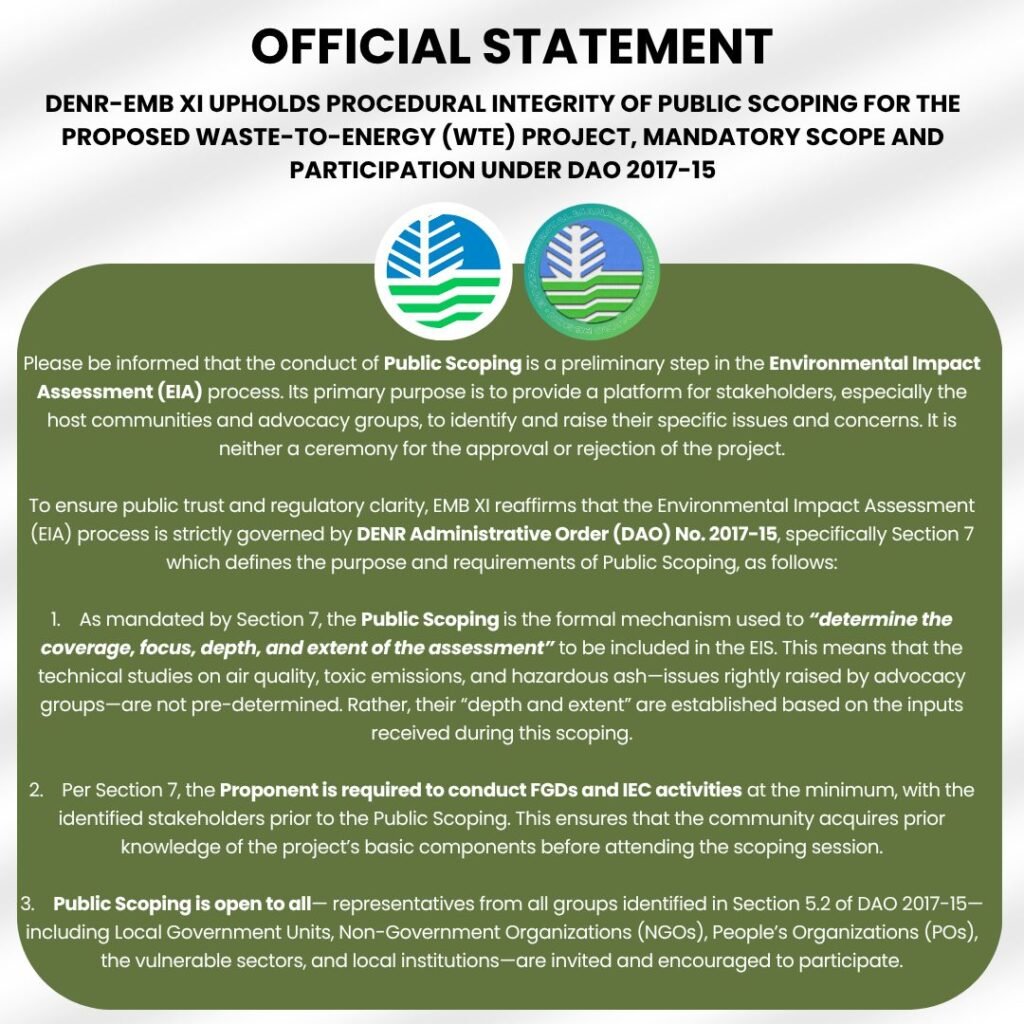
In a statement issued April 4, EMB-Davao stressed that public scoping is “neither a ceremony for approval nor rejection,” positioning the exercise as a neutral step under the Environmental Impact Assessment (EIA) process.
But that neutrality is now being questioned.
Under DENR Administrative Order No. 2017-15, public scoping determines the coverage, depth, and focus of the Environmental Impact Statement (EIS) — effectively shaping which environmental and social risks will be formally studied, and how deeply.
For environmental groups, that means the battleground is not later in the process — but now.
“If the scope is narrow, the impacts are narrow. If the scope is weak, the safeguards are weak,” an advocate said, pointing to concerns that critical issues like toxic emissions, air pollution, and hazardous ash management could be underexamined depending on how the scoping is defined.
EMB-Davao maintains that all inputs — including opposition — will be documented and used to craft the scoping checklist that guides technical studies. It also emphasized compliance with the Clean Air Act of the Philippines and review by a multi-disciplinary EIA Review Committee before any Environmental Compliance Certificate (ECC) is issued.
Still, the assurance of a “science-based review” has done little to ease concerns from groups like Interfacing Development Interventions for Sustainability (IDIS), which has openly opposed the project.
IDIS argues that the WTE proposal risks locking the city into a linear “take-make-dispose-burn” model — undermining ongoing efforts to build a circular economy centered on waste reduction, reuse, and recycling.
The group warned that incineration-based systems could disrupt entire local ecosystems of waste workers — from informal collectors to junk shops — who depend on recyclable materials for income. It also cited studies suggesting that burning waste destroys material value, preventing resources like plastics from re-entering production cycles.
At the heart of the dispute is not just technology, but direction: whether Davao City’s waste crisis will be addressed through resource recovery or waste destruction.
The Davao City Government has long pushed the WTE project as a solution to mounting landfill pressure and rising waste generation. Backed by potential financing from the Japan International Cooperation Agency, the project is being explored under Build-Operate-Transfer or Public-Private Partnership schemes.
But delays, including the need to revisit financial viability, have kept the նախագ project in limbo — pending approval from the National Economic and Development Authority.
Now, as the process moves forward, the focus shifts to public scoping — framed by regulators as participatory, but viewed by critics as decisive.
Because while EMB-Davao stresses that no project moves forward without full review, the scope of that review is not fixed — it is negotiated.
And in that negotiation lies a central question of accountability:
Is public participation shaping the project — or merely shaping how it is justified?