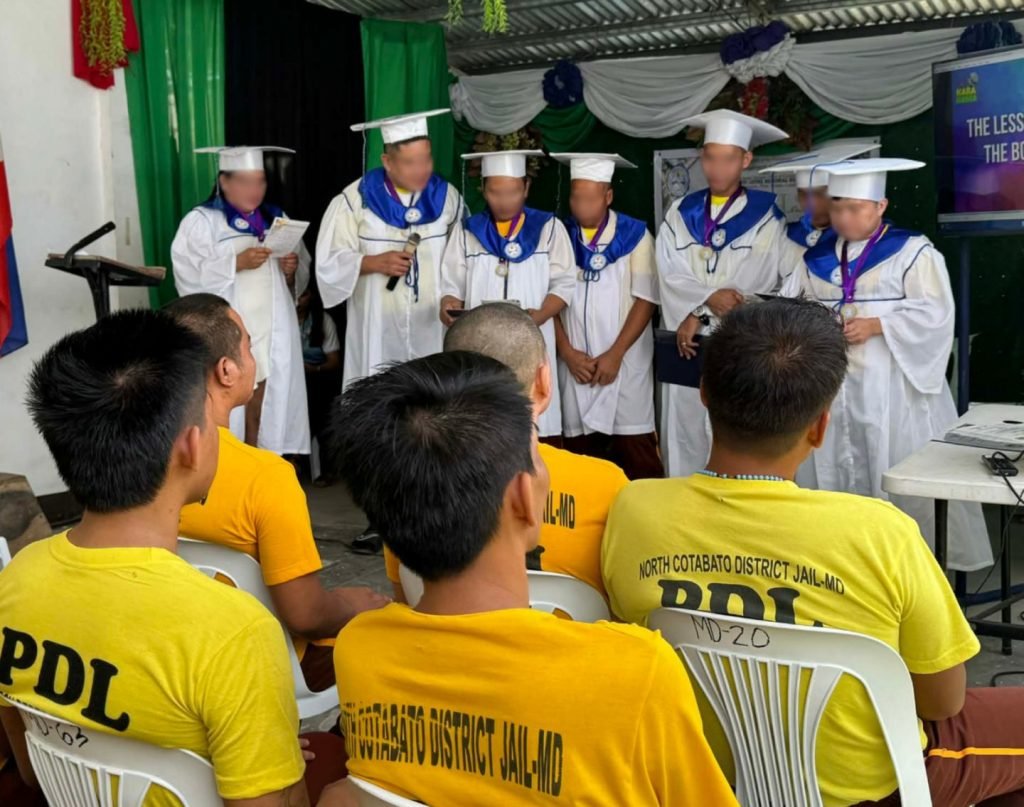
COTABATO CITY (April 21) — Inside the concrete walls of the North Cotabato District Jail, where routines are rigid and freedoms are few, nine individuals in blue uniforms marked a moment that felt anything but confined—they graduated from senior high school.
For Persons Deprived of Liberty (PDLs), the ceremony was more than a milestone. It was proof that even behind steel bars, second chances can take root.
Among them was “Boyboy,” who once believed his path had ended the moment it led him to prison.
“Even though I strayed and ended up behind bars, it did not stop me from achieving my dreams,” he said, his voice steady but heavy with meaning.
Like many others in the facility, Boyboy’s story is shaped by missteps—but also by the quiet, determined choice to begin again.
Through the Department of Education’s Alternative Learning System (ALS), education found its way into the jail’s narrow corridors. With support from Don Antonio Jayme Memorial High School (DAJMHS) and the Bureau of Jail Management and Penology (BJMP), classrooms were improvised, lessons delivered, and hope slowly rebuilt.
Three women and six men completed senior high school under the program, studying in between daily routines of confinement. Just outside the spotlight, 15 more learners moved up to Grade 12—each step forward a small defiance against the limits of their situation.
For “Jiji,” finishing school while incarcerated felt almost unreal.
“Despite our mistakes and challenges, we chose to believe in ourselves, to rise, and to keep fighting for our dreams,” she shared.
Her words echoed across the room—simple, but hard-earned.
The road to graduation was far from easy. Resources were scarce. Teachers traveled regularly to the facility, often relying on personal funds and community support to sustain the program. Yet they returned, again and again, carrying not just lesson plans, but belief.
Because inside the jail, education is more than instruction—it is transformation.
It is learning to read again. To solve problems. To imagine a future beyond a sentence.
For the school behind the program, ALS is not just about compliance with curriculum. It is about restoring dignity and opening doors long thought closed.
And for the graduates, the diploma they now hold is more than paper. It is a quiet declaration: that their story does not end here.
This year’s ceremony marks the second time senior high school graduates have emerged from the facility—a sign that the effort is taking hold, one life at a time.
Beyond policy and programs, what unfolded inside the jail was deeply human: individuals choosing growth over despair, effort over surrender.
In a place defined by limits, these nine graduates proved something enduring— that hope, once learned, cannot be locked away.