Photo: Regional Tripartite Wages and Productivity Board - Northern Mindanao
Photo: Regional Tripartite Wages and Productivity Board – Northern Mindanao
ILIGAN CITY (April 20) — Labor officials are advancing a dual agenda of wage enforcement and “green productivity” in Northern Mindanao, but recent data suggest the region still struggles to translate policy into consistent, verifiable gains for workers.
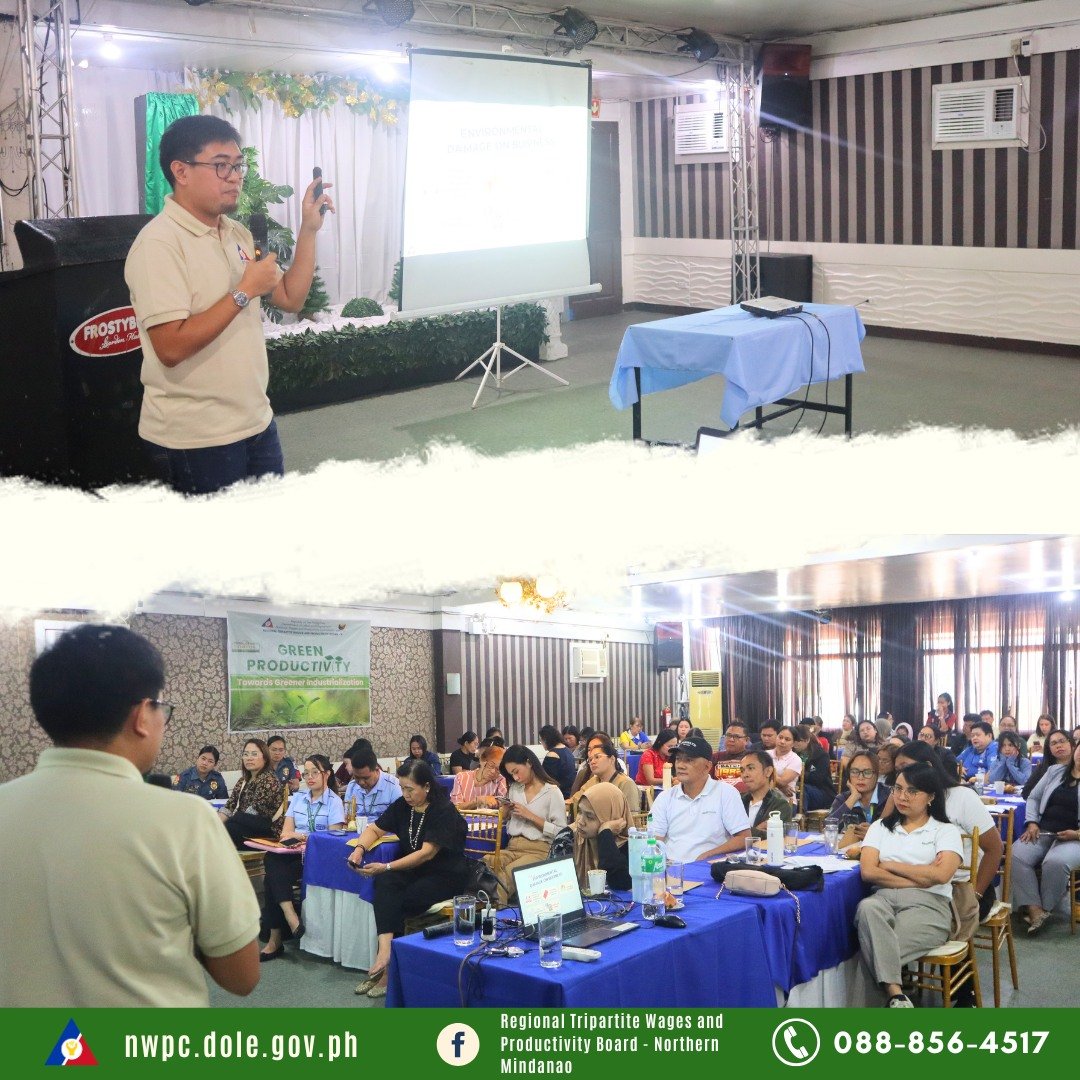
During a training led by the Regional Tripartite Wages and Productivity Board (RTWPB)-10 and the Department of Labor and Employment, stakeholders were briefed on wage compliance and sustainable productivity practices ahead of the region’s new minimum wage rates taking effect on May 1.
Yet enforcement remains a central concern.
Regional labor reports indicate that while compliance with general labor standards in Northern Mindanao can reach above 90 percent after inspections, initial compliance—before government intervention—tends to be significantly lower, with common violations including underpayment, non-payment of mandated benefits, and poor record-keeping.
The gap is especially pronounced among micro and small enterprises, which dominate the region’s economy. In provinces like Lanao del Norte and Bukidnon, labor monitoring is challenged by geographic dispersion, limited inspection capacity, and the prevalence of informal work arrangements.
Even in more urbanized areas such as Cagayan de Oro and Iligan City, compliance issues persist in sectors like retail, construction, and small-scale manufacturing—industries often flagged for wage distortions and inconsistent adherence to minimum standards.
Against this backdrop, the new wage order—raising daily minimum pay to P500 for Wage Category I and P485 for Category II—poses a critical test: whether enforcement mechanisms can keep pace with policy adjustments, particularly for workers in smaller firms and household-based employment.
For domestic workers, the mandated P6,500 monthly minimum signals progress toward standardized compensation. However, enforcement in this sector remains historically weak, as employment arrangements are largely private and complaint-driven.
The training also introduced “green productivity” measures, encouraging businesses to adopt energy-efficient and resource-saving practices. While participants cited practical steps—such as reducing electricity use and installing water-saving systems—these remain largely voluntary and small-scale.
In a region heavily reliant on agriculture and resource-based industries, scaling such practices will likely require more than awareness campaigns. Access to financing, technical support, and market incentives will be key to ensuring that sustainability efforts move beyond pilot adoption.
The broader issue, observers note, is the absence of publicly disaggregated data at the regional level—such as compliance rates by province, sector, or firm size—which limits the ability to track whether policies are reaching the most vulnerable workers.
As Northern Mindanao positions itself for greener industrialization, the challenge for the Department of Labor and Employment is clear: move from reported compliance to demonstrated outcomes.
Without stronger inspection coverage, transparent reporting, and measurable indicators—such as actual wage uptake, productivity gains, and environmental impact—the region’s labor agenda risks remaining aspirational rather than transformative.