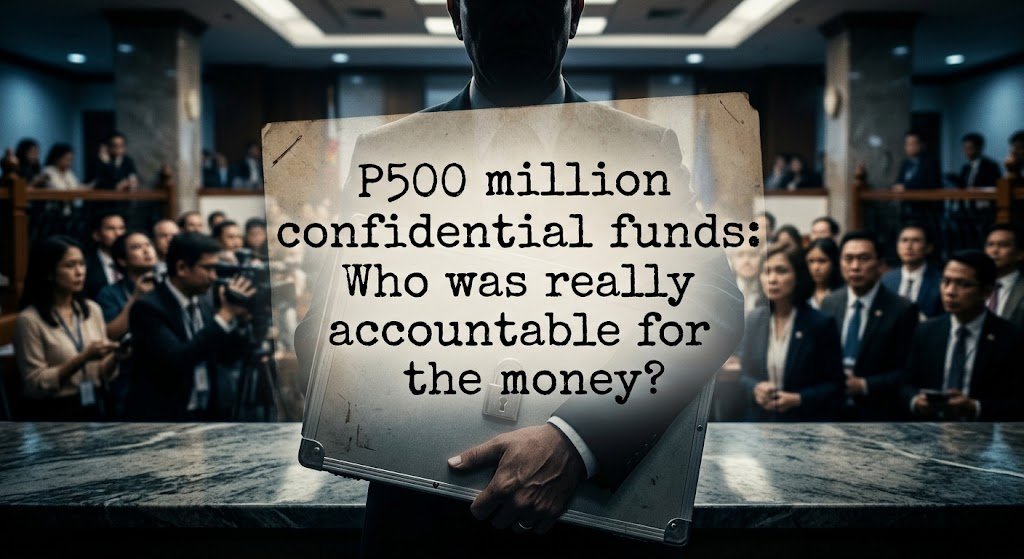
MANILA (August 26) — A troubling question emerged during a congressional hearing Monday: Who was truly accountable for P500 million in confidential funds released to a security officer who was not even bonded to handle public money?
Gina Acosta, former special disbursing officer of the Office of the Vice President (OVP), testified that she released the P500 million in confidential funds to Col. Raymund Dante Lachica, Vice President Sara Duterte’s security officer.
Acosta’s admission puts the spotlight on a basic safeguard in public finance: officials entrusted with government money are expected to be clearly identified, bonded and accountable for its use.
In this case, those roles appear to have been split.
Acosta said Lachica was not a bonded accountable officer. Yet she released the money to him because Duterte had designated him as her security officer and because he was considered to have the expertise to carry out confidential activities.
Acosta maintained that she remained the accountable officer and was therefore responsible for preparing the liquidation.
“He is not bonded. I am still the accountable person, which is why I was the one who prepared the liquidation,” Acosta said.
For private prosecutor Amando Virgil Ligutan, however, that arrangement raises a serious compliance issue.
Ligutan questioned Acosta about provisions of the joint memorandum circular governing confidential and intelligence funds that prohibit the transfer of such funds from one accountable officer to another and restrict the transfer of accountable officers between agencies.
The issue is not merely technical.
A fidelity bond is intended to provide financial protection when a government employee is entrusted with public funds. If the person who physically receives and uses a large amount of money is not bonded, while another officer remains formally accountable, the arrangement raises an obvious question: how effective is accountability if custody and responsibility are separated?
That question becomes even more important when the amount involved is P500 million.
Confidential funds are designed for activities where secrecy is necessary. But confidentiality does not mean the money is exempt from government controls. Public funds remain public funds, whether their intended activities are disclosed or kept confidential.
For ordinary taxpayers, the controversy can be reduced to a simple concern: Who can be held responsible if something goes wrong with the money?
Acosta’s testimony suggests that she retained formal accountability even though the funds were placed in the hands of someone who was not bonded. That creates a potential accountability gap that deserves close scrutiny by auditors and lawmakers.
The hearing should therefore move beyond determining whether Acosta followed instructions.
It should examine who authorized the transfer, what legal basis allowed a non-bonded security officer to receive the funds, how the money was actually disbursed, what documentation supports the expenses and whether the liquidation adequately establishes that the P500 million was used for legitimate confidential activities.
These are not questions of political allegiance.
They are questions of public accountability.
The controversy also highlights why safeguards governing confidential funds matter. The more difficult it is for the public to see how money is spent, the stronger the internal controls and accountability mechanisms should be.
For communities struggling with limited public resources, P500 million is not an abstract figure. It represents money that could otherwise support public services, schools, health programs, disaster response or other urgent needs.
That is why the central issue should not be whether the funds were labeled “confidential.”
It is whether the government can demonstrate, clearly and credibly, where the money went, who controlled it and who can be held responsible for every peso.
Until those questions are fully answered, the disclosure of a P500-million transfer to an unbonded recipient will continue to raise more questions than assurances.