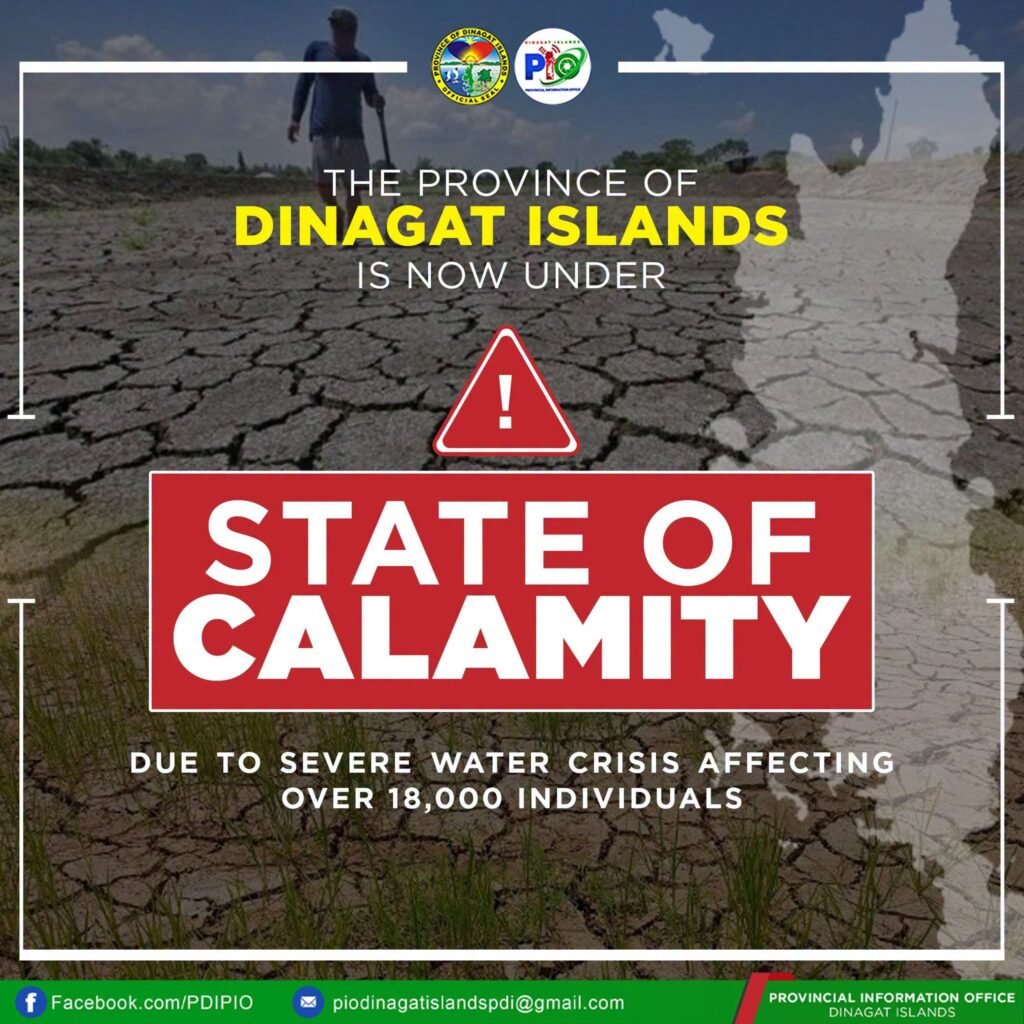
BUTUAN CITY (August 27) — Water is running short across Dinagat Islands, and provincial officials are moving to declare a state of calamity as more than 18,000 residents face dwindling supplies, longer trips for water and growing dependence on hauling and rationing.
The Provincial Disaster Risk Reduction and Management Council (PDRRMC) Technical Working Group, led by Governor Nilo Demerey Jr., approved a resolution Tuesday recommending a province-wide calamity declaration.
The resolution was sent to the Sangguniang Panlalawigan for action. As of Wednesday, however, the provincial board had yet to formally approve the declaration.
For a province of about 120,533 people, the number at risk has already crossed the 15-percent threshold used under state of calamity guidelines. That threshold is roughly 18,080 people.
The PDRRMC said prolonged dry conditions have pushed water sources across the province to increasingly critical levels, affecting both the availability and reliability of potable and domestic water.
The shortages are being felt in practical, everyday ways: lower water yields, interrupted services, longer distances to collect water and greater reliance on water trucks and rationing.
“This is not merely a seasonal inconvenience,” the council said, stressing that water is fundamental to drinking, sanitation, food preparation, health, education, livelihoods and essential public services.
A crisis beyond the faucet
The numbers tell only part of the story.
When water becomes scarce, the burden spreads. Families spend more time and money securing basic supplies. Schools and public facilities face greater pressure to maintain sanitation. Farmers and fisherfolk confront risks to production and income.
The provincial government is therefore treating the shortage as both a humanitarian concern and a threat to the local economy.
The PDRRMC said the proposed declaration would allow government agencies to coordinate more closely, prioritize interventions, mobilize available resources and respond before the situation deteriorates further.
It described the measure as a “proactive and enabling risk-governance” step designed to keep the water shortage from turning into a deeper humanitarian and socioeconomic emergency.
Livelihoods next in line
The province also plans to protect food and livelihood security, with farmers and fisherfolk identified as among those needing priority assistance.
For communities already accustomed to the challenges of island life, the water shortage adds another layer of vulnerability.
The immediate concern is getting enough water to households. The larger challenge is ensuring that prolonged scarcity does not begin taking away people’s ability to work, produce food and maintain basic public services.
With more than 18,000 people already affected or facing immediate risk, Dinagat Islands is asking its provincial board to act before the taps—and the livelihoods that depend on them—run even drier.