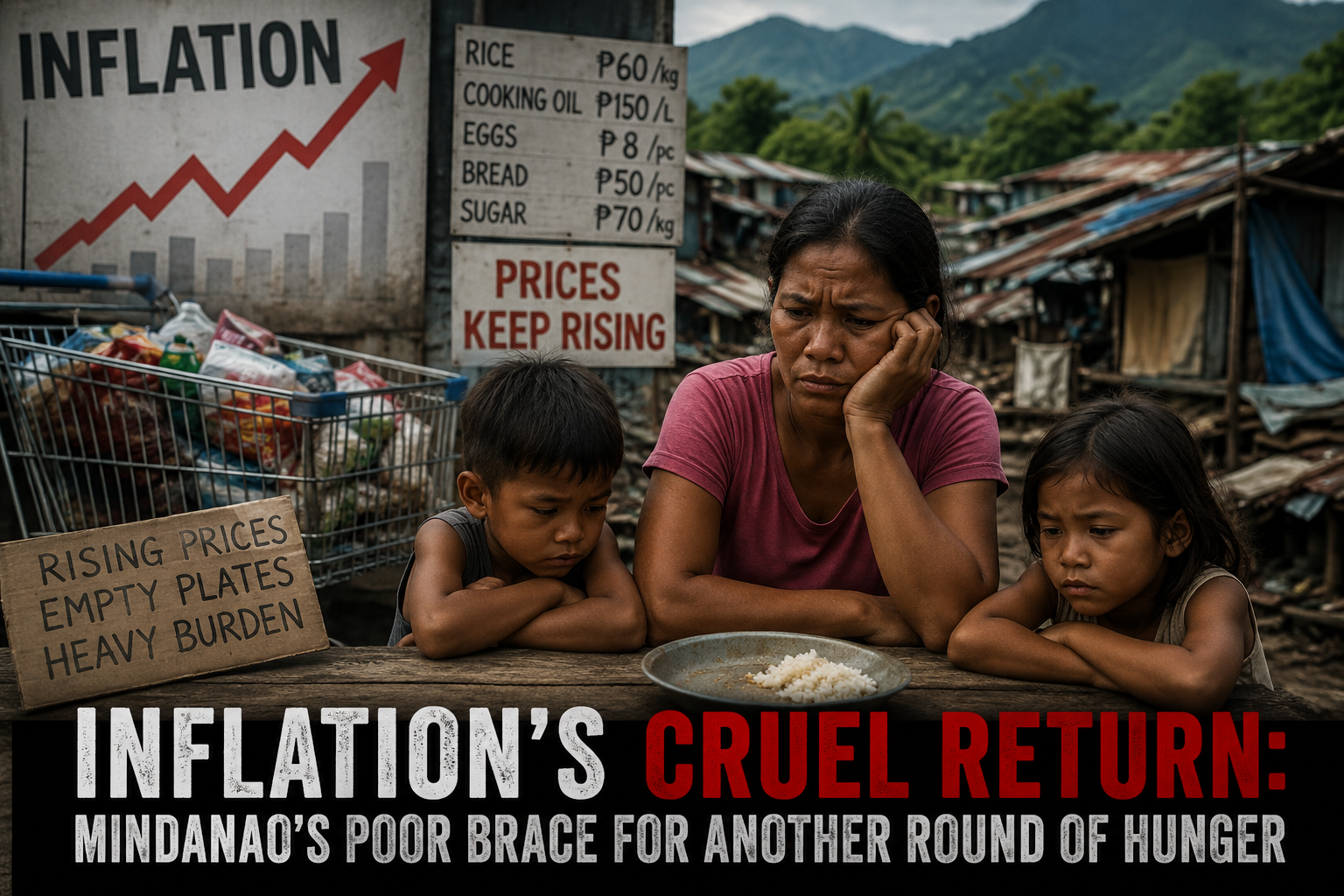
DAVAO CITY (May 31) — For many poor families across Mindanao, inflation is no longer an economic indicator. It is one less kilo of rice, fewer vegetables on the table, and another difficult conversation about which household expense must be sacrificed to survive the week.
As the Bangko Sentral ng Pilipinas (BSP) warned that inflation likely accelerated further in May, the country’s poorest households are once again bearing the heaviest burden of rising prices.
The central bank estimates inflation reached between 7.1 and 7.9 percent during the month, driven largely by higher prices of rice, meat, and vegetables, as well as the continued weakening of the peso. If the upper end of the forecast proves accurate, inflation would hit its highest level in more than three years.
But behind the numbers is a harsher reality unfolding in Mindanao’s urban poor communities, farming villages, and conflict-affected areas.
For minimum-wage earners, informal workers, small farmers, fisherfolk, and indigenous communities, food already consumes the largest share of household income. Every peso added to the cost of rice or vegetables translates directly into less food on the family table.
In many households across Davao Region, Caraga, Northern Mindanao, and the Bangsamoro region, families have long adopted coping mechanisms familiar during periods of economic distress: buying rice by the cup instead of by the sack, reducing meat consumption, skipping meals, or relying on instant noodles and other cheaper alternatives.
The BSP cited rising rice prices as a major driver of inflation. Yet for many Mindanao families, rice has become a symbol of a deeper failure to shield vulnerable consumers from repeated food shocks.
Despite government promises of rice affordability and agricultural modernization, market prices remain stubbornly high. Even imported rice, once viewed as a buffer against domestic shortages, is becoming more expensive as the peso weakens against the US dollar.
The problem extends beyond rice.
Vegetables commonly found in Mindanao households—from tomatoes and eggplants to bitter gourd and beans—have seen sustained price increases. For poor families, nutritional choices are increasingly dictated not by health needs but by what can still be afforded.
Health workers and social development advocates have repeatedly warned that prolonged food inflation carries consequences beyond household budgets. Reduced food consumption among children can worsen malnutrition, weaken school performance, and deepen long-term poverty, particularly in communities already struggling with food insecurity.
The weak peso is making matters worse.
As the currency hovers at historic lows against the US dollar, the cost of imported fuel, fertilizers, feeds, and agricultural inputs rises. Those additional expenses eventually reach consumers through higher transportation costs and more expensive food products.
The cycle is particularly punishing in Mindanao, where agricultural producers are themselves squeezed by rising production costs while consumers face escalating retail prices.
Farmers pay more for fertilizers and fuel. Transport operators spend more to move goods. Vendors raise prices to recover costs. Consumers absorb the final impact.
Economists warn that inflation could climb even higher if global oil prices rise further or if geopolitical tensions disrupt international supply chains.
For Mindanao’s poor, however, the crisis is already here.
The concern is not whether inflation reaches eight percent or exceeds central bank forecasts. The concern is whether daily wages can still cover three meals, school allowances, transportation fares, medicines, and electricity bills.
If inflation continues to outpace wage growth, more families may be pushed deeper into debt, forced to pull children from school, postpone medical treatment, or seek informal work simply to make ends meet.
The BSP may eventually respond with higher interest rates to tame inflation. Yet while monetary policy can cool demand, it cannot immediately lower the price of vegetables in public markets or put affordable rice on family tables.
That is why the inflation debate extends beyond economics.
For millions of poor households across Mindanao, it has become a question of food security, human dignity, and whether economic growth touted in government reports is reaching those who need it most.
As prices continue to rise, the gap between macroeconomic optimism and everyday survival is becoming harder to ignore.