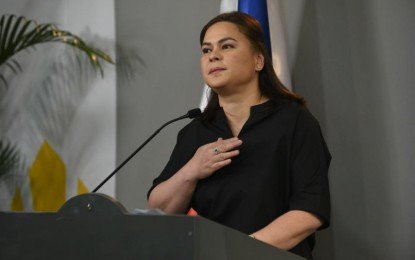
MANILA (May 31) — As Vice President Sara Duterte’s impeachment case inches toward trial, a parallel battle is already unfolding outside the Senate halls: the struggle to shape public perception before senators render judgment.
The House of Representatives may have secured the numbers needed to impeach Duterte, but lawmakers leading the prosecution acknowledge that evidence alone may not determine the political consequences of the case. In an era dominated by social media and competing narratives, they are also confronting what they describe as a relentless campaign of misinformation designed to undermine the proceedings.
This concern has given rise to “Bantay Senado,” a citizen-led monitoring initiative composed of volunteer lawyers and social media influencers tasked with explaining the impeachment process to the public. The project’s stated goal is simple but politically significant: translate legal proceedings into language ordinary Filipinos can understand before online disinformation fills the vacuum.
The initiative reflects a reality often left unstated in impeachment cases. While senators act as judges, the public remains an influential audience whose perceptions can shape political legitimacy long after a verdict is rendered.
House prosecutors have openly identified fake news as one of their greatest obstacles.
“One of the biggest challenges that we face is fake news,” Iloilo 3rd District Rep. Lorenz Defensor said, warning that false narratives are being circulated to distort evidence and influence public understanding of the case.
His remarks underscore a broader concern about how impeachment proceedings are increasingly fought on digital platforms where legal facts compete with viral content, partisan messaging, and organized online campaigns.
The stakes are considerable.
The House voted overwhelmingly, 257-25 with nine abstentions, to impeach Duterte on May 11. The articles were transmitted to the Senate two days later, triggering a constitutional process that could remove the country’s second-highest official from office and permanently bar her from holding public office.
The accusations against Duterte are among the most serious ever leveled against a sitting vice president.
The first article centers on allegations that hundreds of millions of pesos in confidential funds released to the Office of the Vice President and the Department of Education were systematically misused and improperly liquidated.
The second alleges unexplained wealth, incomplete asset disclosures, and continued business interests during her tenure in government.
The third accuses her of bribery and corruption through alleged payments intended to influence procurement-related activities.
The fourth article—arguably the most politically explosive—accuses Duterte of committing high crimes and betraying public trust by allegedly threatening President Ferdinand Marcos Jr., First Lady Liza Araneta-Marcos, and House leaders.
Together, the charges paint a picture not merely of administrative misconduct but of alleged abuses that prosecutors argue strike at the core of public accountability and constitutional governance.
Duterte, however, has categorically denied the allegations.
Her legal team has argued that the impeachment complaints are built on speculation rather than evidence and fail to establish the factual foundations required for conviction. Regarding allegations that she contracted the assassination of government officials, Duterte maintains that no proof exists and that complainants have relied on exaggerated interpretations of her statements.
The clash between these opposing narratives is likely to intensify as the trial approaches.
House Justice Committee Chairperson and lead prosecutor Gerville Luistro acknowledged the close relationship between evidence and public opinion.
“Evidence and public opinion are very much intertwined,” she said. “If you will be able to present strong evidence, you will be able to get a favorable public opinion.”
Her statement reveals an uncomfortable truth about modern political accountability: legal proceedings no longer operate in isolation from the information ecosystem surrounding them.
The Senate trial, expected to begin in July, will formally determine whether Duterte committed impeachable offenses. Yet outside the chamber, another verdict is already being contested—one rendered daily by citizens navigating a flood of claims, counterclaims, and political messaging.
For both the prosecution and the defense, the challenge extends beyond proving their case under constitutional standards. It is also about persuading a deeply polarized public that their version of events deserves to be believed.
As the impeachment process moves forward, the proceedings will test not only the strength of the evidence against Duterte but also the country’s capacity to separate fact from political narrative in one of the most consequential constitutional confrontations of the Marcos administration.