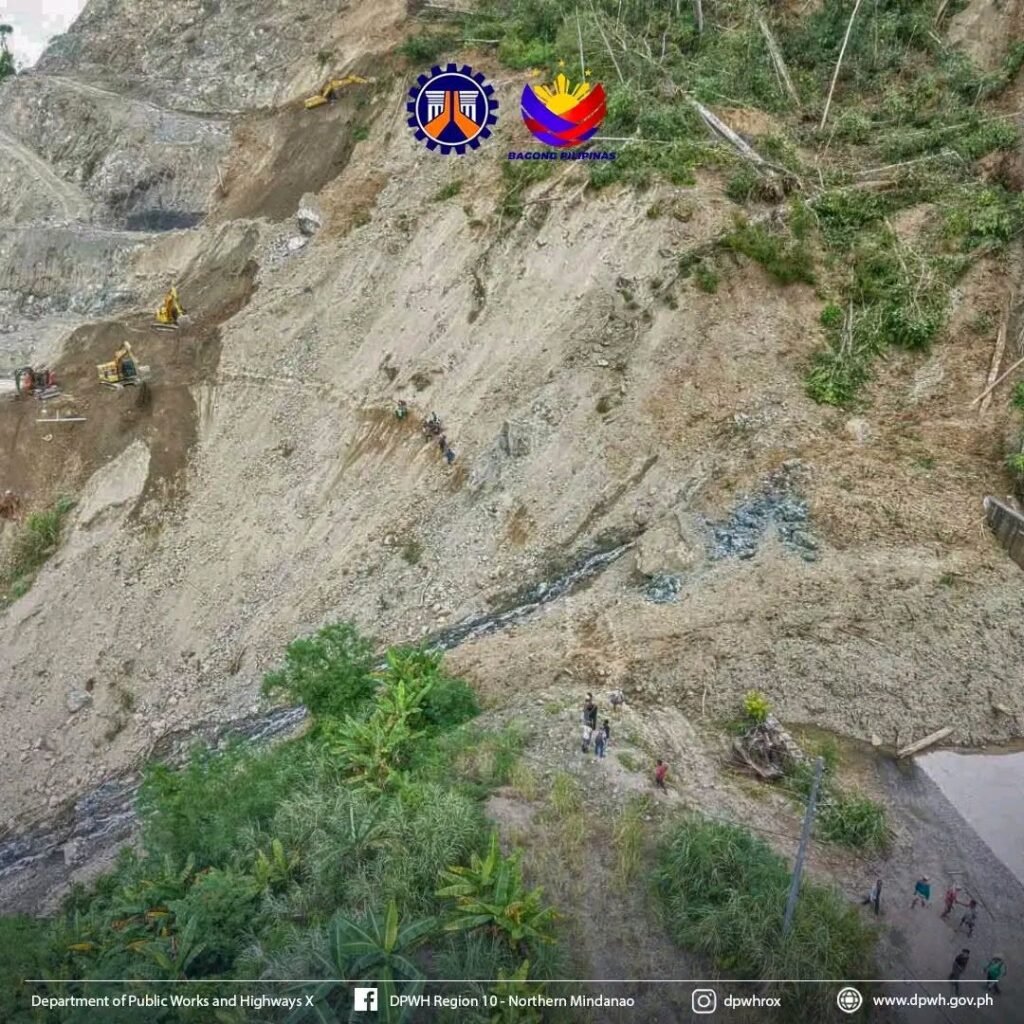
VALENCIA CITY, Bukidnon — For thousands of Indigenous Peoples (IP) living in the remote mountains of Bukidnon, a single landslide has become more than a roadblock—it has severed their lifeline.
A massive slope collapse along the Kapalong-Talaingod-Valencia (KTV) Road in Sitio Balacayo, Barangay Kalagangan, San Fernando, has left upland communities isolated since July 6, cutting off access to markets, schools, health services, and emergency assistance.
Authorities now say reopening the highway could take months.
Triggered by days of relentless southwest monsoon rains intensified by Typhoon Inday (international name: Bavi), the landslide buried nearly 200 meters of the mountain road beneath thousands of cubic meters of mud, boulders, uprooted trees, and other debris.
For residents in the hinterland, the closure means longer journeys on foot, disrupted livelihoods, delayed delivery of basic goods, and limited access to essential government services.
The Department of Public Works and Highways (DPWH) has deployed heavy equipment from Region 10, the First District Engineering Office, and the San Fernando local government to clear the blocked highway. But engineers say the operation cannot be rushed.
“We are removing the debris layer by layer because of the unstable slope,” said Engr. Rainer Valderrama, district maintenance engineer of the DPWH First District Engineering Office.
Crews continue working under hazardous conditions as loose soil, unstable rock formations, and damaged trees pose constant threats. Tree-cutting operations are underway on the upper slope to prevent additional debris from crashing onto workers and equipment below.
DPWH Region 10 said days of continuous rainfall had saturated the mountainside, weakening its foundation. Officials also noted that recent seismic activity may have further destabilized the slope, contributing to the collapse.
Beyond restoring a road, the operation has become a race to reconnect communities.
The KTV Road is a critical transport corridor linking remote villages in Bukidnon and Davao del Norte. It serves as the main route for farmers transporting produce, children traveling to school, patients seeking medical care, and government agencies delivering essential services.
As clearing operations continue, local officials are urging motorists and residents to avoid the affected area and heed safety advisories while engineers monitor the mountainside for further movement.
For the Indigenous communities waiting beyond the landslide, every truckload of debris removed brings renewed hope that their connection to the outside world will soon be restored.