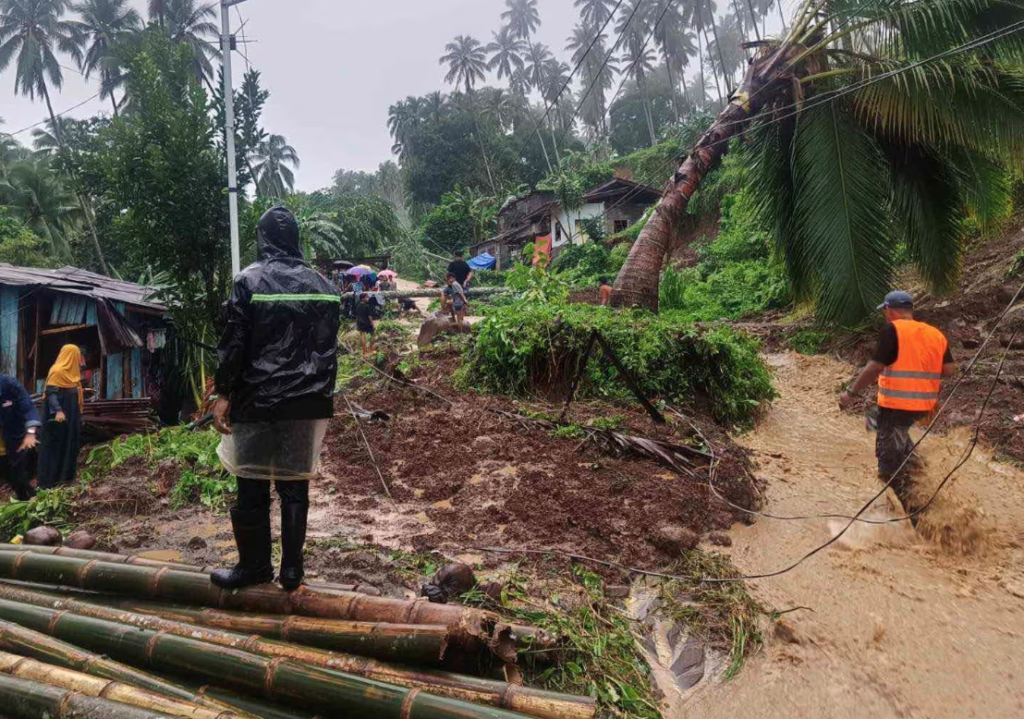
MANILA (July 13) — Even as Typhoon Inday moved out of the Philippine Area of Responsibility, its destructive wake continues to unfold across the country, with at least 17 people dead, nine still missing, and more than half a million residents affected by days of relentless rain, flooding, and landslides intensified by the southwest monsoon.
The National Disaster Risk Reduction and Management Council (NDRRMC) reported that 514,000 people have been affected by the combined impact of Typhoon Inday and the enhanced habagat, highlighting the widespread devastation from Luzon to Mindanao.
Among the fatalities were 15 people killed in separate landslides in Malapatan, Sarangani, and Calanogas, Lanao del Sur, while two others drowned in Bukidnon. Search operations continue for nine missing persons, including six in Calanogas and three in Malapatan.
Communities struggle to recover
More than 11,200 residents remain displaced and are taking shelter in 77 evacuation centers as floodwaters continue to inundate low-lying communities.
The severe weather also damaged 153 houses, with 12 homes completely destroyed, leaving many families facing an uncertain road to recovery.
Government agencies have so far distributed more than P16.4 million worth of food and non-food assistance to affected communities, while local disaster response teams continue relief, rescue, and clearing operations in the hardest-hit provinces.
BARMM among the hardest hit
The Bangsamoro Autonomous Region in Muslim Mindanao (BARMM) remains one of the areas most severely affected.
Floodwaters swept through municipalities in Maguindanao del Norte, Maguindanao del Sur, and Lanao del Sur, affecting more than 60,000 residents and forcing many families to evacuate.
To bolster emergency operations, the Police Regional Office-Bangsamoro deployed 600 police personnel, joining soldiers, local responders, and humanitarian workers in assisting flood-hit communities.
The Bangsamoro Government, through the Ministry of Social Services and Development (MSSD), has begun distributing relief goods to affected families, while BARMM Chief Minister Abdulraof Macacua personally visited evacuation centers in Parang, Maguindanao del Norte, to provide food packs, tents, and other emergency assistance.
Travel disruptions continue
The storm also disrupted transportation across the country, stranding more than 1,000 passengers in ports and airports.
The Philippine Coast Guard reported stranded travelers in 61 ports nationwide, with Southern Tagalog and Western Visayas recording the highest numbers. Passengers were also stranded in BARMM, Palawan, Bicol, and Central Visayas as sea travel remained suspended due to rough conditions.
Air travel was likewise affected after several domestic flights were canceled because of the combined effects of Typhoon Inday and the eruption of Mount Kanlaon.
Authorities continue to advise operators of small boats and the traveling public to monitor weather updates before resuming trips.
Storm exits, risks remain
Although PAGASA confirmed that Typhoon Inday exited the Philippine Area of Responsibility on Saturday morning, the weather bureau warned that the enhanced southwest monsoon continues to bring heavy rainfall to parts of Luzon.
Areas including Zambales, Bataan, and Occidental Mindoro may still experience 100 to 200 millimeters of rain, raising the risk of flash floods and landslides, particularly in low-lying and mountainous communities.
For many families across the country, the storm may have passed, but the work of rebuilding homes, restoring livelihoods, and supporting communities affected by the disaster is only beginning.