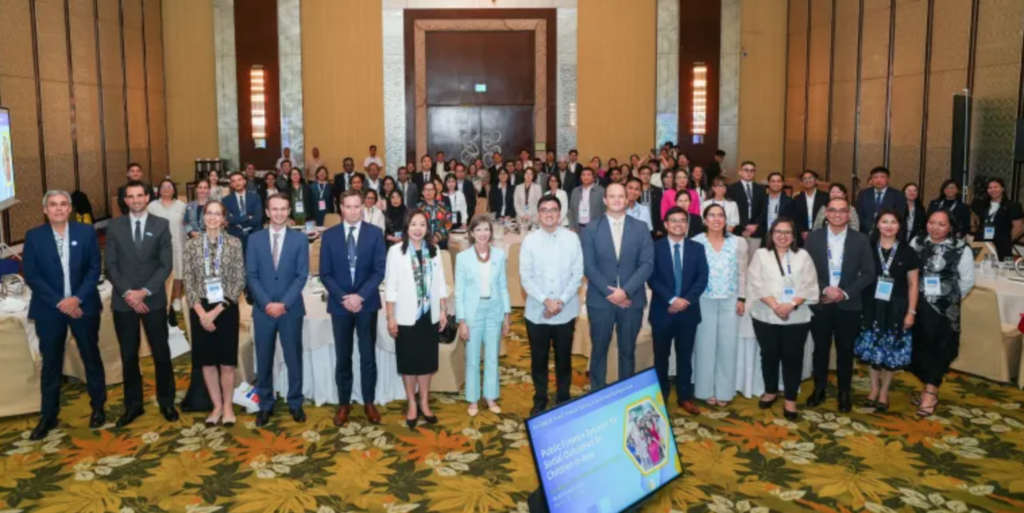
MANILA(August 22) — The Philippines has convened eight Asian countries in a regional effort to make sure that even in tight budgets and worsening climate pressures, spending for children does not get left behind.
From Aug. 18 to 20, the Department of Budget and Management (DBM), with support from the European Union (EU) and UNICEF, hosted the South-South Exchange bringing together officials from Bangladesh, Bhutan, Mongolia, Nepal, the Philippines, Sri Lanka, Thailand, and Vietnam.
At the heart of the three-day meeting: a shared concern that education, health, nutrition, and child protection programs are often the first to feel the squeeze when governments face fiscal stress.
According to the DBM, the discussions focused on how countries can keep child-focused spending steady and effective despite economic shocks, limited fiscal space, and climate-related disruptions.
Officials exchanged practical tools such as budget tagging, expenditure tracking, and evidence-based planning—systems designed to show whether public funds are actually reaching frontline services for children.
The exchange is part of the EU-UNICEF Public Finance Facility in South and Southeast Asia, a regional platform that helps governments improve how they plan, allocate, and monitor spending for children.
Acting Budget Secretary Kim Robert De Leon stressed that investing in children should be seen as a long-term national investment, not just a budget line.
“Spending for our children should never be seen merely as a cost. When we invest in a child, the return is measured, not only in pesos or percentages, but in healthier lives, better opportunities, stronger communities, and ultimately, stronger nations,” De Leon said.
UNICEF Philippines Representative Kyungsun Kim said the initiative is especially timely as the country moves closer to upper-middle-income status, where expectations for stronger public systems are higher.
“As the Philippines continues its transition to upper-middle-income status, this partnership helps ensure that economic progress is matched by stronger public finance systems so that every investment brings us closer to better, more equitable outcomes for children,” Kim said.
EU Chargé d’Affaires Frederic Grillet said the collaboration also supports the EU’s Global Gateway Strategy, which prioritizes investments in governance, institutions, and human capital.
Since 2019, the EU-UNICEF Public Finance Facility—backed by a €3-million EU contribution—has been providing technical assistance and policy support to governments across the region.
The meeting wrapped up with participating countries agreeing on key lessons and reaffirming commitments to reforms that make public finance systems more transparent, accountable, and better able to protect spending that directly benefits children.