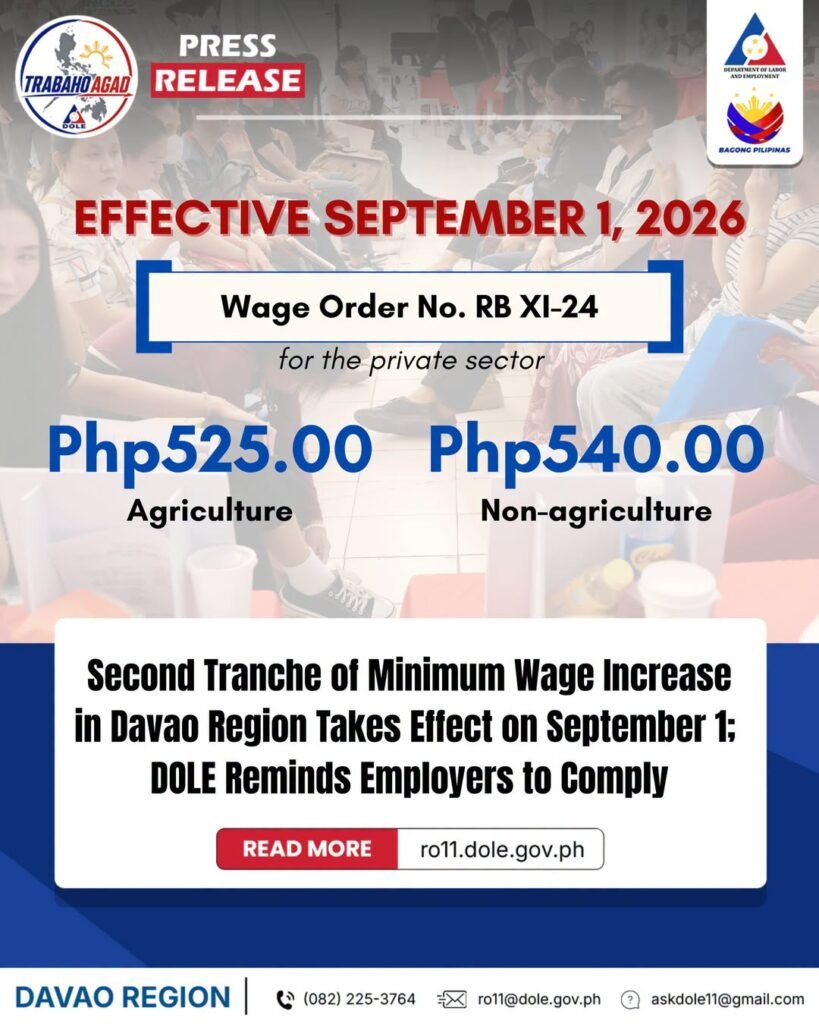
Second wage tranche takes effect Sept. 1 as workers continue to face rising living costs
Photo: Department of Labor and Employment – Davao Region
DAVAO CITY (August 29) — For thousands of minimum wage earners in the Davao Region, the P10 to P15 increase in daily pay beginning Sept. 1 offers some relief—but may do little to ease the pressure of rising household expenses.
The second tranche of the wage adjustment under Wage Order No. RB XI-24 will raise the daily minimum wage for agricultural workers from P515 to P525, while non-agricultural workers will receive an increase from P525 to P540.
The first tranche took effect on March 13.
While the Department of Labor and Employment in Davao Region (DOLE-11) is urging employers to comply with the new rates, the modest adjustment puts the spotlight once again on the gap between the statutory minimum wage and what workers actually need to cover food, transportation, housing, utilities, education and other basic expenses.
For a worker earning the new P540 daily minimum in the non-agriculture sector, the additional P15 a day amounts to only about P390 over a 26-day work month, before deductions and other expenses.
Agricultural workers receiving the P10 increase would gain about P260 more per month based on the same 26-day work assumption.
DOLE-11 Regional Director and Regional Tripartite Wages and Productivity Board (RTWPB-11) Chairperson Dax Villaruel called on employers to fully implement the wage order, saying compliance is a recognition of workers’ contribution to their businesses.
“Employers are encouraged to implement the mandated wage adjustments as a concrete expression of respect for workers’ rights and recognition of their valuable contributions to the enterprise,” Villaruel said.
But for workers already struggling to stretch their income, the more immediate question is whether the additional money can keep pace with the cost of basic necessities.
Villaruel said compliance with labor standards remains crucial to workers’ welfare, industrial peace, productivity and the creation of healthy workplaces.
He also warned employers that minimum wage compliance would remain part of DOLE’s regular labor inspections.
“Compliance with the prescribed minimum wage is part of the regular labor inspection agenda of DOLE. Labor inspectors will verify establishments’ compliance with the wage order during routine inspections,” he said.
The warning is significant because DOLE-11 said minimum wage payment has consistently ranked among the leading areas of non-compliance based on previous labor inspection records.
This means that for some workers, the issue is not only whether the wage floor is high enough, but whether they are actually receiving even the legally mandated amount.
The wage order applies to all minimum wage earners in private establishments across the region regardless of position, designation or employment status, and regardless of the method by which wages are paid.
There is, however, an exemption for Barangay Micro Business Enterprises (BMBEs) with valid Certificates of Authority from the Department of Trade and Industry. These enterprises are exempt from the minimum wage law under Republic Act No. 9178, or the Barangay Micro Business Enterprises Act of 2002.
The wage adjustment followed consultations conducted by RTWPB-11, including a public hearing in February 2026.
The Sept. 1 increase therefore marks another step in the region’s wage policy—but for minimum wage earners, its real value will ultimately be measured not on paper, but in what the additional P10 or P15 can buy at the market, how far it can stretch for transportation and whether it can help keep a household’s monthly budget from falling short.
For workers living from paycheck to paycheck, a wage increase is welcome. The bigger question is whether it is enough.