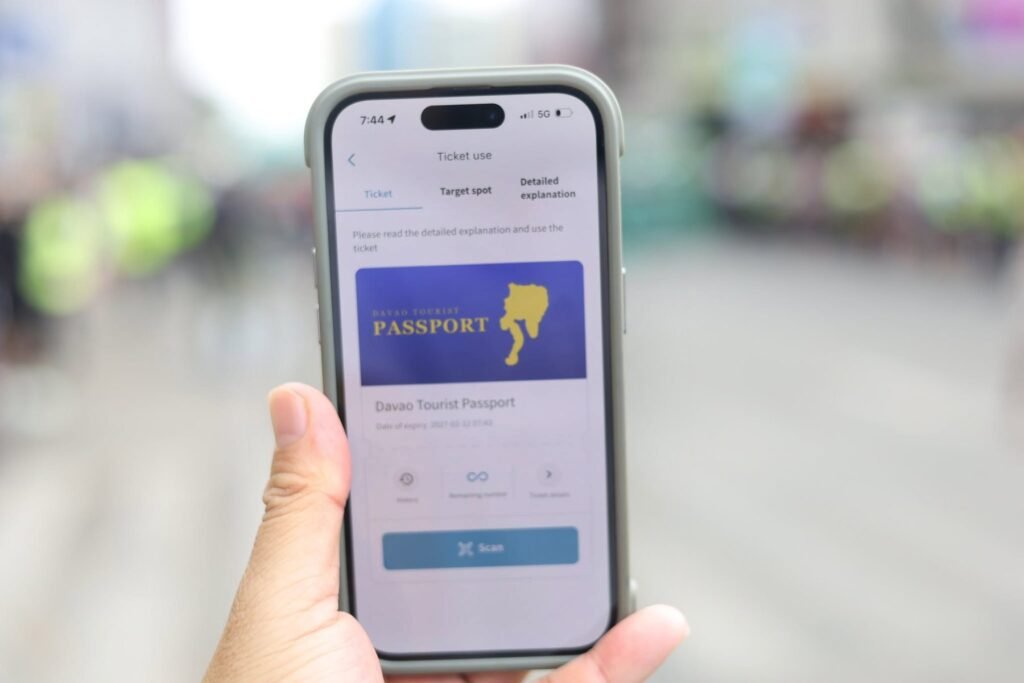
DAVAO CITY (September 1) — A Japan-backed project is turning Davao City’s tourism and transport activity into data that could shape future decisions on public transport, roads and flood management.
But for community residents, the key question is simple: Will the technology improve daily life for the people who live and work in the city?
The latest initiative is the Davao Digital Tourist Passport, a mobile platform supported by Japan’s Ministry of Land, Infrastructure, Transportation and Tourism (MLITT) through its Smart JAMP program.
The program helps cities in Southeast Asia use technology to address urban problems.
In Davao, earlier Smart JAMP studies examined traffic congestion and flooding—two problems that affect commuters, businesses and communities across the city.
MLITT Director for International Planning for the Construction Industry Chiaki Ohya said feasibility studies in 2022 and 2024 looked at possible tools for traffic and flood management.
These included an Automated Traffic Control System, an artificial intelligence-based system that monitors river water levels through existing closed-circuit television cameras, and Blitz GIS, a system designed to help manage stormwater and drainage in real time.
The newest project focuses on tourism, but its intended use goes beyond helping visitors find their way around Davao.
The Digital Tourist Passport will upgrade the city’s existing tourist passport into a Mobility as a Service, or MaaS, platform. It is expected to connect transport options such as taxis, transport network vehicle services and the High Priority Bus System, or HPBS.
The platform is being developed by Tokyo-based engineering startup Scheme Verge and Japanese consultancy Yachiyo Engineering, in cooperation with the Davao City Government, the City Tourism Operations Office and the Davao Tourism Association.
It will use Horai, a smart tourism and area-management platform developed by Scheme Verge.
The system is expected to collect information on where tourists go and how they travel. Planners could then use that information to identify transport needs and guide decisions on routes, service frequency, roads and buildings.
“Visualizing tourist movement can help analyze the necessary public transport routes and frequencies,” Ohya said. “The traffic data can also be used to determine better layouts for roads and buildings.”
That promise depends on how many people use the platform and how representative the data is.
If only tourists and smartphone users are counted, the picture of how Davao moves may be incomplete.
Workers, students, senior citizens, low-income commuters and residents without reliable internet access may not appear in the data in the same way. Yet these groups depend heavily on public transport and are among those most affected by traffic, poor connections and long waiting times.
Tourist movement can provide useful information, but it cannot replace data on the daily trips of residents.
The project also raises questions about privacy and accountability. Residents and visitors need clear information about what data will be collected, how it will be protected, who can access it and whether it will be shared with private companies or other agencies.
Yasuhiro Yamauchi of Yachiyo Engineering said the digital transformation of tourism is only a starting point, with further discussions expected after the study.
One possible use is to feed information from the tourist passport into planning for the HPBS, which is under construction.
That could help improve routes, connections and service frequency—if the data is combined with information from ordinary commuters and communities.
Davao’s growing tourism industry gives the platform a large potential user base.
The City Tourism Operations Office reported 1,045,854 tourist arrivals in the first half of 2026, an 11-percent increase from the same period last year and the highest level since the pandemic.
The Kadayawan Festival also drew about 120,000 people to the Indak-Indak and Pamulak events.
CTOO OIC Willenito Tormis said the city is preparing a wider tourism campaign for 2027, including sports, arts, culture, halal and community-based tourism.
For Japan, the Smart JAMP partnership offers a way to introduce Japanese technology and expertise to Davao.
For the city, however, a smart-city project should be judged by results—not by the amount of data it collects or the sophistication of its software.
Residents will want to know whether it leads to shorter commutes, more reliable public transport, better flood warnings, safer roads and services that reach communities beyond tourist areas.
The Digital Tourist Passport could become more than a tourism app if its data helps improve transportation for everyone.
But the city’s smart-city agenda will fall short if it tracks visitors more closely than it listens to the people who live in Davao every day.