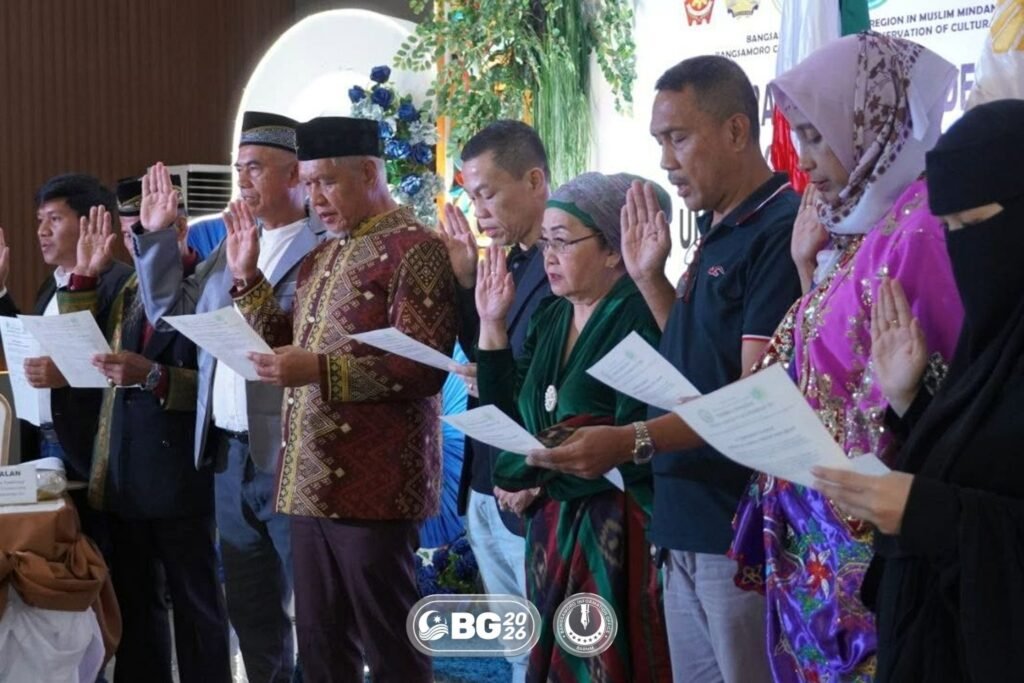
Traditional leaders’ sector from the Bangsamoro Autonomous Region in Muslim Mindanao (BARMM) pledge their commitment during the Traditional Leaders’ Covenant for Peaceful and Credible 1st BARMM Parliamentary Elections on July 16, 2026, in Cotabato City. (Comenei Ali/BIO)
DAVAO CITY (September 9) — In a region where political competition has often tested fragile relationships, Muslim, Christian and Indigenous faith leaders are choosing a different path ahead of the Bangsamoro parliamentary elections: dialogue over division and peace over violence.
Religious leaders and peacebuilders from different faith traditions gathered recently in Davao City for an interfaith dialogue aimed at strengthening calls for peaceful, credible, honest and inclusive elections in the Bangsamoro Autonomous Region in Muslim Mindanao (BARMM).
Hosted by Catholic Relief Services Philippines, the gathering underscored the role of faith communities not only in praying for peace but also in helping protect the gains of the Bangsamoro peace process as voters prepare to choose the region’s first parliamentary representatives.
The participants developed a joint interfaith statement and prayer for peaceful elections, turning their different religious traditions into a shared appeal for restraint, responsible citizenship and democratic participation.
The significance of the gathering lies in that common ground.
Muslim, Christian and Indigenous leaders—communities that have sometimes experienced conflict, displacement and political division—spoke with one voice on the need to keep violence out of the electoral process.
Their message was simple: the election should strengthen, rather than undermine, the peace that communities have worked for over the years.
Faith leaders as peacebuilders
The dialogue highlighted the influence of religious leaders at the community level, particularly in places where political loyalties can intersect with family, clan, ethnic and religious relationships.
Faith leaders can help calm tensions, discourage retaliation and misinformation, encourage voters to participate responsibly and remind communities that political differences do not have to become sources of violence.
Jonas Tetangco, country representative of CRS Philippines, emphasized that maintaining peace cannot be left to government or security forces alone.
“Peace is not someone else’s responsibility. It is a shared responsibility that belongs to all of us,” he said.
That responsibility becomes especially important as the region approaches its parliamentary elections, a critical step in the continuing transition of the Bangsamoro region.
The election is not simply about choosing candidates. It is part of the larger effort to build institutions capable of representing diverse communities within a political framework created through the Bangsamoro peace process.
Protecting the gains of peace
For the interfaith leaders, protecting the credibility of the elections is therefore inseparable from protecting peace.
A peaceful election requires more than the absence of armed clashes. It also demands respect for voters, rejection of intimidation and violence, acceptance of legitimate electoral results, and meaningful participation by communities that have historically been marginalized.
The joint statement and prayer reflected that broader understanding of peace.
By coming together across religious and cultural lines, the leaders demonstrated that faith communities can provide a common moral space at a time when political competition could easily deepen divisions.
Their message also carries a warning: democratic participation loses its meaning when fear determines how people vote.
A vote for the future
With election day set for Sept. 14, the interfaith gathering placed the approaching polls within a larger question facing the Bangsamoro: Can the region translate the gains of its peace process into a democratic political system that communities trust?
The answer will depend partly on the conduct of candidates, political parties and election authorities. But it will also depend on communities themselves—and on institutions such as churches, mosques, Indigenous spiritual communities and other faith-based organizations that have deep roots among voters.
The faith leaders’ appeal is ultimately a call to treat the election not as another contest that communities must survive, but as an opportunity to shape the future of the Bangsamoro peacefully.
As the campaign moves toward election day, their message remains deliberately uncomplicated: choose dialogue over division, participation over fear, and peace over violence.