DAVAO CITY (September 9) — The latest red alert over the Mindanao power grid is exposing a deeper supply problem: electricity demand is rising while dozens of generating units remain unavailable, leaving the grid with an increasingly thin buffer against another outage.
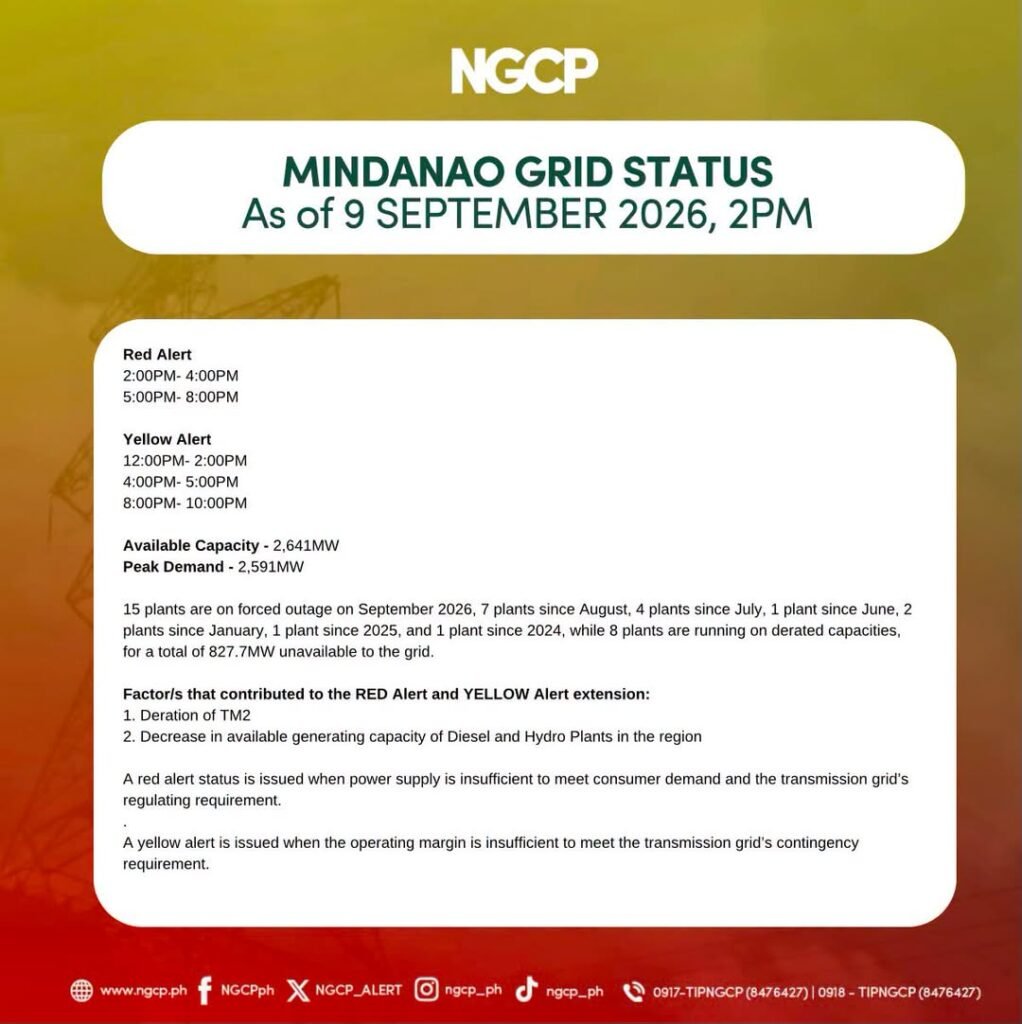
The National Grid Corporation of the Philippines (NGCP) placed the Mindanao grid under red alert Tuesday from 1 p.m. to 4 p.m. and 5 p.m. to 9 p.m. after Unit 2 of the 50-megawatt Minergy Coal plant in Misamis Oriental tripped.
But the loss of the generating unit was not the only pressure on the grid.
NGCP also cited higher projected demand, pushing the system closer to the limits of available supply.
Available capacity fell to about 2,673 megawatts (MW) from 2,805 MW earlier in the day, while peak demand was expected to reach 2,639 MW, up from 2,627 MW.
That left only a narrow margin between available supply and projected demand.
The figures point to a grid increasingly vulnerable to even a single significant generating-unit failure, particularly when a substantial portion of the generation fleet is already offline or operating below capacity.
Dozens of plants remain unavailable
NGCP said 10 power plants in Mindanao have become unavailable this month alone, while 14 others have been out of service since as far back as 2024.
That means the problem extends beyond Tuesday’s trip at Minergy Coal.
Five other plants are operating at derated capacities, resulting in an estimated 756.9 MW reduction in supply.
The cumulative effect is significant: the grid is being asked to meet growing demand with a generation fleet that is, in many cases, unavailable or unable to produce at full capacity.
The figures also raise questions about how quickly these unavailable plants can return to service and whether prolonged outages are becoming a structural constraint on Mindanao’s power supply.
For consumers, the issue is not merely whether the grid can meet demand on an ordinary day. The bigger concern is whether enough reserve remains when a major generating unit suddenly trips.
Red alert is a warning, not just a status
NGCP defines a red alert as a condition in which available capacity is insufficient to meet demand and the grid’s regulating requirement.
A yellow alert means the operating margin is insufficient to meet contingency requirements.
Mindanao’s yellow alert periods Tuesday were scheduled from 12 p.m. to 1 p.m., 4 p.m. to 5 p.m., and 9 p.m. to 10 p.m.
The sequence of yellow and red alerts shows how quickly the system can move from a relatively tight operating margin to an outright supply shortfall when demand increases or a generating unit goes offline.
And Tuesday’s problem was not confined to Mindanao.
Visayas faces the same squeeze
The Visayas grid was also placed under red alert, this time from 2 p.m. to 10 p.m., extending the earlier red alert period of 5 p.m. to 8 p.m.
Available capacity in the Visayas fell to 2,258 MW from 2,400 MW, while peak demand climbed to 2,589 MW from 2,507 MW.
The grid was under yellow alert from 1 p.m. to 2 p.m. and 10 p.m. to 11 p.m.
The simultaneous supply pressures in Mindanao and the Visayas point to a broader reliability challenge: when demand rises at the same time that generating units are unavailable, the margin protecting consumers from supply disruptions can disappear quickly.
For Mindanao, however, the more troubling numbers are buried behind Tuesday’s red alert — 24 generating units or plants unavailable, based on NGCP’s figures, with five more operating below capacity and reducing supply by nearly 757 MW.
The immediate trigger was one generating unit.
The bigger question is why so much generation capacity is already unavailable — and how long consumers can expect the system to operate with such a thin cushion.