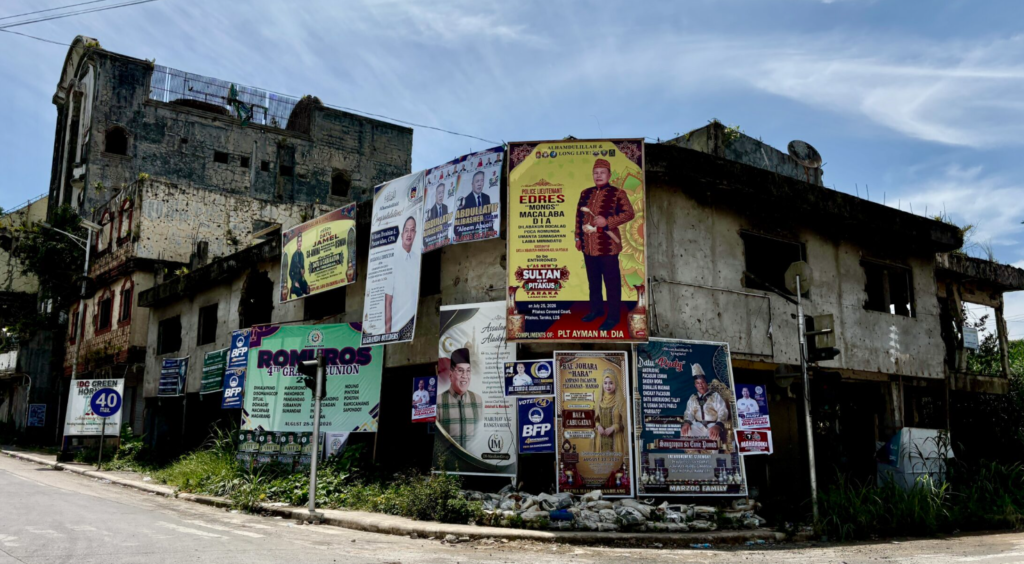
Photo: Election-related posters and other public notices appear along a city street weeks before BARMM’s first regular parliamentary election. Photo: MCJ
COTABATO CITY(September 14) — More than 2.39 million voters in the Bangsamoro Autonomous Region in Muslim Mindanao (BARMM) are voting Monday in the region’s first regularly constituted parliamentary election.
For the Bangsamoro people, it is a historic day.
But for communities that have lived through conflict, displacement, poverty, land insecurity and political exclusion, another question matters just as much:
What will change after the votes are counted?
The Sept. 14 election is a major step in the long Bangsamoro peace process and in the implementation of the 2014 Comprehensive Agreement on the Bangsamoro between the Philippine government and the Moro Islamic Liberation Front (MILF).
Yet peace, community leaders say, cannot be measured by ballots, election results or the number of seats won.
It must be felt in people’s homes and communities.
That was the central message of a public forum, “Peace at Last? Youth and Community Perspectives on the First BARMM Parliamentary Election and the Unfinished Bangsamoro Peace Process,” held on Sept. 1 to open Peace Month.
Organized by the Kinaiyahan Youth Organization, Mindanao Climate Justice Resource Facility, Inc. (MCJ), PANALIPOD People’s Coalition and the UP Law Center Institute of Human Rights, the forum brought together youth, Indigenous leaders, peace advocates and climate justice organizers.
Their message was simple: the election is a milestone, but it is not the end of the peace process.
Peace must be felt on the ground
Aisanie Ibrahim, chairperson of the Kinaiyahan Youth Organization–Marawi Chapter, said peace cannot be measured only through agreements and political institutions.
It must also mean displaced families being able to return home safely, Indigenous Peoples being able to defend their ancestral lands, young people having a voice in government, and marginalized communities gaining access to livelihoods, services and protection.
For communities, these are not abstract political goals.
They are everyday concerns.
BARMM was created in 2019 following the ratification of the Bangsamoro Organic Law, replacing the former Autonomous Region in Muslim Mindanao.
Since then, the region has been governed by the appointed Bangsamoro Transition Authority.
Monday’s election begins the shift to an elected parliamentary government.
Voters are choosing an 80-member Parliament—40 party representatives, 32 district representatives and eight sectoral representatives. The members will then elect the Chief Minister.
The new Parliament will have powers over regional laws, budgets, programs and public resources.
That gives voters a historic opportunity to demand more than familiar names and political promises.
It also creates a test: Can the new parliamentary system broaden political participation, or will old patterns of patronage, clan politics and personality-based politics simply continue under a new structure?
The peace process is not finished
Prof. Tirmizy Abdullah reminded participants that the parliamentary election is part of a much longer peace process.
“The BARMM parliamentary election is not just an ordinary election. It is part of a long peace process.”
Important commitments remain unfinished, including the decommissioning and reintegration of former combatants, disbandment of private armed groups, management of loose firearms and socioeconomic support for conflict-affected communities.
Transitional justice is also moving into a new phase.
On Jan. 28, 2026, the Bangsamoro government enacted Bangsamoro Autonomy Act No. 89, creating a Transitional Justice and Reconciliation Program and commission.
The incoming Parliament will have an important role in making these mechanisms work.
But responsibility does not rest with BARMM alone.
The Philippine government is also bound by the peace agreements and remains responsible for supporting normalization, rehabilitation, human rights and meaningful autonomy.
Marawi remains a test
Few places illustrate the gap between political transition and lived peace more clearly than Marawi.
When fighting erupted in May 2017, hundreds of thousands of people were forced from their homes.
The fighting ended after five months. Displacement did not.
In 2024, the Commission on Human Rights, citing United Nations humanitarian data, reported that about 16,070 families, or 80,300 people, were still internally displaced.
For Marawi residents, peace means more than the absence of armed conflict.
It means returning home safely and voluntarily.
It means compensation, secure housing and land tenure, restored livelihoods, functioning schools and services, and a genuine say in rehabilitation.
The experience of Marawi shows why the success of the Bangsamoro transition cannot be measured only from government buildings or parliamentary chambers.
It has to be measured in communities.
Young people are watching
Young voters are among the most important forces in Monday’s election.
Asmana Umpat, a Bangsamoro youth leader and student, cited COMELEC figures during the forum indicating that 60.8% of BARMM voters are young people, or more than one million voters.
Umpat urged young people to look beyond clan pressure, familiar names and personality politics.
They should examine candidates’ records, platforms and capacity to address community needs.
“We need to ask why communities in BARMM continue to face risks despite the progress of the peace process.”
That question is particularly important in an election increasingly shaped by social media.
Disinformation, unverified claims and personality-driven political content can make it difficult for voters to distinguish platforms from propaganda.
But young people cannot be expected to fix the political system alone.
Poverty, displacement, unequal access to education and information, patronage and limited access to decision-making all influence how young people participate.
The real test will be whether the new government gives young people meaningful roles in policymaking, budgeting, peacebuilding and monitoring public services—not just during elections, but between them.
Indigenous communities demand more than seats
The forum also put the spotlight on non-Moro Indigenous Peoples (NMIPs) living within BARMM.
Archie U. Buaya, an Indigenous leader and former senior commissioner of the Bangsamoro Human Rights Commission, stressed that Indigenous Peoples are not simply beneficiaries of the peace process.
They are partners in it.
“Ancestral land is more than property. It is deeply connected to the identity, history, and survival of Indigenous communities. Peace and development must not come at the expense of Indigenous rights.”
The risks are serious.
An independent peace monitor reported that at least 102 non-Moro Indigenous people had been killed in BARMM since 2019.
The cases do not all have the same causes, and the figure does not refer specifically to election-related violence.
But it points to continuing insecurity affecting Indigenous communities, including conflicts involving land, territory and political authority.
BARMM provides reserved representation for NMIPs.
But Indigenous leaders say representation must mean more than filling seats.
It must mean protecting ancestral domains, respecting Indigenous governance and ensuring that representatives remain accountable to the communities they serve.
Climate change is also a peace issue
For Nosaira A. Gasmala, a Meranaw climate justice advocate based in Marawi, conflict and climate change cannot be treated as separate problems.
Communities already dealing with displacement, poverty, land insecurity and weak public services are more vulnerable when floods, droughts, landslides and extreme weather destroy homes, crops and livelihoods.
During Severe Tropical Storm Paeng in 2022, about 470,000 people were reported displaced in BARMM, according to UNHCR.
Gasmala offered five tests for the incoming Parliament:
· protect communities before disasters strike;
· defend land, water, food systems and livelihoods;
· protect people displaced by conflict, disasters and development;
· ensure communities have a genuine voice in decisions; and
· address the poverty, land insecurity, weak services and environmental destruction that turn hazards into disasters.
For communities already facing conflict and displacement, climate resilience is not a separate environmental issue.
It is a peace issue.
Voters have questions. Government must have answers.
Edward Intang Abelardo, a Teduray Indigenous leader and community advocate from Upi, urged voters to look closely at what candidates and political parties are promising.
“As we face our first parliamentary election, we should ask: What is their platform? What is their vision for good governance? And how will they serve our communities?”
Those questions should not end when the polls close.
They should become the basis for holding elected officials accountable.
Election watchdogs are also watching.
The Legal Network for Truthful Elections (LENTE) said its observers would monitor electoral violence, vote-buying, abuse of state resources, disinformation and other threats to electoral integrity.
For BARMM, the stakes are especially high.
If the first parliamentary election is marred by violence, coercion or manipulation, public trust in the new institutions—and in the peace process itself—could suffer.
What should peace deliver?
For communities, the expectations are concrete.
The new Parliament will be expected to help:
· advance normalization and transitional justice;
· support the safe return, compensation, housing and livelihoods of displaced families;
· protect Indigenous ancestral domains;
· give young people, women and marginalized sectors a meaningful voice;
· improve public services and livelihoods; and
· build climate resilience while ensuring public funds are properly used.
But the Parliament cannot do all of this alone.
The Philippine government must also fulfill its commitments under the peace agreements, support rehabilitation and normalization, protect human rights and provide BARMM with the powers and resources necessary for meaningful autonomy.
The broader lesson from the forum is that peace cannot be declared simply because armed conflict has declined or elections have been held.
Peace has to be built—and felt—over time.
For a displaced family, it may mean finally going home.
For an Indigenous community, it may mean keeping its ancestral land.
For a young person, it may mean having a real voice in government.
For a farmer or fisher, it may mean having a livelihood that can survive conflict and climate disasters.
And for every voter, it should mean being able to demand answers from those who receive their mandate.
The first regularly constituted Bangsamoro Parliament will begin with a historic democratic mandate.
What it does with that mandate will determine whether the election becomes another political milestone—or a meaningful step toward lasting peace.
The ballot is not the finish line. It is where the harder work begins.