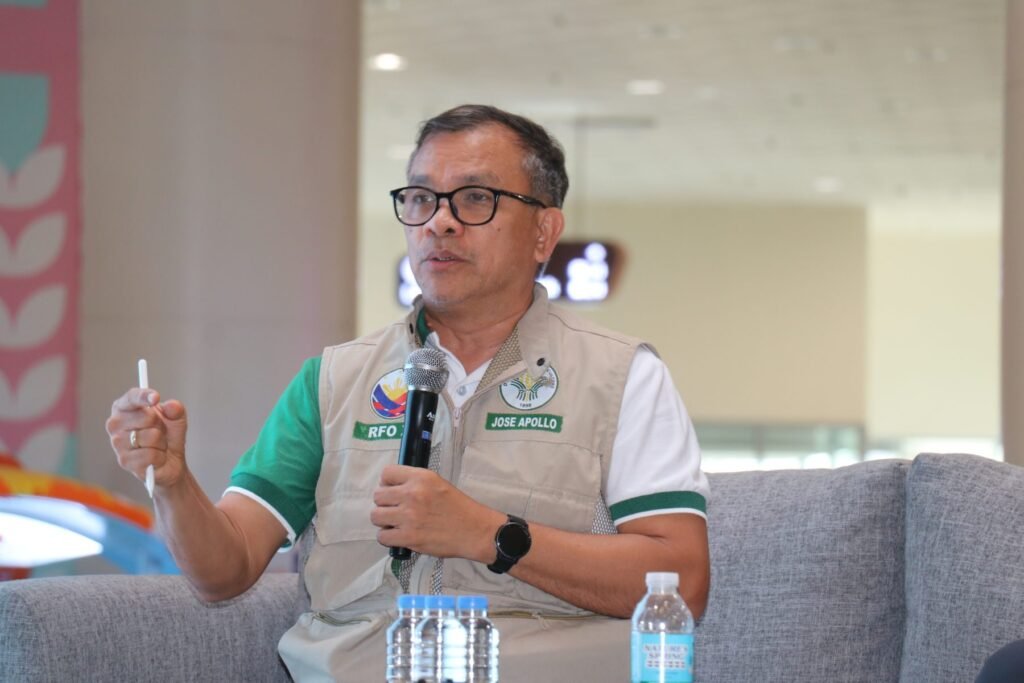
Department of Agriculture-10 Regional Executive Director Jose Apollo Y. Pacamalan calls for collaboration among government agencies, local government units, and farmers to strengthen climate resilience through diversified farming, watershed protection, and soil and water conservation during the Kapihan sa PIA in Cagayan de Oro City. (Photo: KPM/PIA-10)
CAGAYAN DE ORO CITY (July 24) — For farmers in Northern Mindanao, preparing for extreme weather now means more than waiting for the rain to stop or the floodwaters to recede.
The Department of Agriculture in Northern Mindanao (DA-10) is pushing farmers to prepare before disaster strikes — by diversifying crops, protecting soil and water, storing farm inputs in vulnerable areas and finding ways to preserve excess harvests.
The measures are part of the agency’s effort to strengthen the region’s food security amid the possible effects of El Niño and increasingly unpredictable weather patterns.
During the Kapihan sa PIA, DA-10 Regional Executive Director Jose Apollo Y. Pacamalan said the agency is working with the Philippine Atmospheric, Geophysical and Astronomical Services Administration (PAGASA) to turn weather forecasts into early action for farming communities.
Instead of waiting for disaster reports, DA-10 monitors weather advisories and prepares interventions based on forecasts, ground validation and drone mapping.
“Within 24 hours after a weather disturbance, we conduct ground-truthing and drone mapping to determine the exact number of affected hectares, identify the barangays and sitios involved, and verify the farmers who need assistance,” Pacamalan said.
The rapid assessment helps the agency identify who needs help and where assistance should be sent, speeding up recovery for farmers whose crops and livelihoods have been damaged by typhoons, floods or drought.
Prepare before the storm
DA-10 has been prepositioning seeds and fertilizers in areas expected to be affected by severe weather. Farm machinery is also deployed to help farmers prepare their fields once floodwaters subside.
The agency coordinates with the National Irrigation Administration to clear irrigation canals in flood-prone communities, helping ensure that farms can recover more quickly after flooding.
Pacamalan recalled that after a previous typhoon hit Bukidnon, DA-10 immediately deployed land-preparation equipment, allowing farmers to resume rice planting soon after the floodwaters receded.
For communities facing drought, the agency is encouraging farmers to plant crops that can better withstand changing weather conditions.
Planting materials for sweet potato and cassava have been prepositioned in municipalities surrounding Mt. Kitanglad, Mt. Balatukan and Mt. Kalatungan, where rainfall conditions remain suitable for farming.
But DA-10 says the bigger lesson is diversification.
“We encourage farmers not to rely on a single commodity,” Pacamalan said. “Diversifying crops reduces production risks and ensures that families still have food and income even during extreme weather conditions.”
For small farmers, the approach could mean the difference between losing an entire harvest and still having something to eat or sell when one crop fails.
Turning surplus into food security
DA-10 is also looking beyond the farm.
The agency is promoting food processing facilities that can turn surplus crops — including corn, squash, sweet potato and sayote — into flour and powder with longer shelf lives.
The idea is simple: instead of allowing excess produce to spoil when harvests are high, farmers can preserve it for later use.
Pacamalan said these processed products could also supplement food packs distributed by the Department of Social Welfare and Development and the Office of Civil Defense during disasters.
“We need a collective effort to prepare, store, and ensure food supply, especially for vulnerable communities during worst-case scenarios,” he said.
The strategy could help address two problems at once: postharvest losses during good harvests and food shortages during emergencies.
Farming with the climate in mind
DA-10 is also promoting longer-term solutions, including diversified farming, agroforestry, contour farming, and soil and water conservation.
The agency maintains demonstration farms in Claveria, Misamis Oriental, and in Lantapan and San Fernando, Bukidnon, where farmers can see how rice, corn, coffee, cacao, fruit trees and other crops can be integrated into farming systems designed to withstand climate stresses.
Such practices are particularly important in sloping areas, where heavy rains can quickly wash away fertile soil and damage farms.
DA-10 has also started incorporating heat index and relative humidity data, together with rainfall forecasts, into its agricultural planning to better anticipate the effects of prolonged heat on crops.
For farmers, the message from DA-10 is clear: climate resilience cannot be built only after a disaster.
It has to begin before the storm, before the drought and before the harvest is lost.
And it cannot be done by government alone.
“This is not something the government can prepare for alone,” Pacamalan said. “It requires the participation of local governments and farmers to adopt diversified farming, protect our watersheds, and implement soil and water conservation measures.”
For Northern Mindanao communities that depend on agriculture for food and income, the challenge is no longer simply how to recover from the next disaster.
It is how to make sure the next disaster does not wipe out everything they have built.