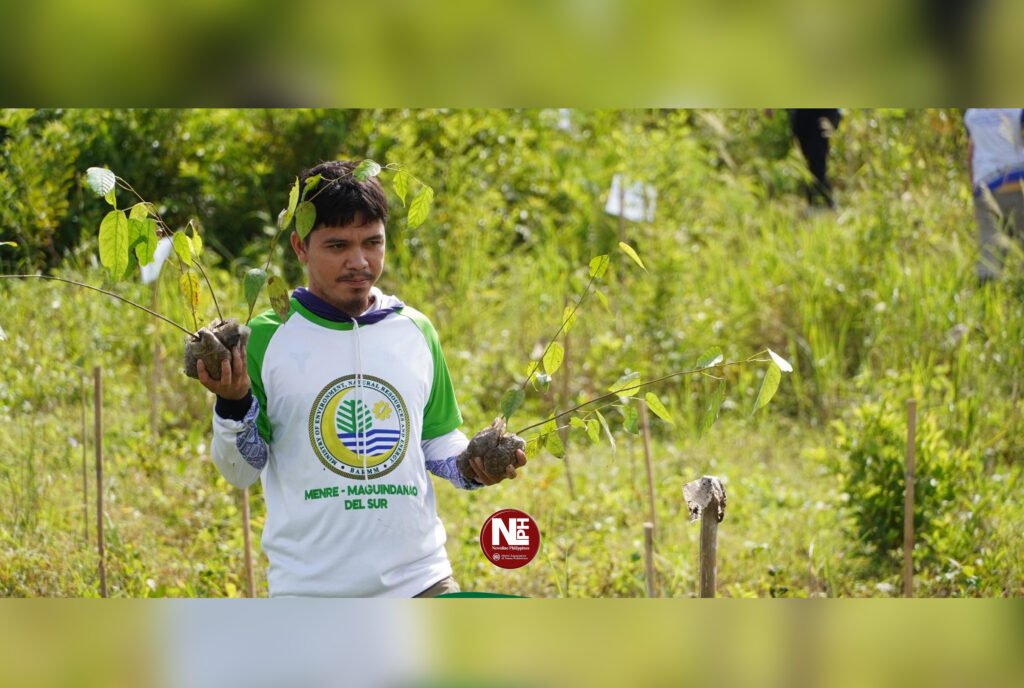
The Bangsamoro Government, through its Ministry of Environment, Natural Resources and Energy (MENRE), boosts environmental protection and mitigates climate change through tree-planting activities across the region. (Marhom Ibrahim/BIO)
COTABATO CITY(January 28) — The Bangsamoro Autonomous Region in Muslim Mindanao (BARMM) is investing ₱168 million to rehabilitate 2,600 hectares of degraded forestland — a move that aims to boost climate resilience, create jobs, and provide income opportunities for upland communities.
The tree‑planting initiative will be carried out by the Ministry of Environment, Natural Resources and Energy (MENRE) under the Integrated Bangsamoro Greening Program (IBGP) — BARMM’s regional counterpart to the national Expanded National Greening Program (ENGP) implemented by the Department of Environment and Natural Resources (DENR).
“MENRE will support the reforestation of 2,600 hectares of forestland through the ₱168‑million Integrated Bangsamoro Greening Program,” BARMM Interim Chief Minister Abdulraof Macacua announced on January 21 during the region’s foundation day kickoff in Cotabato City.
Targeted sites and community impact
MENRE said the program will prioritize degraded and critical forest areas in Maguindanao del Sur, Lanao del Sur, Basilan, Sulu, and Tawi‑Tawi, particularly around key watershed zones that are prone to soil erosion and flooding. The focus on these upland areas reflects the linkage between forest health and water security for both rural and lowland communities.
Based on ENGP implementation elsewhere, reforesting 2,600 hectares could involve planting millions of seedlings over the project cycle — a common scale in Philippine national greening efforts. National programs have historically planted tens of millions of seedlings annually across larger areas, generating employment for rural populations in seedling production, site preparation, planting, and maintenance.
“Through IBGP, we are investing in both environmental recovery and human resilience,” said MENRE Minister Akmad A. Brahim, emphasizing that local participation is crucial to long‑term forest protection.
Voices from the ground
For upland residents, reforestation offers both ecological and livelihood benefits. “Ang tanom dili lang para karon, para ni sa among mga anak. Naa na mi panginabuhian, naa pa gyud proteksyon ang among yuta,” said Abdulrahman Matalam, a community member involved in early planting activities in Maguindanao del Sur. (The trees are not just for today, but for our children. We earn a living while protecting our land.)
Aligning with national climate and development goals
The BARMM initiative dovetails with national climate and forest‑restoration goals. The ENGP seeks to rehabilitate millions of hectares of denuded forestland nationwide, helping mitigate climate change impacts, preserve biodiversity, and reduce poverty in upland areas — where past greening efforts have generated millions of jobs and over a billion seedlings since 2011.
Macacua said reforestation is central to BARMM’s development agenda, especially as communities face increased climate threats.
“We will create safe and sustainable living conditions through resilience programs that will strengthen our communities physically and environmentally,” he said.
MENRE added that the program also supports watershed protection and enhances food and water security, making it a cornerstone of BARMM’s broader sustainability and climate adaptation strategy.