
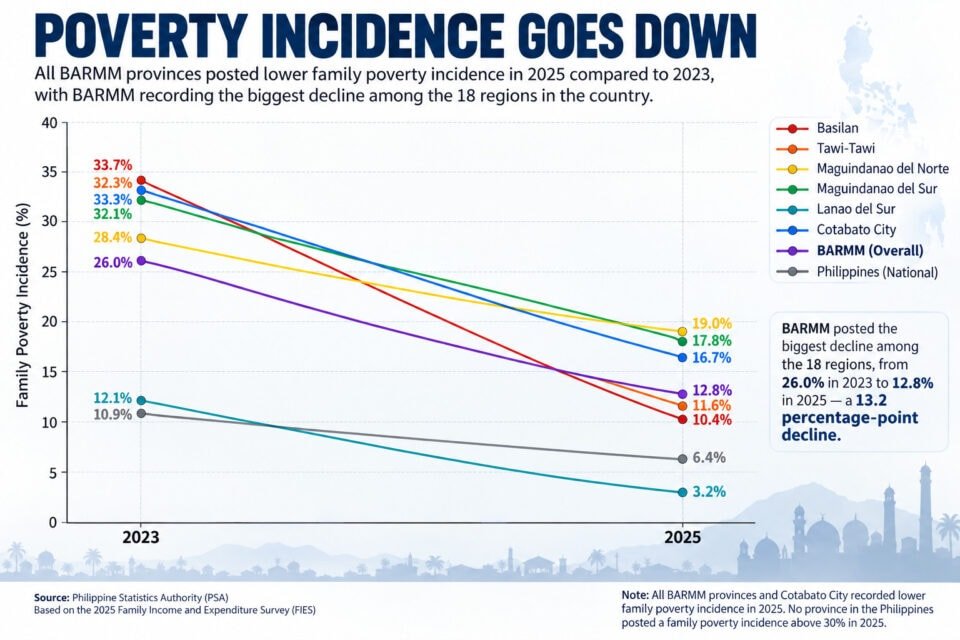
DAVAO CITY (September 6) — The family poverty incidence in BARMM dropped by almost three times, from 26 percent in 2023 to 12.8 percent in 2025, a 13.2 percentage-point decline.
This is larger than the 4.5 percentage-point decline recorded nationwide.
At the national level, the family poverty incidence decreased from 10.9 percent in 2023 to 6.4 percent in 2025.
Due to the significant decrease, BARMM, which had the second-highest family poverty incidence in 2023, is now tied with Eastern Visayas at the fourth-highest rate in 2025, both at 12.8 percent.
Poverty incidence decreased in all BARMM provinces.
All BARMM provinces, including Cotabato City, recorded a decrease in family poverty incidence in 2025.
One of the biggest improvements was recorded in Basilan, where poverty incidence dropped from 33.7 percent to 10.4 percent.
In Tawi-Tawi, it dropped from 32.3 percent to 11.6 percent.
The lowest in BARMM was recorded in Lanao del Sur, from 12.1 percent in 2023 to just 3.2 percent in 2025.
In Maguindanao del Norte, it dropped from 28.4 percent to 19 percent, while in Maguindanao del Sur it dropped from 32.1 percent to 17.8 percent.
Cotabato City also saw a significant drop, from 33.3 percent in 2023 to 16.7 percent in 2025.
According to the PSA, no province in the Philippines will have a family poverty incidence exceeding 30 percent in 2025.
Despite the significant improvement in poverty figures, BARMM still has the lowest average annual family income in the country.
The average annual family income in the region was only P246,050 in 2025, compared with the national average of P411,350.
The average annual family expenditure in BARMM was P202,170, also the lowest among all regions and lower than the national average of P321,850.
At the provincial level, Maguindanao del Sur recorded the lowest average annual family income in the country at P177,750.
It is also noteworthy that BARMM is the only region in which entrepreneurial activities are the primary source of family income, accounting for 43.8 percent of total family income.
In other regions of the country, wages and salaries remain the primary source of income for families.
According to the Bangsamoro Planning and Development Authority (BPDA), the new data is important in the development of future programs and policies of the Bangsamoro government.
The Ministry of Finance and Budget and Management (MFBM) also emphasized the importance of evidence-based budgeting to direct government resources to programs that will directly improve the socioeconomic conditions of the Bangsamoro people.
According to the MFBM, it is important to sustain momentum so that more families can benefit from the region’s development gains.
The PSA poverty estimates are based on income data from the 2025 Family Income and Expenditure Survey (FIES) and compared to the poverty thresholds set for each region./ezc


, the new data is important in the development of future programs and policies of the Bangsamoro government.)