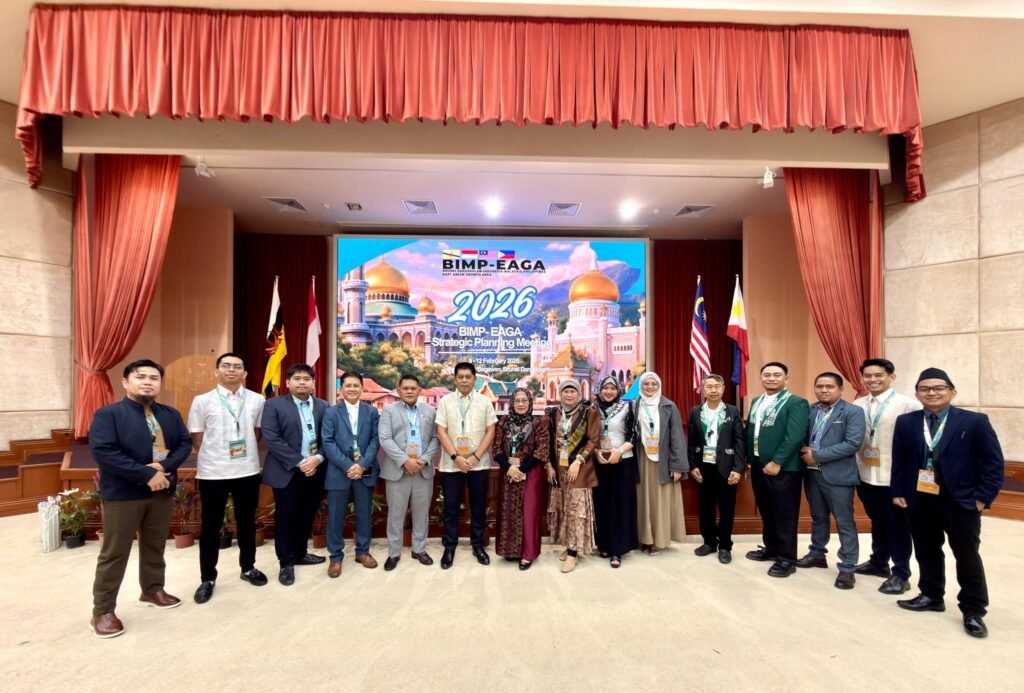
COTABATO CITY (February 16) — The Bangsamoro Autonomous Region in Muslim Mindanao (BARMM) stepped onto the regional stage this week, pitching new air and sea routes, halal agribusiness ventures, and digital connectivity upgrades at the 2026 Strategic Planning Meeting of the Brunei Darussalam-Indonesia-Malaysia-Philippines East ASEAN Growth Area (BIMP-EAGA) in Brunei.
Hosted by the Brunei government in Bandar Seri Begawan from Feb. 9 to 12, the five-day gathering drew around 300 government officials, development partners, and private sector leaders from across the four-nation corridor. The Mindanao Development Authority (MinDA) chaired the meeting and led the secretariat.
At the center of discussions: how to turn BIMP-EAGA Vision 2035 into tangible programs and investments that would speed up inclusive growth in border and island communities — long among Southeast Asia’s most underserved areas.
Connectivity through Tawi-Tawi
BARMM delegates, led by representatives from the Office of Interim Chief Minister Abdulraof Macacua, presented short- and medium-term priority projects focused on food security, transportation, and connectivity.
Among the proposals: opening new air and sea routes linking BARMM — particularly via Tawi-Tawi — to Brunei’s airports and to ports in Lahad Datu, Malaysia. Officials said the move could strengthen trade flows and people-to-people exchanges within the growth area.
The delegation also pushed for joint halal poultry development projects connecting Bangsamoro producers with counterparts in Brunei, Malaysia, and Indonesia — an effort aimed at building cross-border halal value chains in a region with deep Islamic cultural ties.
Digital and human capital push
Beyond trade and transport, BARMM underscored the need for digital transformation. Delegates proposed expanded satellite broadband and 5G connectivity linking higher education institutions across BIMP-EAGA, alongside investments in human capital development.
Regional researchers and economic advocates said stronger linkages between Bangsamoro communities and neighboring Muslim-majority areas could be built not only on commerce, but on shared historical and cultural roots.
“Interim Chief Minister Macacua should assert the gainful participation of the Bangsamoro region in related BIMP-EAGA strides this time,” one academic researcher noted, reflecting growing calls for BARMM to maximize its role in regional cooperation.
A vision decades in the making
BIMP-EAGA was formed in 1994 under the initiative of former Philippine president Fidel V. Ramos to accelerate development in lagging but resource-rich border areas of Brunei, Indonesia, Malaysia, and the Philippines. For Mindanao and the Bangsamoro region — long affected by conflict and underinvestment — the corridor was envisioned as a bridge to shared prosperity.
More than three decades later, BARMM’s participation in the 2026 planning meet signals a renewed push to anchor peace gains in economic opportunity — and to ensure that the Bangsamoro region is not just a participant, but a driver, in shaping growth across Southeast Asia’s maritime frontier.