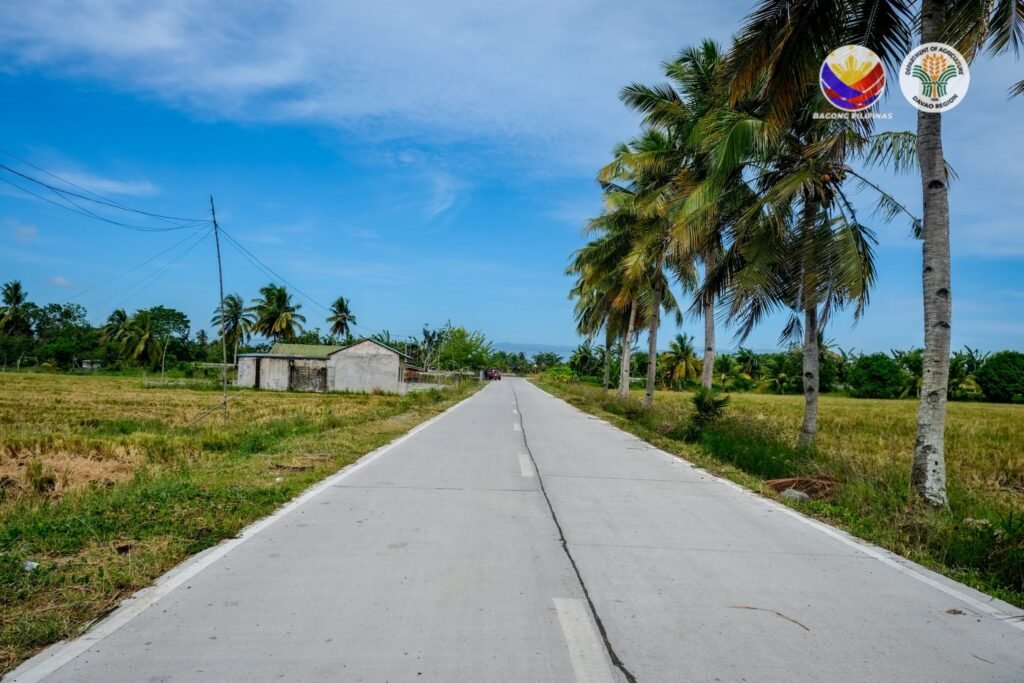
DAVAO CITY (March 29) — A newly completed PHP14.96-million farm-to-market road (FMR) in Kiblawan, Davao del Sur is expected to ease long-standing transport challenges for farmers, but its limited scope underscores broader gaps in rural infrastructure across the region.
The one-kilometer concrete road in Barangay Balasiao was formally turned over on March 26 under the Department of Agriculture’s Farm-to-Market Road Development Program.
For local farmers, the project promises immediate relief.
Easier access to markets could mean lower transport costs, reduced post-harvest losses, and better farmgate prices for key crops such as sugarcane, banana, coconut, corn, and rice—commodities that form the backbone of the town’s agricultural economy.
Barangay chairperson Jessi Pandian said the road would especially benefit residents in remote areas like Purok 1, where difficult terrain has long slowed the movement of goods.
“We assure the government that we will take responsibility for maintaining the road,” Pandian said, signaling community buy-in—often a weak point in rural infrastructure projects.
The Department of Agriculture in Davao Region (DA-11) estimates the road will directly serve 85 farmers and fisherfolk, along with 150 households, agrarian reform beneficiaries, and members of indigenous communities.
But while the benefits are clear at the village level, questions linger about impact at scale.
A one-kilometer road, though critical for an isolated barangay, highlights the piecemeal nature of farm-to-market infrastructure in many agricultural areas, where connectivity gaps remain a major barrier to competitiveness.
Regional Director Macario Gonzaga said additional FMR projects worth PHP195 million are lined up across Davao del Sur, covering the municipalities of Hagonoy, Sulop, Malalag, and Matanao in partnership with the Department of Public Works and Highways.
These projects aim to cut logistics costs and improve productivity—but their success will depend on sustained funding, proper maintenance, and integration with broader supply chain systems.
Beyond physical access, farmers continue to face structural challenges, including fluctuating market prices, limited storage facilities, and vulnerability to climate-related disruptions.
Still, for Barangay Balasiao, the new road marks a tangible step forward.
Whether it becomes a model of rural transformation—or just another isolated improvement—will depend on how effectively similar projects are expanded and sustained across the region.