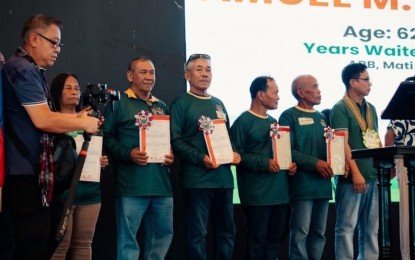
Agrarian Reform Beneficiaries in the Davao Region show their land titles during a turnover ceremony at the DAR Stakeholders’ Forum in Tagum City, Davao del Norte, on June 3, 2026. The Department of Agrarian Reform condoned PHP509.6 million in unpaid land debts for over 8,500 farmers under the New Agrarian Emancipation Act. (Photo from DAR-11)
DAVAO CITY (June 5) — After years—and for some, decades—of carrying the weight of land debts, thousands of farmers across the Davao Region are finally getting a fresh start.
The Department of Agrarian Reform (DAR) has erased PHP509.6 million in unpaid land amortizations, interests, and surcharges under the New Agrarian Emancipation Act, freeing more than 8,500 agrarian reform beneficiaries (ARBs) from financial obligations tied to lands they received through the government’s agrarian reform program.
For farmers like 65-year-old Eduardo Gomez of Davao del Norte, the debt condonation is life-changing.
“The debt condonation has lifted a heavy burden from my family and given us a fresh opportunity to rebuild our livelihood,” Gomez said after learning that his PHP92,641 obligation had been wiped out.
The debt relief package, announced during a stakeholders’ forum in Tagum City, covered farmers in Davao del Norte, Davao de Oro, and Davao Oriental. Beneficiaries also received Certificates of Condonation with Release of Mortgage, electronic land titles, and farm machinery worth PHP4.1 million.
But beyond the figures lies a deeper story about the unfinished promise of agrarian reform.
For years, many beneficiaries struggled to meet amortization payments as farmgate prices stagnated, production costs rose, and climate-related disasters repeatedly damaged crops. While farmers technically owned the land, many remained trapped by debts that steadily accumulated through interests and penalties.
The government’s latest intervention seeks to break that cycle.
“A total of 5,473 CoCRoMs covering over 22,000 hectares completely freed 8,548 ARBs from historical land debts so they can reinvest in their farms,” DAR-11 Regional Director Joseph Orilla said.
The program also delivered 132 electronic land titles generated from collective land awards, securing ownership rights for thousands of beneficiaries.
For 62-year-old farmer Nolie Biol, receiving his individual title after 32 years was as significant as the debt relief itself.
“This document is more than a piece of paper. It symbolizes our future and our hard work as farmers,” he said.
Yet the debt write-off also raises a critical question: What happens after emancipation?
Agrarian reform advocates have long argued that land ownership alone does not guarantee economic security. Farmers continue to grapple with expensive farm inputs, inadequate irrigation, weak market access, and limited post-harvest facilities—constraints that often keep rural families poor despite owning land.
The turnover of tractors, a combine harvester, and transport equipment signals an effort to address some of those gaps. Still, experts note that sustained support, not one-time assistance, will determine whether beneficiaries can turn debt relief into lasting gains.
DAR Undersecretary Amihilda Sangcopan acknowledged the need for continued engagement with farming communities.
“We are ready to serve, listen, and deliver services that will truly help our farmers,” she said.
For now, the government’s half-billion-peso debt condonation has given thousands of farmers something many thought impossible: a clean slate.
Whether that fresh start leads to greater productivity and rural prosperity—or becomes another missed opportunity in the country’s long agrarian reform journey—will depend on what comes next.