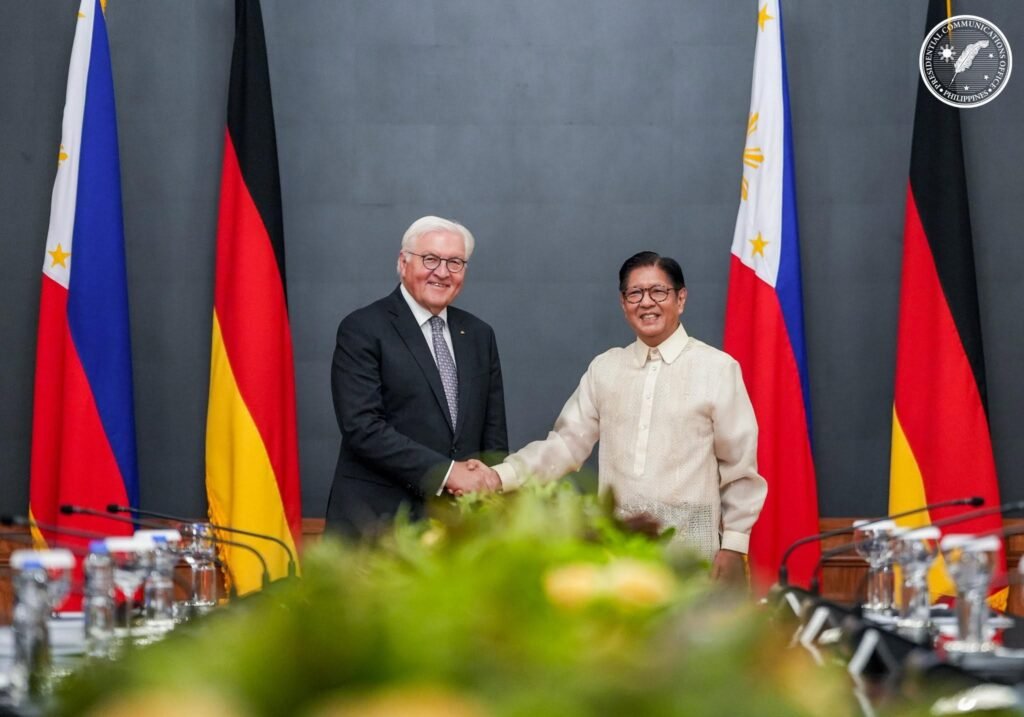
MANILA (June 17) — President Ferdinand Marcos Jr.’s openness to a future Visiting Forces Agreement (VFA) with Germany signals a significant shift in Philippine foreign and defense policy: the country’s effort to build a broader network of security partners amid growing tensions in the Indo-Pacific region.
Speaking after bilateral talks with German President Frank-Walter Steinmeier on June 16, Marcos said the Philippines is willing to explore the possibility of a military agreement with Germany, although discussions remain at an early stage.
“Why not?” Marcos told reporters when asked about the prospect of a VFA with Berlin.
While no formal negotiations are underway, the statement reflects Manila’s continuing strategy of expanding defense cooperation beyond its traditional alliance with the United States.
Building a Wider Security Network
The Philippines has accelerated defense partnerships in recent years as confrontations in the West Philippine Sea continue and geopolitical tensions intensify across Asia.
Under the Marcos administration, Manila has either renewed or established visiting forces agreements with several countries, including the United States, Australia, Japan, New Zealand, Canada, and France.
If realized, Germany would become another important European security partner for the Philippines.
For Manila, the logic is increasingly clear: strengthening relationships with multiple countries creates a broader support network in an era when security challenges extend beyond conventional military threats.
These concerns include maritime disputes, cyberattacks, supply chain disruptions, climate-related disasters, and humanitarian emergencies.
Marcos emphasized that no single nation can address today’s global challenges alone.
“The best path to stability is to have partnerships and a wide base of alliances,” he said.
Why Germany Matters
Unlike the United States, Germany is not a traditional military actor in Southeast Asia. However, Berlin has become increasingly involved in Indo-Pacific security issues over the past decade.
Germany’s growing interest reflects Europe’s concern that instability in Asian sea lanes could affect global trade, energy supplies, and economic growth.
The Philippines and Germany already maintain expanding cooperation in defense, trade, and development assistance.
In May 2025, Defense Secretary Gilberto “Gibo” Teodoro Jr. and German Defense Minister Boris Pistorius signed a defense cooperation agreement covering cybersecurity, logistics, defense technology, and peacekeeping operations.
Germany is also one of the Philippines’ important economic partners, with bilateral trade exceeding $5 billion and dozens of German companies operating in the country.
Thousands of Filipinos, particularly nurses and healthcare workers, are employed in Germany, further strengthening people-to-people ties.
Strategic Opportunity or Growing Risk?
Supporters of expanding defense partnerships argue that diversified alliances enhance the Philippines’ ability to protect its territory and national interests.
A broader network of partners can provide access to military training, technology, disaster-response capabilities, and diplomatic support during regional crises.
However, critics caution that increasing military agreements may also draw the Philippines deeper into geopolitical rivalries among major powers.
China has repeatedly criticized Manila’s growing defense cooperation with Western countries, viewing such arrangements as part of a broader effort to contain Beijing’s influence.
Analysts note that every new defense partnership must balance deterrence with diplomacy, ensuring that security cooperation does not undermine opportunities for peaceful dialogue in the region.
The challenge for the Philippines is to strengthen its defenses without becoming overly dependent on any single bloc or appearing to choose sides in global power competitions.
What It Means for Ordinary Filipinos
For many Filipinos, discussions about visiting forces agreements may seem distant from everyday concerns. Yet their effects can be felt in several ways.
Stronger defense partnerships can improve disaster response capabilities, maritime security, and protection of fishing grounds that support coastal communities.
Defense cooperation can also bring investments in technology, infrastructure, and training that contribute to national development.
At the same time, public scrutiny remains essential. Questions about national sovereignty, environmental impacts of military activities, accountability of foreign troops, and transparency in defense agreements continue to be important concerns for civil society groups.
As the Philippines broadens its international partnerships, citizens will likely demand assurances that security agreements serve national interests while protecting democratic oversight and constitutional safeguards.
A New Foreign Policy Era
President Steinmeier’s state visit—the first by a German head of state to the Philippines in more than six decades—underscores the growing importance both countries place on their relationship.
Whether a Philippines-Germany VFA eventually materializes remains uncertain.
What is clear is that Manila is pursuing a foreign policy that seeks security through diversification rather than dependence on a single ally.
As regional tensions reshape international relations, the Philippines appears determined to position itself within a wider network of partners stretching across Asia, North America, and Europe.
The success of that strategy will ultimately depend not only on the number of agreements signed, but on whether those partnerships contribute to peace, stability, and the welfare of the Filipino people.