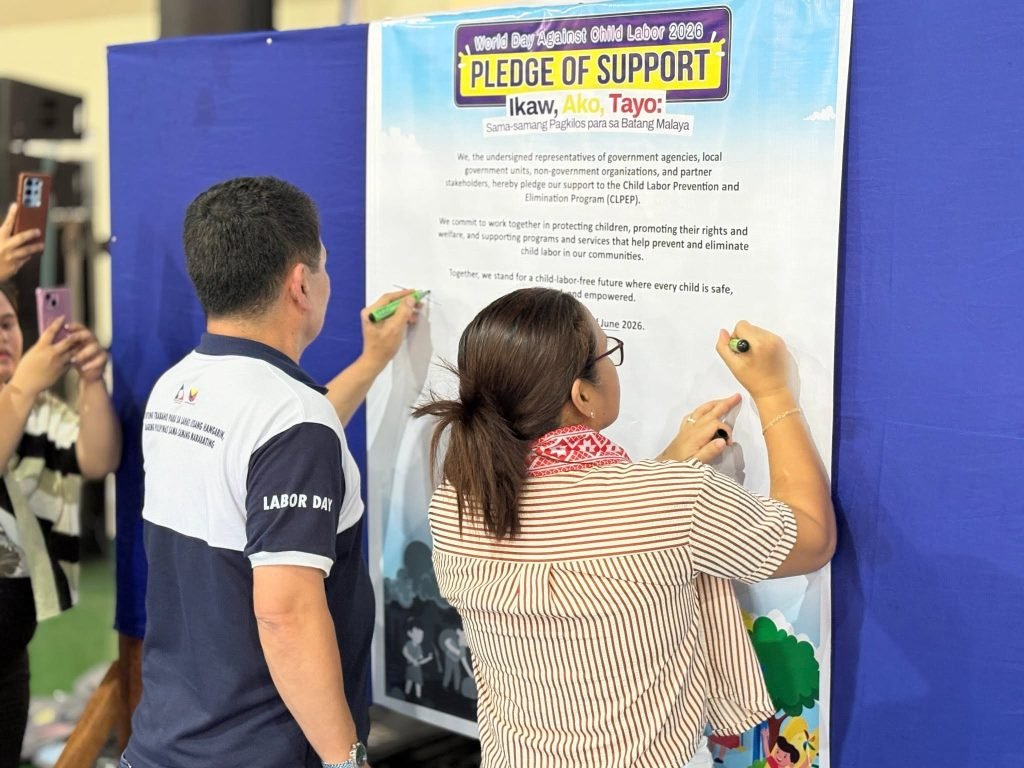
ZAMBOANGA CITY (June 17) — When the municipality of Ramon Magsaysay in Zamboanga del Sur was recently declared child labor-free by the Department of Labor and Employment (DOLE), local officials hailed the recognition as a milestone in protecting children’s rights and promoting family welfare.
The declaration, announced during the observance of World Day Against Child Labor 2026, marked the culmination of years of intervention involving government agencies, schools, communities, and families. Yet beyond the celebration lies a more important question: Can the municipality sustain its gains and prevent children from returning to work?
DOLE’s validation showed that 424 identified child laborers from the municipality’s 27 barangays were profiled and provided with interventions ranging from educational support to livelihood assistance for their families.
Among them, 112 children participated in programs such as Project Angel Tree, Career Fair Play, and career guidance initiatives. Government records indicate that these children have since returned to school.
For child rights advocates, however, school re-enrollment is only the first step.
Many children enter labor not because they choose to work, but because poverty leaves families with few alternatives. Unless household incomes improve and social support remains available, the risk of children returning to labor remains a persistent concern.
Recognizing this challenge, the government provided livelihood starter kits to 91 parents of former child laborers. The assistance is intended to help families establish small businesses and generate income that can replace earnings previously contributed by working children.
Beneficiary Mary Grace Permejo said the livelihood package offers hope for a more stable future.
Another beneficiary, Marilyn Tapia, described the assistance as a significant boost to their family’s daily income.
But livelihood support alone does not guarantee long-term success. Across many communities in the Philippines, livelihood projects have struggled due to limited market access, insufficient capital, weak monitoring, and lack of technical support.
This is why local officials say sustained monitoring will be critical.
Mayor Margie Machon emphasized that the local government will continue overseeing the livelihood projects to help ensure that families achieve stable and sustainable income.
Child protection experts note that a child labor-free declaration should not be viewed as an endpoint but as a continuing commitment. Economic shocks, crop failures, health emergencies, and natural disasters can quickly push vulnerable families back into crisis, increasing the likelihood that children may once again be forced into work.
The challenge is particularly relevant in rural communities where agriculture remains a primary source of income and where children often contribute labor in farms, fishing activities, and informal family enterprises.
For Ramon Magsaysay, the declaration represents more than a government recognition. It is a test of whether coordinated investments in education, livelihood, and social protection can break the cycle of child labor for good.
If sustained, the municipality’s experience could provide a model for other local governments across Mindanao seeking to protect children while addressing the poverty that often drives them into labor.
The true measure of success, however, will not be the declaration itself but whether the children who returned to school today remain there years from now, equipped with the opportunities needed to build better futures for themselves and their communities.