DAVAO CITY (June 17) — While government agencies remain focused on relief and recovery efforts following the powerful June 8 earthquake in southeastern Mindanao, an ongoing livelihood program for hundreds of fishery workers in Davao Occidental is moving forward as planned.
The Integrated Livelihood Program (ILP), which supports 572 workers affected by the annual closed fishing season in the Davao Gulf, continues to provide temporary employment, training, and livelihood assistance during the three-month fishing ban from June 1 to August 31.
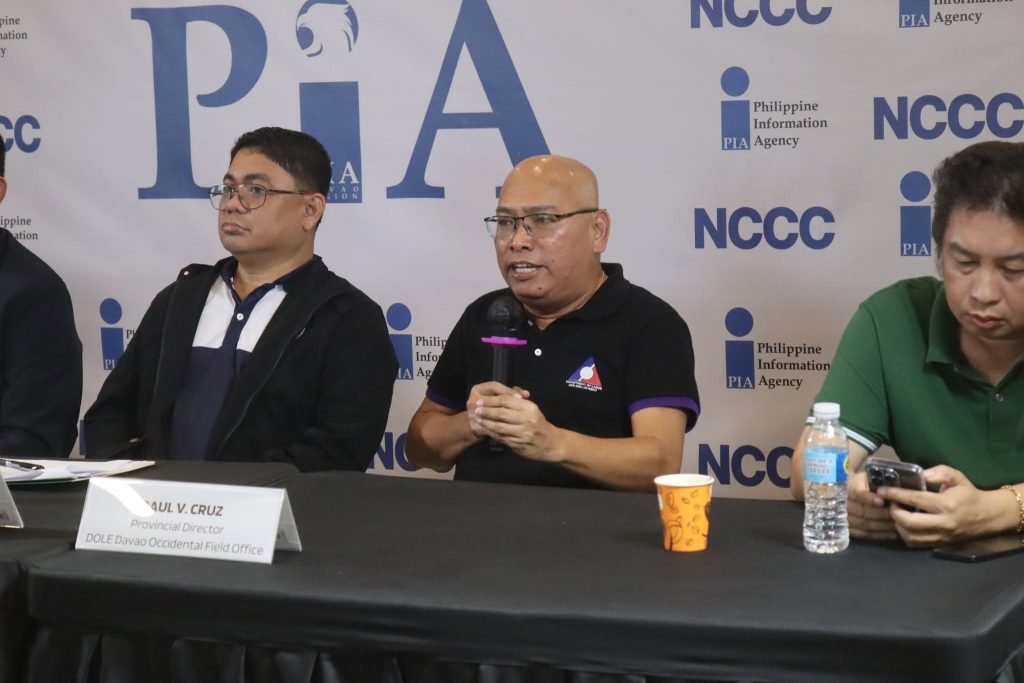
According to Paul V. Cruz, provincial director of the Department of Labor and Employment (DOLE) Davao Occidental Provincial Office, program activities have remained on schedule despite the region’s ongoing disaster response.
“We have already completed the orientation. Beneficiaries are now engaged in community work and have started their training activities,” Cruz said.
The initial training focuses on safety at sea, with additional skills training to be conducted in partnership with the Technical Education and Skills Development Authority (TESDA).
Under the program, beneficiaries will first complete a 15-day work engagement, after which they will receive emergency employment wages from DOLE. The Department of Social Welfare and Development (DSWD) will then provide further assistance.
The ILP adopts an inter-agency approach aimed at helping fishing communities cope with income losses during the annual fishing closure, which is enforced by the Bureau of Fisheries and Aquatic Resources (BFAR) to protect fish stocks and support marine conservation efforts in the Davao Gulf.
Of the 572 beneficiaries in Davao Occidental, 451 are sea-based workers while 121 are land-based workers involved in the fishing industry.
Cruz emphasized that the program is designed as a comprehensive package of support rather than a one-time intervention.
“This is not a piecemeal approach. The program provides continuous livelihood services throughout the closed fishing season,” he said.
Government agencies are also exploring the possibility of expanding the initiative to cover other provinces across the Davao Region.
Despite the strong earthquake that struck Mindanao, Cruz reported that none of the program’s beneficiaries were directly affected.
“The fishing communities are mostly located along the coast, while the areas hardest hit by the earthquake are in the mountainous parts of the region,” he explained.
DOLE Supports Earthquake Relief Operations
Alongside the livelihood program, DOLE is actively participating in disaster response efforts following the magnitude 7.8 earthquake.
The agency initially launched a clean water campaign to assist affected communities. It is also preparing emergency employment opportunities related to the construction of temporary shelters and the packing and distribution of relief goods.
“We are looking at providing emergency employment for those helping install temporary shelters and for volunteers involved in relief packing operations,” Cruz said.
The initiative is expected to provide additional income opportunities for residents while helping communities recover from one of the strongest earthquakes to hit Mindanao in recent years.
As both the fishing ban and earthquake recovery efforts continue, government agencies are working to ensure that vulnerable workers and affected families receive the support they need to sustain their livelihoods and rebuild their communities.