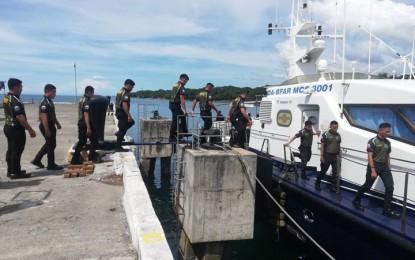
ZAMBOANGA CITY – The Bureau of Fisheries and Aquatic Resources -Zamboanga Peninsula (BFAR-9) positioned Thursday two monitoring, control, and surveillance (MCS) vessels to implement the three-month closed season for the conservation of sardines in Sibuguey Bay, Basilan Strait, and East Sulu Sea.
Deployed during a ceremony at the Ensign Majini pier of the Naval Station Romulo Espaldon here were MCS-3006 and MCS-3001, manned by personnel of the Philippine Coast Guard and BFAR’s Fishery Protection Regulatory Group.
The annual closed fishing season, which took effect Thursday and ends on March 1 next year, aligns with BFAR Administrative Circular No. 255, otherwise known as the Establishing of Closed Season for the Conservation of Sardines within the three areas.
Al-Zath Kunting, BFAR-9 acting director, said the closed fishing season is a conservation measure to protect valuable fish species during their spawning period by allowing juveniles to mature and replenish.
“Data shows that the closed fishing season has been effective not only in conserving sardines but also in enriching the waters of Zamboanga Peninsula, Basilan Strait, and East of Sulu Sea,” Kunting said.
He said monitoring of landed catch, composed mostly of sardine species Sardinella lemuru, locally known as tamban, in at least 33 landing sites in the Zamboanga Peninsula showed a continuous 10.7 percent annual growth from 2016 to 2020.
Kunting noted that the highest increase was observed in 2020 when fish catch recorded a growth of 28 percent resulting in a total volume of 357,804.41 metric tons.
Of the total 1,398,342 metric tons landed catch in the Zamboanga Peninsula recorded by DA-BFAR’s National Stock Assessment Program (NSAP) during the five years, 989,029 metric tons or 70.7 percent is Sardinella lemuru.
NSAP data validates that the sardine species dominant in the Zamboanga Peninsula is Sardinella lemuru at 97.8 percent.
Other sardines species consisted of Amblygaster sirm, Sardinella gibossa, Dissumeria acuta, Sardinella fimbriata, Herklotsichthys quardimaculatus, Sardinella albella and Escualosa albella.
Sardines make up around 15 percent of the total fish catch in the country and are one of the most accessible protein sources for Filipinos.
A large portion of the production comes from the East Sulu Sea