CAGAYAN DE ORO CITY (September 16) — Electricity consumers will no longer pay value-added tax (VAT) on the allowable system loss charge under a new Bureau of Internal Revenue (BIR) ruling aimed at trimming a portion of the tax burden in power bills.
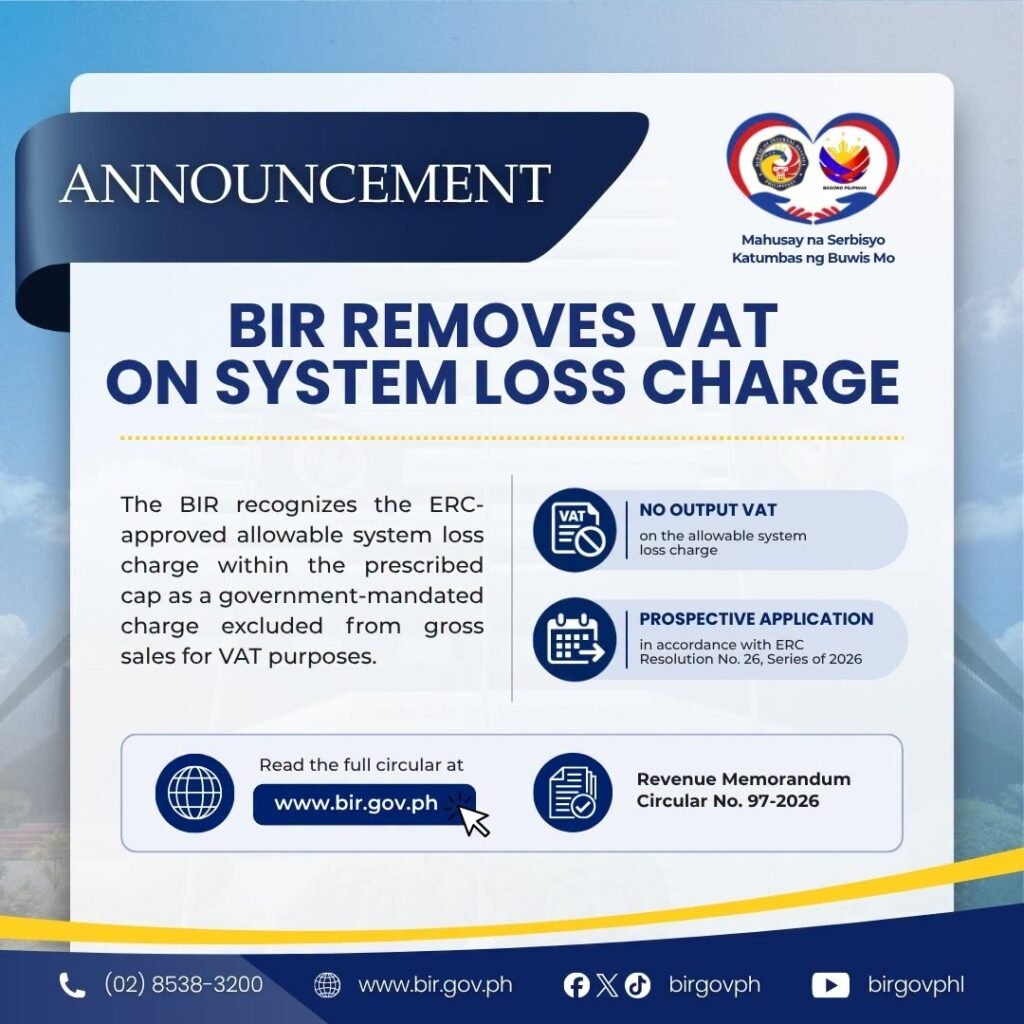
The BIR, through Revenue Memorandum Circular No. 97-2026 issued Monday, classified the allowable system loss charge within the cap set by the Energy Regulatory Commission (ERC) as a government-mandated pass-through cost excluded from gross sales for VAT purposes.
The change means electricity providers will no longer impose output VAT on the allowable system loss component of covered billings.
“This may be one part of a broader effort to bring down electricity costs, but it is relief that can be implemented under existing law,” BIR Commissioner Charlito Martin Mendoza said.
“While Congress continues to consider wider reforms on electricity charges and taxes, the BIR is acting on the measures within its authority that can reduce the burden on consumers,” he added.
Not a VAT exemption on the whole bill
The BIR stressed that consumers should not interpret the ruling as the removal of VAT from their entire electricity bill.
The relief applies only to the allowable system loss charge, which must be separately identified in the billing statement, invoice or similar document and must comply with ERC rules.
The ERC approved a resolution on Aug. 26 declaring that the allowable system loss charge does not form part of the gross sales of generation companies, the National Grid Corporation of the Philippines (NGCP) and distribution utilities for VAT purposes.
Distribution utilities are expected to modify their billing formats to separately identify the system loss charge as a government-mandated line item not subject to VAT.
What is system loss?
System loss refers to electricity that has already been generated and paid for but is lost before reaching consumers through the power distribution network.
Some losses are technical, occurring through conductors, transformers and other equipment. Others are nontechnical, including electricity pilferage, illegal connections and meter tampering.
But consumers are not automatically liable for all electricity lost by a distribution utility.
Under ERC rules, only system losses within the regulator’s prescribed limits may be recovered through the system loss charge. Losses beyond those approved caps must be absorbed by the distribution utility.
The distinction is important because the new BIR treatment applies only to the allowable portion.
How much will consumers save?
The actual reduction in an individual electricity bill will depend on the amount of the allowable system loss charge included in the billing.
Because the ruling covers only that component, the overall effect on monthly electricity bills is expected to be smaller than if VAT had been removed from the entire power charge.
The BIR said the exclusion will apply prospectively based on the effectivity of ERC Resolution No. 26, Series of 2026.
It also clarified that the new treatment applies only to VAT. It does not remove the system loss charge from income-tax or creditable-withholding-tax computations.
“Once the new rules become effective, VAT will no longer be imposed on the allowable system loss portion of the electricity bill,” Mendoza said.
“That means a lower amount will be passed on to consumers on covered billings and transactions,” he added.
For consumers, the immediate question now is not simply whether the VAT has been removed on paper, but when the lower charge will appear on their bills and how much they will actually save.
The separate identification of the system loss charge in electricity bills will allow consumers to see the portion affected by the new tax treatment.