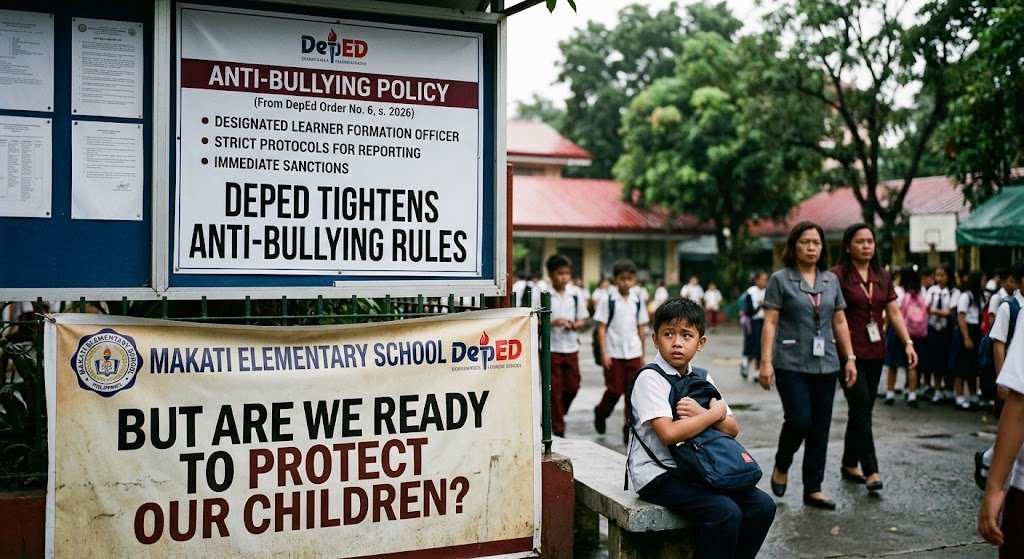
MANILA (September 16) — A child who reports bullying should not have to wonder whether speaking up will make things worse.
That is the real test facing schools as the Department of Education (DepEd) implements stricter rules for preventing and responding to bullying: not simply whether schools can punish offenders, but whether they can make children feel safe enough to report, protect them while cases are being investigated, and ensure that their voices are heard.
DepEd Order No. 006, s. 2026 strengthens school mechanisms for reporting, investigating and addressing bullying and retaliation. Schools are required to provide secure channels for complaints, including anonymous reporting mechanisms, while protecting those who report from retaliation. (Cebu Province DepEd)
But a child-rights approach requires looking beyond the procedures.
What happens after a child presses “submit,” drops a report into a box or tells a teacher that a classmate is bullying them?
The answer can determine whether the policy becomes a meaningful protection mechanism—or another set of rules that exists mainly on paper.
A right to be safe—and heard
Bullying is not merely a disciplinary problem. It can affect a child’s right to education, dignity, participation, mental health and protection from violence.
For children, reporting is itself an act of trust.
A learner who comes forward may fear retaliation, being labeled a “snitch,” being disbelieved, or being forced to continue sharing a classroom with the person accused of bullying.
That makes the school’s response critical.
An anonymous report may help a child overcome the fear of being identified. But anonymity cannot be the end of the process. Schools must still establish the facts through a fair investigation while ensuring that the child who reported is not exposed to further harm.
The question for school heads is therefore not only “Do we have a reporting mechanism?”
It is “Will a child trust us enough to use it?”
Protection cannot wait for a verdict
DepEd’s procedures provide for fact-finding investigations and give the accused student and their parents or guardians an opportunity to respond.
Due process matters. So does the presumption that allegations must be properly investigated.
But the rights of the child who reports bullying also require attention during the investigation.
A student should not have to wait for a final decision before the school takes reasonable steps to prevent further harassment or intimidation.
This is where implementation becomes crucial.
Schools need to determine what immediate safety measures are available, how information is kept confidential, who monitors the child’s welfare, and how retaliation is prevented while the case is being resolved.
Punishment is only part of protection
The new rules establish different levels of disciplinary intervention depending on the seriousness of the conduct.
But a child-rights approach should not reduce anti-bullying policy to a question of how severely the offender can be punished.
DepEd itself has emphasized interventions that include counseling, empathy, accountability and behavior change, alongside mental-health support. (DepEd SDO Bukidnon)
That distinction matters.
A school has two responsibilities that must be pursued at the same time: protect the child who has been harmed and address the behavior of the child who caused the harm.
Accountability should not mean humiliation. Protection should not mean ignoring the rights of the accused child.
The objective should be a safer school—not simply a longer list of punishments.
The implementation gap
DepEd has been reiterating its anti-bullying policy nationwide, including requiring schools to align localized policies with the 2026 order. (DepEd Region VIII)
The harder question is whether schools have the people, training and resources to implement it consistently.
Does every school have a functioning Child Protection Committee?
Are teachers trained to distinguish ordinary peer conflict from bullying, harassment and abuse?
Do schools have enough guidance personnel to provide sustained support?
Do children know whom to approach outside the classroom?
And when a child reports bullying, is the response immediate—or does the complaint move slowly through an adult-centered process while the child remains exposed?
These are not administrative details.
They are child-protection questions.
The measure of success
DepEd’s new rules will ultimately be measured not by the number of complaints filed or penalties imposed but by whether children become safer and more confident in seeking help.
A child-friendly anti-bullying system should allow a learner to say “This is happening to me” without fear of retaliation, disbelief or blame.
It should ensure that the child is heard, protected and supported while the facts are established.
And it should hold schools accountable when warning signs are ignored or when a child who asks for help is left to face the problem alone.
The real measure of DepEd’s anti-bullying policy is therefore not how tough the punishment is. It is whether a child who speaks up can trust that the adults will protect them.
This would give Newsline a much sharper accountability frame: DepEd has supplied the rules; now schools must prove that the rights promised on paper are experienced by children in actual classrooms.