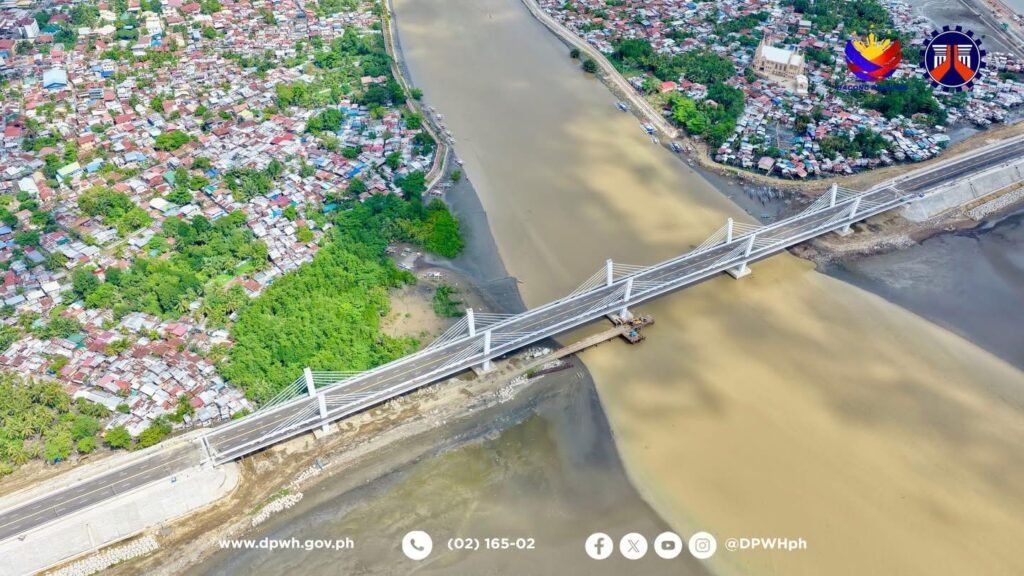
DAVAO CITY (January 1, 2026) -The opening of the Bucana Bridge is more than an infrastructure milestone. It is a political moment, one that lays bare the delicate and increasingly tense balance between national authority and entrenched local power in Davao City. While the bridge promises to ease congestion and stimulate economic activity, its rollout underscores a familiar truth in Philippine governance: major public works are never just about steel and concrete. They are also about narrative control, political credit, and loyalty on the ground.
For the administration of Ferdinand R. Marcos Jr., the bridge is an opportunity to demonstrate tangible delivery in Mindanao—a region long associated with the Duterte brand of leadership. Infrastructure remains one of the few policy arenas in which presidents can demonstrate immediate, visible results, and the project aligns neatly with Malacañang’s push to project competence and continuity under the Build Better More agenda.
But Davao is not a neutral stage. For decades, the city has been synonymous with the Duterte family, a reality that persists despite changes in national leadership. The overwhelming victory of Rodrigo Duterte in the 2025 mayoral race—even while detained abroad—underscored how deeply rooted that political capital remains. In this context, any national project entering Davao must navigate not only technical requirements but also local power structures that expect consultation, deference, and recognition.
Mayor Sebastian Duterte’s public expression of safety concerns days before the bridge’s opening was therefore more than a routine precaution. On the surface, it framed him as a cautious local executive prioritizing public welfare. Politically, it reasserted local authority over a nationally driven project—reminding both the Department of Public Works and Highways and Malacañang Palace that, in Davao, legitimacy flows upward from local trust rather than downward from national announcements. The brief delay and rechecking reinforced a powerful message: no major project can bypass the Duterte imprimatur without consequence.
The episode also highlights the fragility of the Marcos–Duterte alliance. While the two camps are not openly at war in Davao, the bridge opening revealed a relationship that is conditional and transactional. National officials may fund and inaugurate projects, but local leaders retain the power to validate—or complicate—their success. In practical terms, Malacañang can build in Davao, but it cannot fully own the political credit.
Adding another layer to the calculus is the project’s Chinese funding. While officials emphasize pragmatism and continuity, foreign-funded infrastructure remains sensitive in public discourse. Any perceived shortcut in safety, transparency, or consultation can be quickly amplified, especially by local leaders keen to protect political turf or distance themselves from national decisions that could later become liabilities.
Ultimately, the Bucana Bridge reflects a broader truth about Philippine governance: infrastructure is one of the last arenas where national and local power collide in full public view. In Davao, the project demonstrates that while administrations change in Malacañang, the city’s political center of gravity remains firmly Duterte-aligned. The Marcos government can deliver roads and bridges, but governing Davao still requires negotiating with a local dynasty that commands loyalty, shapes public opinion, and decides when development is celebrated—or questioned.
In this sense, the Bucana Bridge does not merely connect two sides of a river. It connects—and exposes—the uneasy coexistence between national ambition and local dominance, an arrangement that will continue to define Davao politics long after the ribbon-cutting fades from memory.