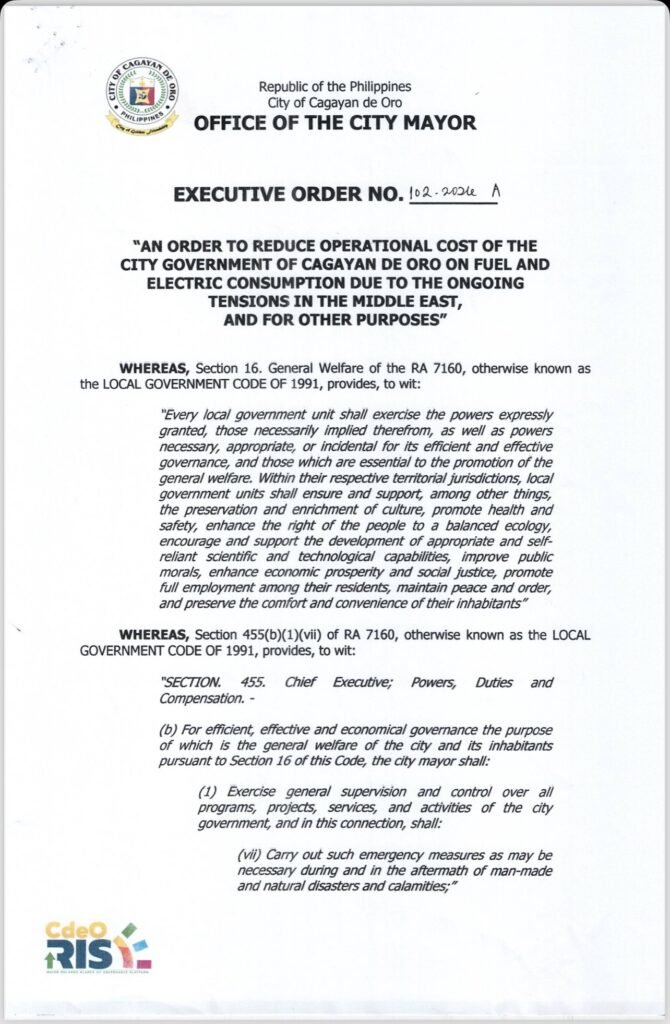
CAGAYAN DE ORO CITY (March 9) — The city government has ordered energy-saving measures across all local offices and facilities as authorities brace for possible fuel price spikes linked to escalating tensions in the Middle East.
Mayor Rolando Uy issued Executive Order 102-2026-A on Friday night directing all city departments, offices, and government-managed facilities to cut fuel and electricity consumption in line with national government advisories.
The order aligns the city with directives from the Office of the President and the Inter-Agency Energy Efficiency and Conservation Committee (IAEECC), which called on government institutions to adopt immediate energy conservation measures amid uncertainty in global oil markets.
“National government agencies and private institutions within the territorial jurisdiction of the city are highly encouraged to adopt these advisories and take appropriate measures,” Uy said in the executive order.
10% energy reduction target
Under the IAEECC advisory and the government’s Energy Management Program, public offices are required to reduce energy consumption by at least 10 percent in daily operations.
The measures implement the provisions of Energy Efficiency and Conservation Act, which mandates government agencies to lead energy-saving initiatives.
The policy also enforces Memorandum Circular 114 issued by the Office of the President, directing government offices nationwide to implement operational adjustments to reduce electricity and fuel use.
Workweek adjustments, tighter energy controls
Among the key measures ordered under the circular:
- Adoption of four-day onsite work arrangements through compressed workweeks or designated work-from-home days, in accordance with rules of the Civil Service Commission
- Maintaining air-conditioning thermostat settings at 24°C
- Activating sleep modes for office equipment and shutting down computers and lights during lunch breaks and after office hours
- Limiting official travel to essential activities and strengthening vehicle fleet management to reduce fuel consumption
- Encouraging virtual meetings to reduce transport-related energy use
- Minimizing elevator operations and other high-energy facility systems where feasible