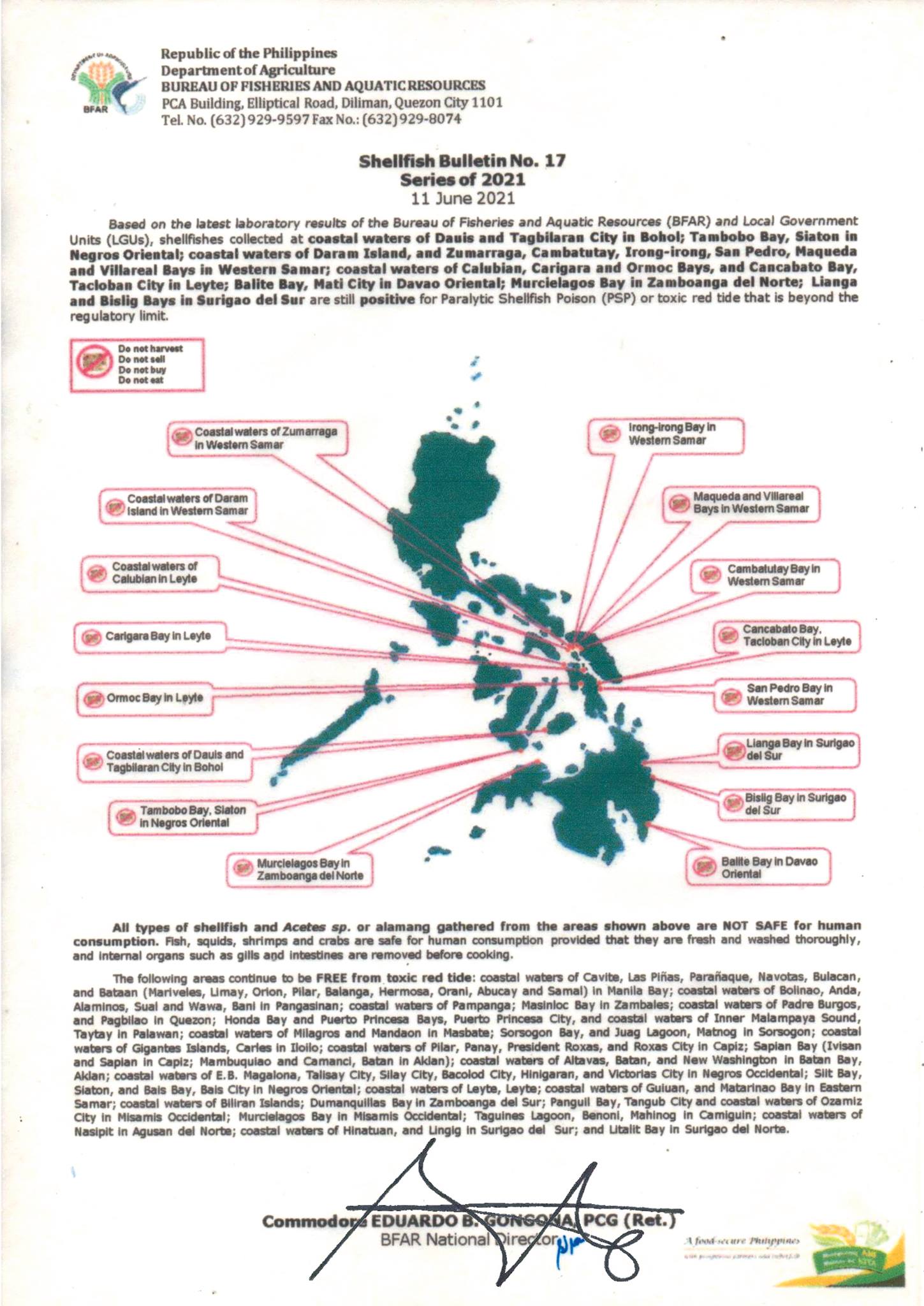
MANILA –The Bureau of Fisheries and Aquatic Resources (BFAR) announced on Friday that red tide has been detected in seven provinces’ coastal zones.
The latest results indicated paralytic shellfish poison (PSP), or the toxin that causes red tide, is beyond the regulatory limit.
The affected areas are the coastal waters of Dauis and Tagbilaran City in Bohol; Tambobo Bay, Siaton in Negros Oriental; Daram Island, and Zumarraga, Cambututay, Irong-irong, San Pedro, Maqueda and Villareal Bays in Western Samar; Calubian, Carigara and Ormoc Bays, and Cancabato Bay, Tacloban City, Leyte; Balite Bay, Mati Bay in Davao Oriental; Murcielagos Bay in Zamboanga del Norte; and Lianga and Bislig Bays in Surigao del Sur.
The report stated that all shellfish and “alamang” (tiny shrimp) collected from the affected areas are unsafe to eat.
Fish, squids, regular shrimps, and crabs are safe to eat provided that they are fresh and washed thoroughly.
Internal organs such as gills and intestines must also be removed before cooking.
Eating shellfish products with red tide can cause death. Early symptoms of paralytic shellfish poisoning include tingling of the lips and tongue, which may begin within minutes of eating poisonous shellfish or may take an hour or two to develop.