DAVAO CITY (May 22) — A court-sanctioned expansion has cleared the way for Davao Light and Power Company Inc. to take over electricity distribution in key areas of Davao del Norte, marking a decisive shift in Mindanao’s power landscape—but also reigniting concerns over regulatory oversight, consumer choice, and the fate of cooperative-led service.
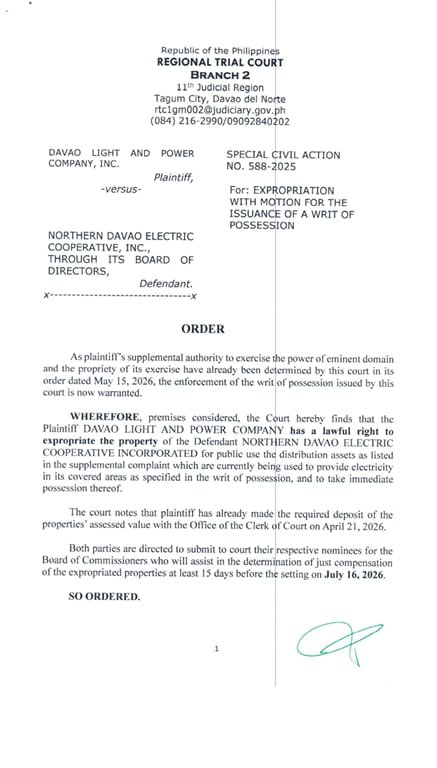
The expansion follows a Supplemental Writ of Possession issued by the Regional Trial Court Branch 2 in Tagum City on May 15, 2026, allowing Davao Light to assume control of remaining distribution assets previously operated by Northern Davao Electric Cooperative Inc. (Nordeco).
The order effectively accelerates implementation of Republic Act No. 12144, which broadened Davao Light’s franchise coverage beyond Davao City into parts of Davao del Norte and Davao de Oro.
At its core, the ruling affirms Davao Light’s legal authority to take possession of utility assets deemed necessary for public service operations, following earlier Supreme Court rulings upholding the law’s constitutionality. But in practical terms, it also signals the displacement of a long-standing electric cooperative system in favor of a private utility operator.
The court’s order cited Davao Light’s compliance with expropriation requirements under Rule 67 of the Rules of Court, including the required deposit for possession—procedural safeguards meant to balance state-backed expansion with property rights.
A Notice to Vacate has also been served to Nordeco as transition activities begin.
The affected coverage area includes Tagum City and municipalities such as Asuncion, San Isidro, Kapalong, Talaingod, and New Corella—communities now caught in the middle of a legal and institutional handover that will reshape how electricity is delivered and governed locally.
Davao Light said it has begun taking over substations and distribution facilities and assured consumers of uninterrupted service.
“Davao Light remains committed to ensuring a smooth, orderly, and lawful transition process,” the company said, amid expectations of operational overlap and coordination with existing field personnel.
Yet beyond the technical transition lies a deeper tension: the rapid consolidation of power distribution under a single franchise raises questions about market concentration in a sector traditionally balanced between cooperatives and private utilities.
Nordeco’s displacement effectively reduces the role of cooperative governance in areas where member-consumers historically had representation in utility decision-making.
The transition also highlights the expanding role of judicial mechanisms in determining utility control.
While the courts have upheld the legality of the franchise expansion, the pace of implementation has left limited room for broader public consultation in affected communities—particularly on issues such as service pricing, infrastructure integration, and long-term accountability.
The shift is being described as one of the most significant restructurings of Mindanao’s power distribution system in recent years, but its long-term impact will likely depend on whether regulatory institutions can ensure that service improvements, not just legal victories, define the outcome for consumers.