DAVAO CITY (June 4) — As Davao City celebrates Duaw Davao and observes Environment Month this June, piles of uncollected garbage lining roadsides, public spaces, and residential communities are casting a shadow over the city’s image and raising urgent questions about the sustainability of its waste management system.
Environmental group Interfacing Development Interventions for Sustainability (IDIS) warned that the worsening garbage situation is no longer merely a collection problem but a symptom of deeper structural weaknesses that have remained unresolved for years.
“The crisis demands immediate attention and responsibility,” the organization said, citing mounting public health and environmental risks brought about by accumulating waste across the city.
The warning comes at a particularly vulnerable time. With the southwest monsoon bringing frequent heavy rains, uncollected garbage is increasingly finding its way into drainage systems, creeks, and waterways, aggravating flooding and exposing communities to disease outbreaks.
“Uncollected garbage is easily washed into drainage systems and waterways during heavy rains, worsening flooding in vulnerable communities and creating avoidable public health hazards,” IDIS said.
Landfill Disaster Reveals System Under Strain
The current crisis was triggered by the suspension of operations at the New Carmen Sanitary Landfill in Tugbok District following a deadly waste-slide on May 20.
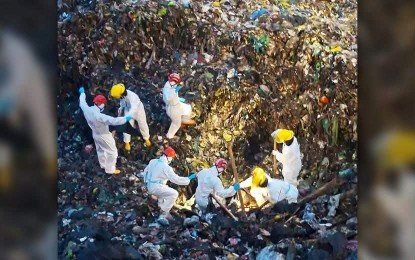
After days of heavy rainfall, a portion of the landfill collapsed, sending tons of garbage cascading toward nearby homes. Two waste pickers were killed while another remains missing, turning what was already an environmental concern into a human tragedy.
In response, the Department of Environment and Natural Resources suspended waste disposal operations at the facility, effectively cutting off the city’s primary waste disposal site.
The closure immediately exposed the fragility of a system heavily dependent on a single landfill that had long been operating beyond its intended capacity.
Serving a population of more than 1.8 million people, Davao City generates roughly 750 metric tons of garbage daily. The New Carmen landfill, which began operations in 2010, had already reached full capacity, receiving more than 753 tons of waste every day by 2025.
The collapse raised concerns not only about landfill safety but also about whether the city had adequately prepared for the predictable consequences of relying on an aging and overloaded disposal facility.
A Recurring Problem
For environmental advocates, the sight of garbage accumulating across the city is not an isolated incident but part of a recurring pattern.
Years of recommendations on waste segregation, recycling, decentralized waste management, and community participation have produced limited structural change, they argue.
“The persistent cycle of waste accumulation, flooding, public health risks, repeated recommendations, and limited structural change needs stronger, sustained action,” IDIS said.
The organization stressed that waste segregation campaigns alone cannot solve the problem if collection systems remain inefficient and accountability mechanisms weak.
While city officials have moved to address the immediate consequences of the landfill closure, including the approval of P34 million for landslide mitigation measures and efforts to comply with regulatory requirements for reopening the facility, critics warn that these responses remain largely reactive.
The larger challenge, they argue, is reducing the volume of waste reaching disposal sites in the first place.
Beyond Cleanup Operations
IDIS called for a comprehensive overhaul of the city’s waste management strategy, emphasizing waste segregation at source, stronger household and barangay participation, localized monitoring systems, and sustained environmental education.
Such measures are already mandated under national ecological solid waste management policies, but implementation has often been uneven across communities.
Environmental groups contend that without stronger enforcement and community ownership, Davao risks repeating the same cycle: garbage accumulation, flooding, emergency cleanup operations, and renewed calls for reform after each crisis.
The timing of the current situation has also amplified public concern. As thousands of visitors arrive for Duaw Davao festivities and Environment Month activities highlight environmental stewardship, visible garbage accumulation has become a stark reminder of the gap between policy commitments and on-the-ground realities.
Preventing the Next Disaster
For IDIS, the landfill collapse and the ensuing garbage backlog should serve as a turning point rather than another temporary setback.
“The people of Davao deserve a waste management system that is preventive, not reactive; community-driven, not top-down alone; and capable of preventing disasters rather than repeatedly responding to them after the fact,” the group said.
Whether the current crisis becomes a catalyst for long-term reform or simply another chapter in the city’s recurring waste management challenges may depend on how quickly authorities move beyond emergency measures and address the systemic issues that environmental advocates say have been building for years.
For now, as garbage continues to accumulate in parts of the city and the monsoon season intensifies, the consequences of those unresolved issues are becoming increasingly difficult to ignore.