Dy, Sandro Marcos file anti-dynasty bill — but skepticism clouds reform push Palace warns vs. “half-cooked” measures as church, business groups demand real action
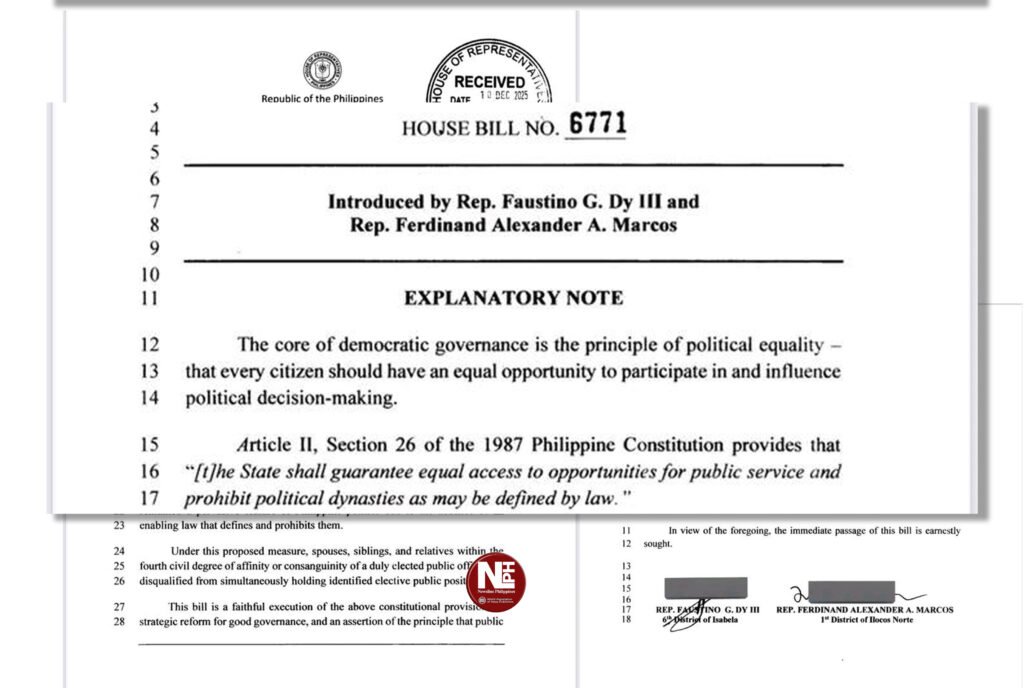
MANILA(December 13) — In a move that has drawn equal parts attention and skepticism, Speaker Faustino Dy III and Ilocos Norte Rep. Sandro Marcos — both scions of long-entrenched political families — have filed a bill seeking to finally outlaw political dynasties, a reform that Congress has avoided for nearly 40 years.
House Bill 6771 bars the spouse, siblings and relatives within the fourth civil degree of any elected official from holding another elective post simultaneously.
On paper, the proposal strikes at the heart of a system long dominated by clans that control entire provinces and cities.
But critics note the irony: the bill is being championed by lawmakers who themselves belong to influential dynasties, fueling doubts about whether the measure will survive beyond committee hearings or be weakened through amendments.
Reform rhetoric meets political reality
President Marcos has placed the anti-dynasty proposal on his priority list — yet Malacañang has refused to certify it as urgent, a decision observers say could stall the measure amid the few remaining session days before Congress adjourns.
Presidential Communications Undersecretary Claire Castro said the Palace wants to avoid “half-cooked” laws by thoroughly examining the provisions.
But reform advocates point out that similar justifications have been used for decades to delay legislation that threatens entrenched interests.
The measure is part of a broader reform package the President wants prioritized, including party-list reforms, creation of an Independent People’s Commission to investigate anomalous infrastructure projects, and the Citizen Access and Disclosure of Expenditures for National Accountability (CADENA) Act.
CBCP: Congress must prove critics wrong
The Catholic Bishops’ Conference of the Philippines said Congress should pass the anti-dynasty bill “without delay,” warning that decades of failure have allowed political clans to entrench themselves further.
“Even newer politicians quickly expand their reach through the election or appointment of their relatives,” said Bishop Gerardo Alminaza.
He said Filipinos must “stand together” to break the cycle of concentrated political power that has enabled corruption and weakened democratic checks.
Business sector pushes transparency, calls reforms overdue
The American Chamber of Commerce of the Philippines backed the CADENA Act, saying that strong public access to budget data would boost investor confidence and signal seriousness in tackling corruption — another reform area long hindered by political resistance.
“This measure will strengthen trust in public institutions and attract more investment,” said Steve Winkates, Arangkada project director.
CONTEXT: Who are the major political clans?
Political dynasties dominate every region of the Philippines. Many control multiple seats across different levels of government — the very practice HB 6771 seeks to curb.
• Marcos family (Ilocos Norte, national) Multiple members in Congress, local government, and executive agencies; historically one of the most influential clans.
• Dy family (Isabela) Holds or has held key positions from governor to congressional seats; among the longest-running provincial dynasties.
• Duterte family (Davao region) Occupies national and local posts, including the vice presidency, Congress, and city hall.
• Marcoses’ key allies in the North: Remullas (Cavite), Singsons (Ilocos Sur), Ortegas (La Union)
• Long-standing Mindanao clans: Ampatuans, Mangudadatus, Adiongs Maintain influence in provincial, regional, and municipal posts.
• Visayas power blocs: Garcias (Cebu), Roxases (Capiz), Villafuertes (Camarines Sur) Often hold multiple simultaneous seats from Congress to LGUs.
These family networks are precisely why past attempts to enact an anti-dynasty law have collapsed inside Congress: lawmakers would be regulating themselves — and potentially dismantling their own political machinery.