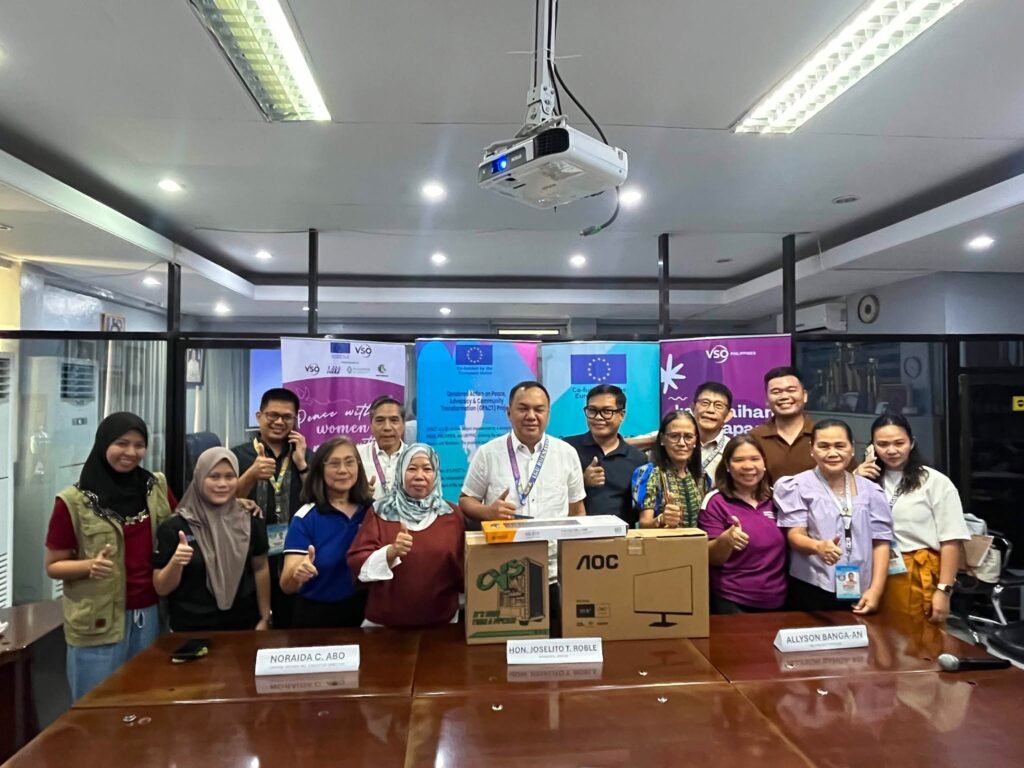
Mayor Joselito T. Roble of Buenavista, Agusan del Norte signs a Memorandum of Understanding with the United Youth Philippines–Women (UNYPHIL-Women) and Volunteer Service Overseas (VSO) for the implementation of the European Union-funded Gendered Action on Peace, Advocacy, and Community Transformation (G-PACT) Project aimed at strengthening women’s participation in peacebuilding, conflict resolution, and inclusive community governance in Mindanao. (Photo courtesy of MLGU Buenavista)
BUTUAN CITY (June 4) — In a region where armed conflict, political exclusion, and social inequalities have historically shaped community life, a new European Union-funded initiative seeks to place women at the forefront of peacebuilding and local governance in the municipality of Buenavista, Agusan del Norte.
The Gendered Action on Peace, Advocacy, and Community Transformation (G-PACT) Project was formally launched through a partnership among the municipal government of Buenavista, United Youth Philippines–Women (UNYPHIL-Women), and Volunteer Service Overseas (VSO).
Backed by funding from the European Union from 2025 to 2027, the initiative aims to strengthen women’s participation in peacebuilding, conflict resolution, and community decision-making while promoting more inclusive governance in vulnerable and conflict-affected communities.
Supporters of the project argue that meaningful peace cannot be sustained if half the population remains underrepresented in decision-making processes that affect security, development, and social cohesion.
Beyond Symbolic Participation
For decades, women in many conflict-affected communities across Mindanao have often served as informal mediators, caregivers, and community organizers, yet their roles in formal peace and governance structures have remained limited.
The G-PACT initiative seeks to address that imbalance by creating opportunities for women and youth to engage more actively in local governance and peace mechanisms.
The partnership was formalized through a Memorandum of Understanding signed by Buenavista Mayor Joselito T. Roble, UNYPHIL-Women Executive Director Noraida C. Abo, and VSO Project Officer Allyson Banga-an.
Mayor Roble welcomed the initiative, describing it as an opportunity to strengthen local peacebuilding efforts and community resilience.
“We are grateful for this partnership that will help empower women and strengthen peacebuilding initiatives in our communities. Through this project, we hope to build a more inclusive, peaceful, and resilient Buenavista for future generations,” he said.
The Challenge of Sustaining Peace
The project arrives at a time when peacebuilding efforts in Mindanao have increasingly shifted from large-scale political settlements toward localized approaches that focus on community participation, social cohesion, and inclusive governance.
While significant gains have been achieved through peace agreements and normalization programs, development practitioners note that many communities continue to face challenges linked to poverty, political marginalization, gender inequality, and limited access to decision-making spaces.
Programs such as G-PACT are designed to address these underlying drivers of conflict by strengthening local institutions and encouraging broader civic participation.
However, peace advocates caution that training sessions and partnership agreements alone do not automatically translate into long-term empowerment.
The success of such initiatives often depends on whether local governments institutionalize women’s participation beyond the lifespan of donor-funded projects and whether communities themselves embrace more inclusive forms of leadership.
Linking Local Action to National and Global Agendas
The initiative supports the Philippine government’s Women, Peace, and Security (WPS) agenda, which promotes the active participation of women in conflict prevention, mediation, peacebuilding, and governance.
It also aligns with broader peace and development priorities under the Philippine Development Plan 2023–2028 and ongoing efforts to strengthen localized peace engagement in Mindanao.
Globally, the project contributes to the United Nations Sustainable Development Goals, particularly those focused on gender equality, peaceful societies, and strong institutions.
For development organizations, these connections underscore a growing recognition that sustainable peace is not achieved solely through security interventions but through inclusive governance systems that allow women, youth, and marginalized sectors to shape decisions affecting their communities.
Measuring Impact Beyond Funding Cycles
As implementation begins in Buenavista, one of the key questions will be how success is measured.
Beyond the number of trainings conducted or participants reached, observers say the true test will be whether women gain meaningful influence in local decision-making bodies, conflict-resolution mechanisms, and community development processes.
For communities that have experienced the long-term consequences of exclusion and instability, empowerment is ultimately measured not by project documents but by whether local voices gain a permanent place at the table.
The G-PACT Project represents another effort to advance that goal. Whether it becomes a catalyst for lasting institutional change or another short-term development intervention will depend largely on how effectively local stakeholders transform project commitments into sustained community action long after external funding ends.