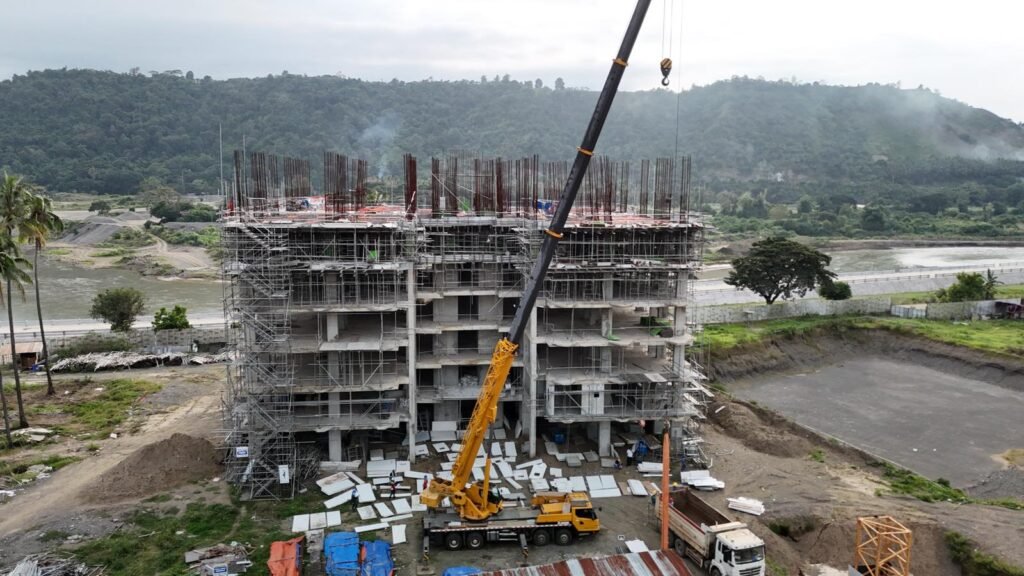
The PHIVIDEC Housing Project under the Expanded 4PH Program is shown in its construction phase as of July 2025. The development is set to include four 12-story buildings with about 1,152 housing units. (File photo courtesy of DHSUD-10)
CAGAYAN DE ORO CITY (May 4) — The government’s expanded Pambansang Pabahay Para sa Pilipino (4PH) program promises more housing options for low-income families in Northern Mindanao—but affordability and access remain key concerns on the ground.
Officials say the revised program now allows both condominium units and house-and-lot packages, moving beyond its earlier focus on vertical housing.
For DHSUD-10 Regional Director Paris Raymond S. Gaballo, the shift is a welcome policy change under Housing Secretary Jose Ramon Aliling.
But for many families earning between ₱12,000 and ₱34,000 a month—the program’s main target—the bigger question is not choice, but whether they can realistically keep up with monthly payments.
Lower rates, same burden?
The program offers subsidized interest rates as low as 3% for the first five years through the Pag-IBIG Fund, with possible extensions and added subsidies for the lowest-income borrowers.
Still, applicants must prove capacity to pay—a requirement that could exclude informal workers and those with unstable incomes, a large segment of Northern Mindanao’s labor force.
The shift to a “buyer-driven” approach—where families choose units and apply directly for financing—also transfers more responsibility to applicants, who must navigate loan processes and verify developers on their own.
Supply rising—but where, and for whom?
Several housing projects are lined up across the region, including developments in Cagayan de Oro, Tubod, Lanao del Norte, and Tagoloan, Misamis Oriental.
A separate partnership aims to build up to 30,000 units across Mindanao, backed by the Mindanao Development Authority and private developers.
But housing advocates have long pointed out that location matters as much as availability. Units built far from job centers or lacking transport access often remain out of reach in practical terms—even if they are technically “affordable.”
Numbers vs. need
DHSUD-10 reports over 2,300 units delivered or financed in the region as of 2025. Yet this remains a fraction of the housing backlog, especially for informal settler families and low-wage earners.
Most units were financed through Pag-IBIG, reinforcing concerns that those outside the formal financial system may be left behind.
Guardrails—and gaps
Authorities say safeguards are in place. DHSUD has strengthened its task force against illegal real estate practices, working with agencies like the National Bureau of Investigation and Philippine National Police to crack down on fraudulent developers.
Still, buyers are ultimately advised to do their own due diligence—placing the burden of protection largely on would-be homeowners.
Promise vs. reality
The expanded 4PH program signals a broader push to make housing more flexible and market-responsive. But for many families in Northern Mindanao, the real test lies beyond policy design: stable incomes, accessible locations, and financing terms that match everyday realities.
Until then, the promise of “more choices” may remain just that—a promise.